


Thalamic local field potentials recorded using the deep brain stimulation pulse generator
- PMID: 35345863
- PMCID: PMC8956842
- DOI: 10.1016/j.cnp.2022.03.002
Thalamic local field potentials recorded using the deep brain stimulation pulse generator
Abstract
Background: Essential tremor (ET) is one of the most common movement disorders, and continuous deep brain stimulation (DBS) is an established treatment for medication-refractory cases. However, the need for increasing stimulation intensities, with unpleasant side effects, and DBS tolerance over time can be problematic. The advent of novel DBS devices now provides the opportunity to longitudinally record LFPs using the implanted pulse generator, which opens up possibilities to implement adaptive DBS algorithms in a real-life setting.
Methods: Here we report a case of thalamic LFP activity recorded using a commercially available sensing-enabled DBS pulse generator (Medtronic Percept PC).
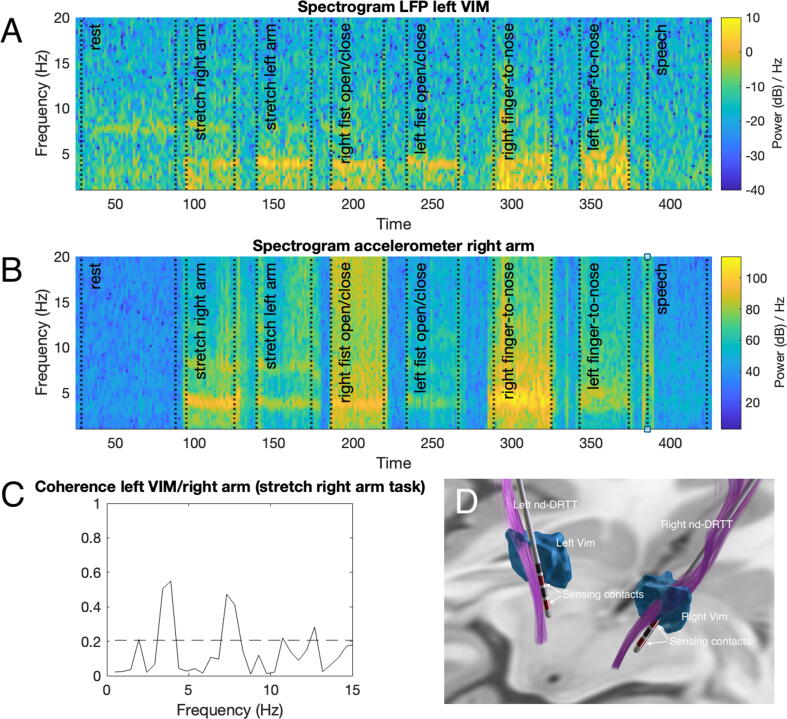
Results: In the OFF-stimulation condition, a peak tremor frequency of 3.8 Hz was identified during tremor evoking movements as assessed by video and accelerometers. Activity at the same and supraharmonic frequency was seen in the frequency spectrum of the LFP data from the left vim nucleus during motor tasks. Coherence analysis showed that peripherally recorded tremor was coherent with the LFP signal at the tremor frequency and supraharmonic frequency.
Conclusion: This is the first report of recorded tremor-related thalamic activity using the electrodes and pulse generator of an implanted DBS system. Larger studies are needed to evaluate the clinical potential of these fully implantable systems, and ultimately pulse generators with sensing-coupled algorithms driving stimulation, to really close the loop.
Keywords: Adaptive; Closed-loop; Deep brain stimulation; Essential tremor; Tremor.
© 2022 International Federation of Clinical Neurophysiology. Published by Elsevier B.V.
Figures
References
-
- Bhatia K.P., Bain P., Bajaj N., Elble R.J., Hallett M., Louis E.D., Raethjen J., Stamelou M., Testa C.M., Deuschl G. Consensus Statement on the classification of tremors. from the task force on tremor of the International Parkinson and Movement Disorder Society. Mov Disord. 2018;33:75–87. doi: 10.1002/mds.27121. - DOI - PMC - PubMed
-
- Costa Junior J.D., de Seixas J.M., Miranda de Sá A.M.F.L. A template subtraction method for reducing electrocardiographic artifacts in EMG signals of low intensity. Biomed Signal Process Control. 2019;47:380–386. doi: 10.1016/j.bspc.2018.09.004. - DOI
-
- Elble R., Comella C., Fahn S., Hallett M., Jankovic J., Juncos J.L., LeWitt P., Lyons K., Ondo W., Pahwa R., Sethi K., Stover N., Tarsy D., Testa C., Tintner R., Watts R., Zesiewicz T. Reliability of a New Scale for Essential Tremor. Mov Disord. 2012;27:1567–1569. doi: 10.1002/mds.25162. - DOI - PMC - PubMed
-
- Ewert S., Plettig P., Li N., Chakravarty M.M., Collins D.L., Herrington T.M., Kühn A.A., Horn A. Toward defining deep brain stimulation targets in MNI space: A subcortical atlas based on multimodal MRI, histology and structural connectivity. NeuroImage. 2018;170:271–282. doi: 10.1016/j.neuroimage.2017.05.015. - DOI - PubMed
Publication types
LinkOut - more resources
Full Text Sources
Miscellaneous
