


The economic burden of pulmonary arterial hypertension in Spain
- PMID: 35346140
- PMCID: PMC8962538
- DOI: 10.1186/s12890-022-01906-2
The economic burden of pulmonary arterial hypertension in Spain
Abstract
Background: Pulmonary Arterial Hypertension (PAH) is a rare, debilitating, and potentially fatal disease. This study aims to quantify the economic burden of PAH in Spain.
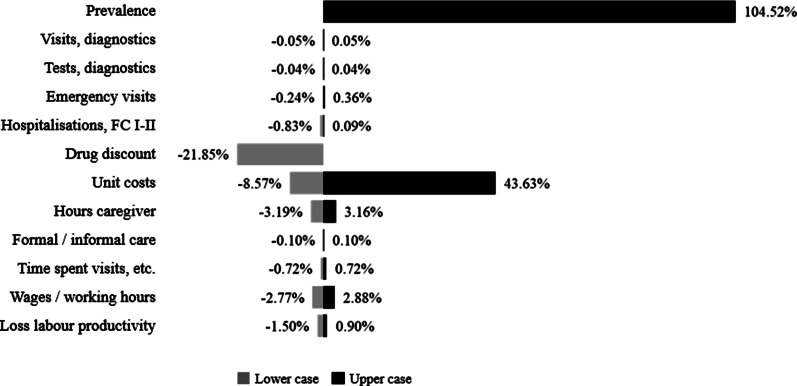
Methods: The study was conducted from a societal perspective, including direct and indirect costs associated with incident and prevalent patients. Average annual costs per patient were estimated by multiplying the number of resources consumed by their unit cost, differentiating the functional class (FC) of the patient. Total annual costs per FC were also calculated, taking the 2020 prevalence and incidence ranges into account. An expert committee validated the information on resource consumption and provided primary information on pharmacological consumption. Unit costs were estimated using official tariffs and salaries in Spain. A deterministic sensitivity analysis was conducted to test the uncertainty of the model.
Results: The average annual total cost was estimated at €98,839 per prevalent patient (FC I-II: €65,233; FC III: €103,736; FC IV: €208,821), being €42,110 for incident patients (FC I-II: €25,666; FC III: €44,667; FC IV: €95,188). The total annual cost of PAH in Spain, taking into account a prevalence between 16.0 and 25.9 cases per million adult inhabitants (FC I-II 31.8%; FC III 61.3%; FC IV 6.9%) and an incidence of 3.7, was estimated at €67,891,405 to €106,131,626, depending on the prevalence considered. Direct healthcare costs accounted for 64% of the total cost, followed by indirect costs (24%), and direct non-healthcare costs (12%). The total costs associated with patients in FC I-II ranged between €14,161,651 and €22,193,954, while for patients in FC III costs ranged between €43,763,019 and €68,391,651, and for patients in FC IV between €9,966,735 and €15,546,021. In global terms, patients with the worst functional status (FC IV) account for only 6.9% of the adults suffering from PAH in Spain, but are responsible for 14.7% of the total costs.
Conclusions: PAH places a considerable economic burden on patients and their families, the healthcare system, and society as a whole. Efforts must be made to improve the health and management of these patients since the early stages of the disease.
Keywords: Burden; Economic impact; PAH; Pulmonary arterial hypertension; Social perspective.
© 2022. The Author(s).
Conflict of interest statement
The authors declare that they have no competing interests.
Figures
References
-
- Vazquez ZGS, Klinger JR. Guidelines for the treatment of pulmonary arterial hypertension. Lung. 2020;198:581–596. - PubMed
-
- Humbert M, Sitbon O, Simonneau G. Treatment of pulmonary arterial hypertension. N Engl J Med. 2004;351:1425–1436. - PubMed
-
- McDonough A, Matura LA, Carroll DL. Symptom experience of pulmonary arterial hypertension patients. Clin Nurs Res. 2011;20:120–134. - PubMed
-
- Aguirre-Camacho A, Moreno-Jiménez B. Depression and anxiety in patients with pulmonary hypertension: the role of life satisfaction and optimism. Psychosomatics. 2018;59:575–583. - PubMed
