Review
. 2022 Oct;52(11):2159-2172.
doi: 10.1007/s00247-022-05322-w. Epub 2022 Mar 26.

The role of artificial intelligence in paediatric neuroradiology

Affiliations
Review

The role of artificial intelligence in paediatric neuroradiology

Catherine Pringle et al. Pediatr Radiol. 2022 Oct.

Abstract

Imaging plays a fundamental role in the managing childhood neurologic, neurosurgical and neuro-oncological disease. Employing multi-parametric MRI techniques, such as spectroscopy and diffusion- and perfusion-weighted imaging, to the radiophenotyping of neuroradiologic conditions is becoming increasingly prevalent, particularly with radiogenomic analyses correlating imaging characteristics with molecular biomarkers of disease. However, integration into routine clinical practice remains elusive. With modern multi-parametric MRI now providing additional data beyond anatomy, informing on histology, biology and physiology, such metric-rich information can present as information overload to the treating radiologist and, as such, information relevant to an individual case can become lost. Artificial intelligence techniques are capable of modelling the vast radiologic, biological and clinical datasets that accompany childhood neurologic disease, such that this information can become incorporated in upfront prognostic modelling systems, with artificial intelligence techniques providing a plausible approach to this solution. This review examines machine learning approaches than can be used to underpin such artificial intelligence applications, with exemplars for each machine learning approach from the world literature. Then, within the specific use case of paediatric neuro-oncology, we examine the potential future contribution for such artificial intelligence machine learning techniques to offer solutions for patient care in the form of decision support systems, potentially enabling personalised medicine within this domain of paediatric radiologic practice.

Keywords: Artificial intelligence; Children; Machine learning; Magnetic resonance imaging; Neuroradiology; Radiogenomics.


Conflict of interest statement

None

Figures
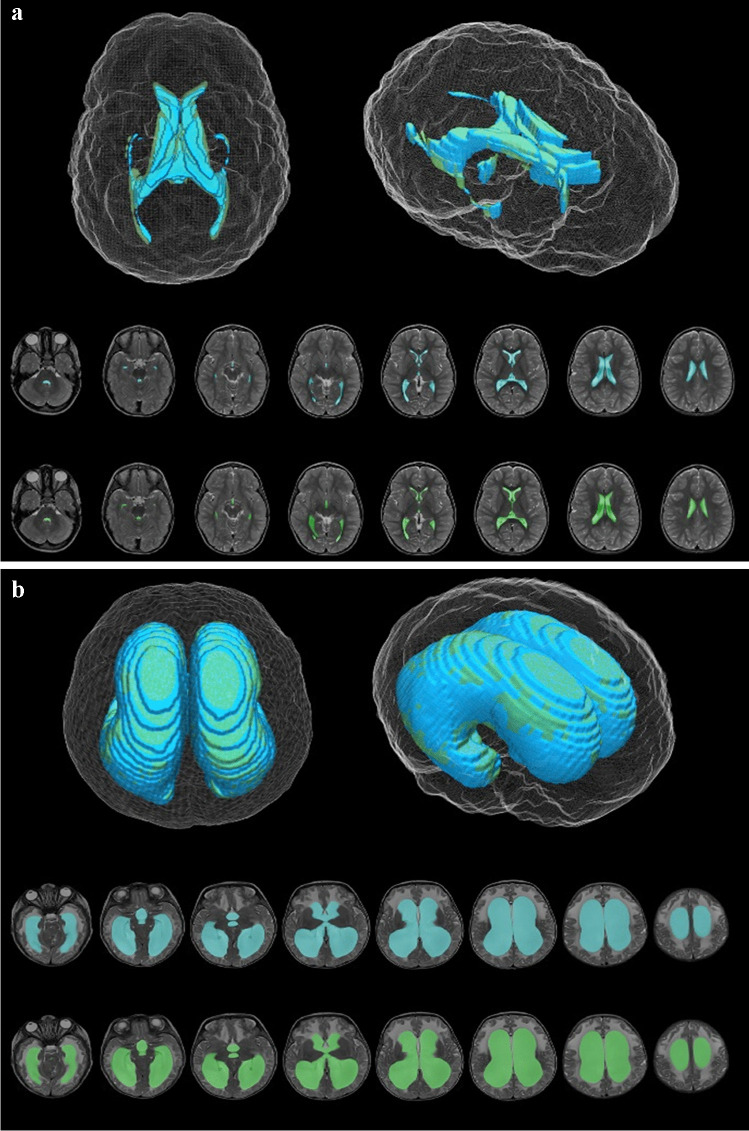
Fig. 1
Fig. 1
Artificial neural networks. a, b Deep learning model (blue) and ground truth manual (green) segmentation of a representative control (a) and hydrocephalus (b) using axial T2-weighted MR images. Reproduced from [19]
Fig. 2
Fig. 2
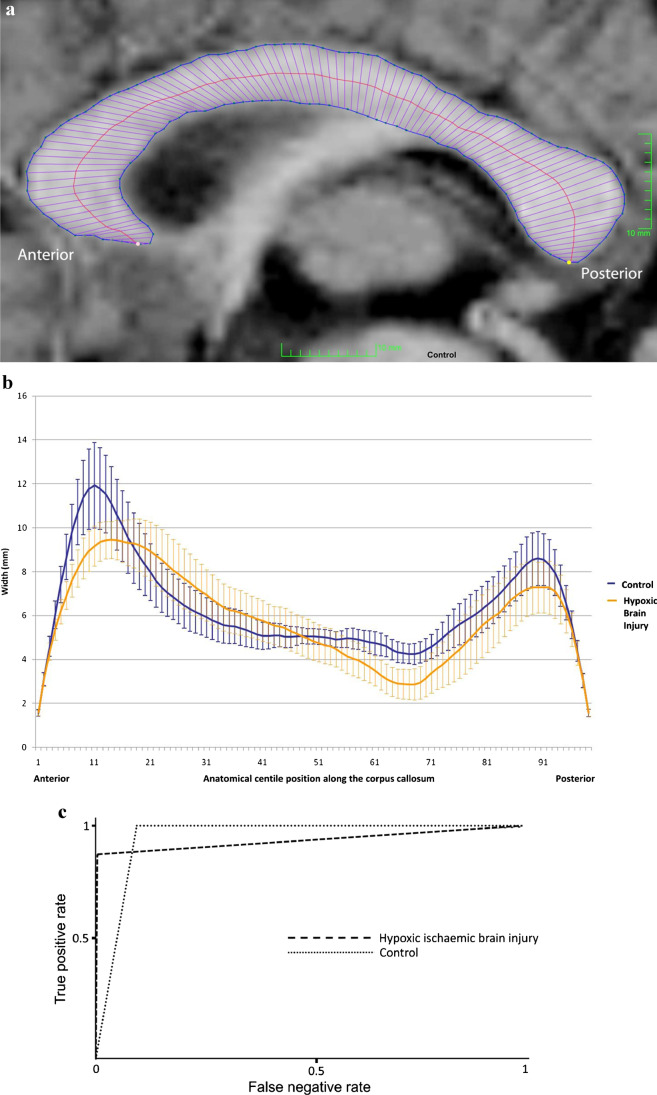
Support vector machine (SVM) stratification. a Midline sagittal T1-weighted MR image shows a normal corpus callosum in a 6-year-old age-matched male control. The image also shows the placement of regions of interest and 99th-percentile widths. b The width profiles (95% confidence interval of the mean) for each centile generated for the control cases (blue) and the age-matched cases of profound hypoxic–ischaemic brain injury (yellow). c SVM stratification performed on the imaging dataset for each participant with classification into one of two groups: (1) hypoxic–ischaemic brain injury or (2) developmental delay control. Receiver operator characteristics curves show classification (correct classification = true positive) into either the hypoxic–ischaemic brain injury group or the control group. Note the high degree of stratification, with an area under the curve of over 95% relating to both groups. This demonstrates the power of this technique when applied to this particular imaging metric. As such, it points towards machine learning callosal analysis in translational clinical and academic applications. Reproduced from [24]
Fig. 3
Fig. 3
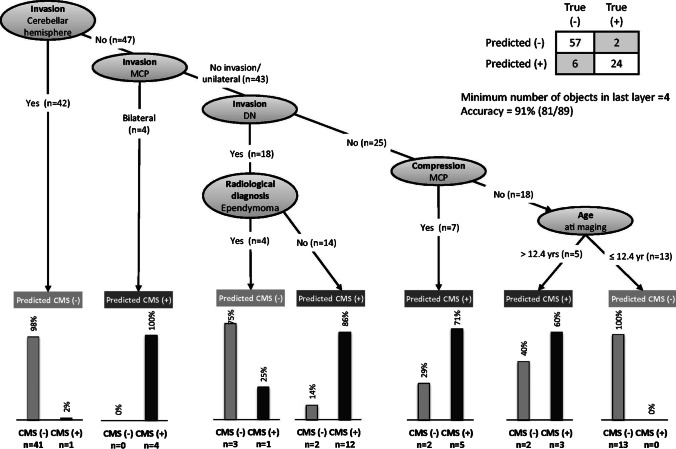
A C.45 decision tree with the highest accuracy (91.0%, 81/89) to predict cerebellar mutism syndrome (CMS). This decision tree was based on radiologic identification of specific imaging features including cerebellar hemisphere invasion, bilateral middle cerebellar peduncle (MCP) invasion, dentate nucleus (DN) invasion, preoperative radiologic diagnosis of ependymoma, MCP compression and age. n number, yr year. Reproduced from [97]

References

    1. Lambin P, Leijenaar RTH, Deist TM, et al. Radiomics: the bridge between medical imaging and personalized medicine. Nat Rev Clin Oncol. 2017;14:749–762. doi: 10.1038/nrclinonc.2017.141. - DOI - PubMed
    1. Price G, van Herk M, Faivre-Finn C. Data mining in oncology: the ukCAT project and the practicalities of working with routine patient data. Clin Oncol. 2017;29:814–817. doi: 10.1016/j.clon.2017.07.011. - DOI - PubMed
    1. Shiffrin RM. Drawing causal inference from big data. Proc Natl Acad Sci U S A. 2016;113:7308–7309. doi: 10.1073/pnas.1608845113. - DOI - PMC - PubMed
    1. Deo RC. Machine learning in medicine. Circulation. 2015;132:1920–1930. doi: 10.1161/CIRCULATIONAHA.115.001593. - DOI - PMC - PubMed
    1. Deo RC, Nallamothu BK. Learning about machine learning: the promise and pitfalls of big data and the electronic health record. Circ Cardiovasc Qual Outcomes. 2016;9:618–620. doi: 10.1161/CIRCOUTCOMES.116.003308. - DOI - PMC - PubMed

LinkOut - more resources