


Endomysial fibrosis, rather than overall connective tissue content, is the main determinant of conduction disturbances in human atrial fibrillation
- PMID: 35348667
- PMCID: PMC9282911
- DOI: 10.1093/europace/euac026
Endomysial fibrosis, rather than overall connective tissue content, is the main determinant of conduction disturbances in human atrial fibrillation
Abstract
Aims: Although in persistent atrial fibrillation (AF) a complex AF substrate characterized by a high incidence of conduction block has been reported, relatively little is known about AF complexity in paroxysmal AF (pAF). Also, the relative contribution of various aspects of structural alterations to conduction disturbances is not clear. In particular, the contribution of endomysial fibrosis to conduction disturbances during progression of AF has not been studied yet.
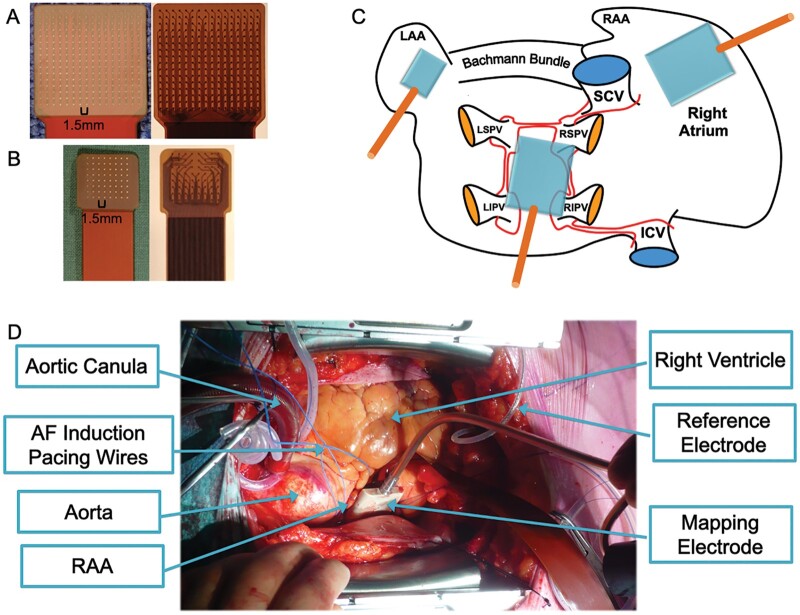
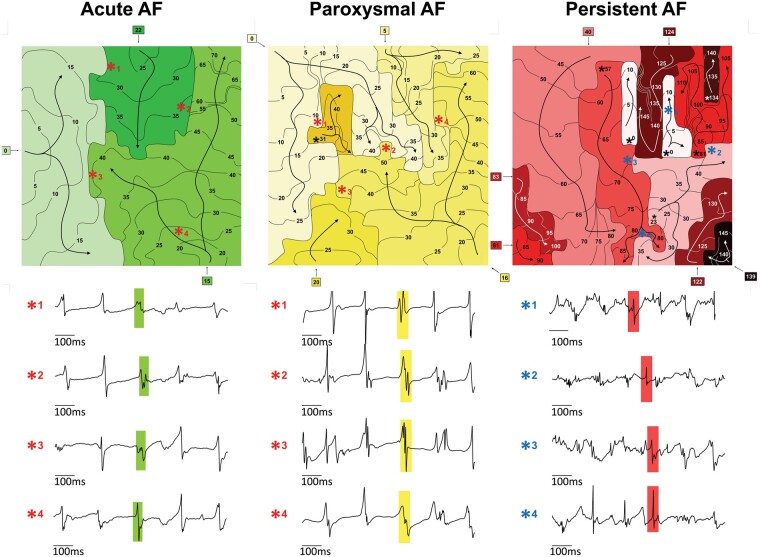
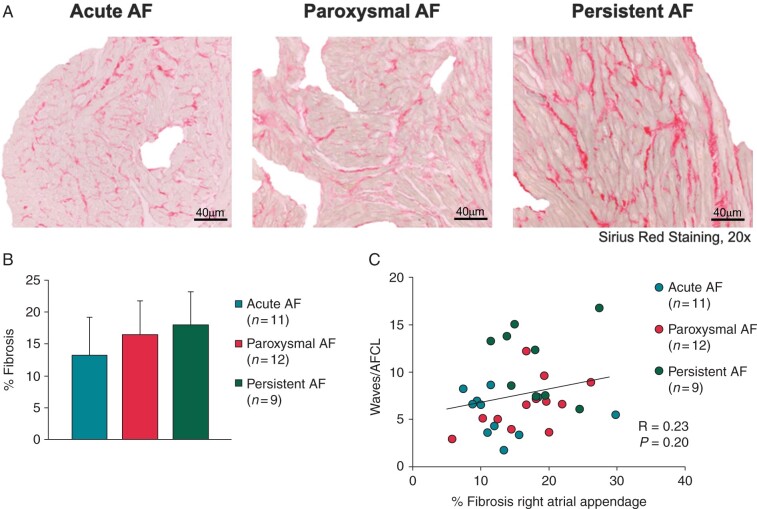
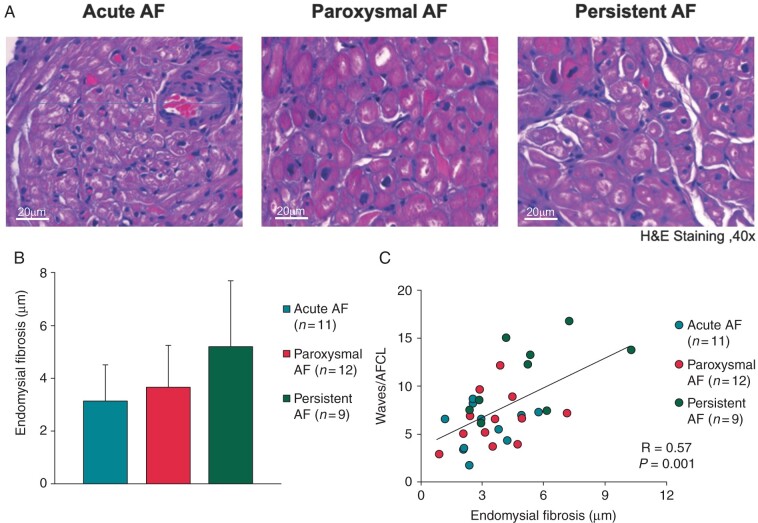
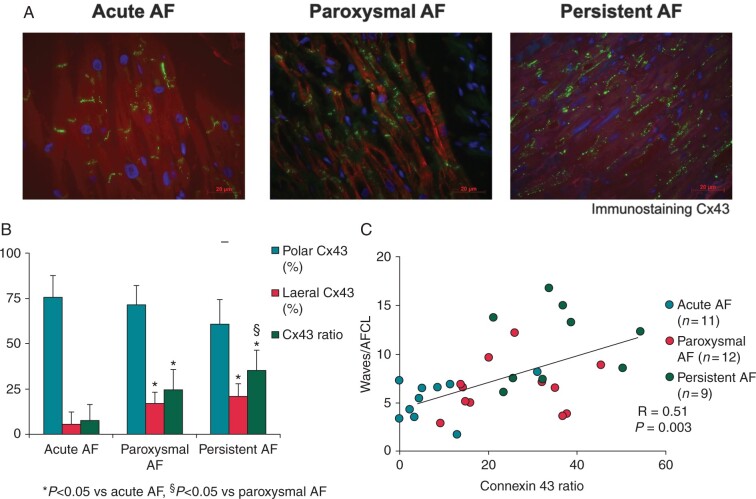
Methods and results: During cardiac surgery, epicardial high-density mapping was performed in patients with acutely induced (aAF, n = 11), pAF (n = 12), and longstanding persistent AF (persAF, n = 9) on the right atrial (RA) wall, the posterior left atrial wall (pLA) and the LA appendage (LAA). In RA appendages, overall and endomysial (myocyte-to-myocyte distances) fibrosis and connexin 43 (Cx43) distribution were quantified. Unipolar AF electrogram analysis showed a more complex pattern with a larger number of narrower waves, more breakthroughs and a higher fractionation index (FI) in persAF compared with aAF and pAF, with no differences between aAF and pAF. The FI was consistently higher at the pLA compared with the RA. Structurally, Cx43 lateralization increased with AF progression (aAF = 7.5 ± 8.9%, pAF = 24.7 ± 11.1%, persAF = 35.1 ± 11.4%, P < 0.001). Endomysial but not overall fibrosis correlated with AF complexity (r = 0.57, P = 0.001; r = 0.23, P = 0.20; respectively).
Conclusions: Atrial fibrillation complexity is highly variable in patients with pAF, but not significantly higher than in patients with acutely induced AF, while in patients with persistent AF complexity is higher. Among the structural alterations studied, endomysial fibrosis, but not overall fibrosis, is the strongest determinant of AF complexity.
Keywords: AF complexity; AF substrate; Atrial fibrillation; Endomysial fibrosis; Epicardial mapping; Fibrosis.
© The Author(s) 2022. Published by Oxford University Press on behalf of the European Society of Cardiology.
Figures
References
-
- Schotten U, Verheule S, Kirchhof P, Goette A.. Pathophysiological mechanisms of atrial fibrillation: a translational appraisal. Physiol Rev 2011;91:265–325. - PubMed
-
- Pontecorboli G, Figueras I, Ventura RM, Carlosena A, Benito E, Prat-Gonzales S, Padeletti Let al. Use of delayed-enhancement magnetic resonance imaging for fibrosis detection in the atria: a review. Europace 2017;19:180–9. - PubMed
-
- Verheule S, Tuyls E, Gharaviri A, Hulsmans S, van Hunnik A, Kuiper Met al. Loss of continuity in the thin epicardial layer because of endomysial fibrosis increases the complexity of atrial fibrillatory conduction. Circ Arrhythm Electrophysiol 2013;6:202–11. - PubMed
-
- Kanagaratnam P, Kojodjojo P, Peters NS.. electrophysiological abnormalities occur prior to the development of clinical episodes of atrial fibrillation: observations from human epicardial mapping. Pacing Clin Electro 2008;31:443–53. - PubMed
MeSH terms
Substances
LinkOut - more resources
Full Text Sources
Medical
