. 2022 Nov;71(11):2829-2836.
doi: 10.1007/s00262-022-03165-w. Epub 2022 Mar 29.

Tafasitamab mediates killing of B-cell non-Hodgkin's lymphoma in combination with γδ T cell or allogeneic NK cell therapy

Affiliations

Tafasitamab mediates killing of B-cell non-Hodgkin's lymphoma in combination with γδ T cell or allogeneic NK cell therapy

Jung Hyun Her et al. Cancer Immunol Immunother. 2022 Nov.

Abstract

Tafasitamab is an Fc-modified monoclonal antibody that binds to CD19, a cell-surface antigen that is broadly expressed on various types of B-cell non-Hodgkin's lymphoma (NHL). Antibody-dependent cellular cytotoxicity (ADCC), a key mode of action of tafasitamab, is mediated through the binding of tafasitamab's Fc region to FcγRIIIa receptors on immune effector cells and results in antitumor activity. Despite the proven clinical activity of tafasitamab in combination with lenalidomide in the treatment of diffuse large B-cell lymphoma (DLBCL), a higher number of immune cells in cancer patients may improve the activity of tafasitamab. Here, we characterized two ex vivo-expanded FcγRIIIa receptor-expressing cell types-γδ T and MG4101 natural killer (NK) cells-as effector cells for tafasitamab in vitro, and found that in the presence of these cells tafasitamab was able to induce ADCC against a range of NHL cell lines and patient-derived cells. We also explored the concept of effector cell supplementation during tafasitamab treatment in vivo by coadministering MG4101 NK cells in Raji and Ramos xenograft models of NHL. Combination treatment of tafasitamab and allogeneic MG4101 NK cells in these models demonstrated a survival benefit compared with tafasitamab or MG4101 monotherapy (Raji: 1.7- to 1.9-fold increase in lifespan; Ramos: 2.0- to 4.1-fold increase in lifespan). In conclusion, adoptive cell transfer of ex vivo-expanded allogeneic NK or autologous γδ T cells in combination with tafasitamab treatment may potentially be a promising novel approach to increase the number of immune effector cells and enhance the antitumor effect of tafasitamab.

Keywords: ADCC; B-cell non-Hodgkin’s lymphoma; Immunotherapy; NK cells; Tafasitamab; γδ T cells.


Conflict of interest statement

MP, JS, RB, CH, SS, and JE are employees of MorphoSys AG, Planegg, Germany. SS owns shares of MorphoSys AG. GC LabCell and MorphoSys AG report a joint patent application.

Figures

Fig. 1
Fig. 1
γδ T cell ADCC assays against lymphoma cell lines. Mino (a), Jeko (b), U-2932 (c), and Daudi (d) target cells (T) were combined with γδ T effector cells (E) at different ratios. Cells were incubated for 4 h with 1 μg/mL of tafasitamab, XmAb5603, or IgG1 isotype as a control. Cell lysis was determined by fluorescence-activated cell sorting (FACS) analysis of CFSE- and TO-PRO-3-stained target cells. Data are mean values plus standard deviation for three different assays using γδ T cells derived from three different healthy donors. *P < 0.05; **P < 0.01
Fig. 2
Fig. 2
γδ T cell ADCC assays against leukemia (CLL) and lymphoma (MCL) cells from patient samples. Cells from two different patients with CLL (a, b) and MCL (c, d) were used as target cells (T). The target cells were combined with γδ T effector cells (E) from one healthy donor and tested at different E/T ratios. Cells were incubated for 4 h with 1 μg/mL of tafasitamab, XmAb5603, or IgG1 isotype as a control. Cell lysis was determined by FACS analysis of CFSE- and TO-PRO-3-stained target cells. Because of limited availability of patient samples, single measurements were performed for each condition
Fig. 3
Fig. 3
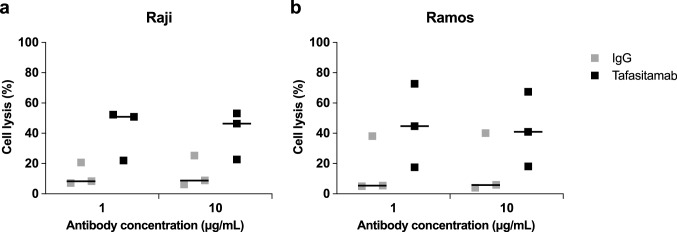
Allogeneic NK cell ADCC assays against lymphoma cell lines. The B-cell lymphoma Raji (a) and Ramos (b) cell lines were incubated for 2 h with saturating concentrations of tafasitamab or IgG isotype control (1 or 10 μg/mL) in the presence of expanded MG4101 NK cells from three healthy donors at an E/T ratio of 3:1. Calcein release from labeled target cells was measured using a fluorescence microplate reader. Results from three different donors (squares) and the median values (solid lines) are depicted
Fig. 4
Fig. 4
Survival of disseminated xenograft mice models treated with MG4101 NK effector cells and/or tafasitamab. For the Raji model (a), groups of 10 SCID mice were injected i.v. with 1 × 105 Raji cells (Day 0). Mice were then injected s.c. with a single dose of tafasitamab (2.5 μg/kg) on Day 1 and/or i.v. with MG4101 (2 × 107 NK cells) on Days 1, 3, 6, 8, and 10. Median survival was 25.5, 38.5, 40.0, and 51.0 days for mice treated with freezing medium + control IgG, MG4101, tafasitamab, and MG4101 + tafasitamab, respectively. For the Ramos model (b), groups of 10 SCID mice were injected i.v. with 1 × 106 Ramos cells (Day 0). Mice were then injected i.v. with tafasitamab (10 mg/kg) on Days 3, 6, 10, 13, 17, and 20 and/or i.v. with MG4101 (2 × 107 NK cells) on Days 4, 7, 11, 14, 18, and 21. Median survival was 30.5, 38.0, 45.5, and 62.0 days for mice treated with freezing medium + control IgG, MG4101, tafasitamab, and MG4101 + tafasitamab, respectively. Statistically significant differences compared with the freezing medium + control IgG are indicated. ***P < 0.001; ****P < 0.0001

References

    1. Awan FT, Lapalombella R, Trotta R, et al. CD19 targeting of chronic lymphocytic leukemia with a novel Fc-domain-engineered monoclonal antibody. Blood. 2010;115:1204–1213. doi: 10.1182/blood-2009-06-229039. - DOI - PMC - PubMed
    1. Horton HM, Bernett MJ, Pong E, et al. Potent in vitro and in vivo activity of an Fc-engineered anti-CD19 monoclonal antibody against lymphoma and leukemia. Cancer Res. 2008;68:8049–8057. doi: 10.1158/0008-5472.CAN-08-2268. - DOI - PubMed
    1. Olejniczak SH, Stewart CC, Donohue K, Czuczman MS. A quantitative exploration of surface antigen expression in common B-cell malignancies using flow cytometry. Immunol Invest. 2006;35:93–114. doi: 10.1080/08820130500496878. - DOI - PubMed
    1. Salles G, Duell J, González Barca E, et al. Tafasitamab plus lenalidomide in relapsed or refractory diffuse large B-cell lymphoma (L-MIND): a multicentre, prospective, single-arm, phase 2 study. Lancet Oncol. 2020;21:978–988. doi: 10.1016/S1470-2045(20)30225-4. - DOI - PubMed
    1. Braakman E, van de Winkel JGJ, van Krimpen BA, et al. CD16 on human γδ T lymphocytes: expression, function, and specificity for mouse IgG isotypes. Cell Immunol. 1992;143:97–107. doi: 10.1016/0008-8749(92)90008-D. - DOI - PubMed

MeSH terms

LinkOut - more resources