


Integrative Proposals of Sports Monitoring: Subjective Outperforms Objective Monitoring
- PMID: 35348932
- PMCID: PMC8964908
- DOI: 10.1186/s40798-022-00432-z
Integrative Proposals of Sports Monitoring: Subjective Outperforms Objective Monitoring
Erratum in
-
Correction: Integrative Proposals of Sports Monitoring: Subjective Outperforms Objective Monitoring.Sports Med Open. 2022 May 6;8(1):61. doi: 10.1186/s40798-022-00460-9. Sports Med Open. 2022. PMID: 35524018 Free PMC article. No abstract available.
Abstract
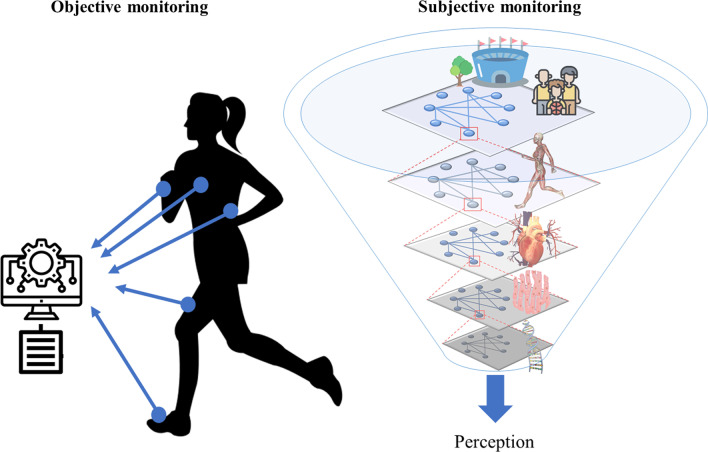
Current trends in sports monitoring are characterized by the massive collection of tech-based biomechanical, physiological and performance data, integrated through mathematical algorithms. However, the application of algorithms, predicated on mechanistic assumptions of how athletes operate, cannot capture, assess and adequately promote athletes' health and performance. The objective of this paper is to reorient the current integrative proposals of sports monitoring by re-conceptualizing athletes as complex adaptive systems (CAS). CAS contain higher-order perceptual units that provide continuous and multilevel integrated information about performer-environment interactions. Such integrative properties offer exceptional possibilities of subjective monitoring for outperforming any objective monitoring system. Future research should investigate how to enhance this human potential to contribute further to athletes' health and performance. This line of argument is not intended to advocate for the elimination of objective assessments, but to highlight the integrative possibilities of subjective monitoring.
Keywords: Awareness; Complex adaptive systems; Health; Performance; Self-regulation; Technology.
© 2022. The Author(s).
Conflict of interest statement
Lluc Montull, Agne Slapšinskaitė-Dackevičienė, John Kiely, Robert Hristovski and Natàlia Balagué declare that they have no conflicts of interest relevant to the content of this article.
Figures
References
-
- Foster C, Rodriguez-Marroyo JA, de Koning JJ. Monitoring training loads: the past, the present, and the future. Int J Sports Physiol Perform. 2017;12(2):1–8. - PubMed
-
- Moser O, Riddell MC, Eckstein ML, Adolfsson P, Rabasa-Lhoret R, van den Boom L, et al. Glucose management for exercise using continuous glucose monitoring (CGM) and intermittently scanned CGM (isCGM) systems in type 1 diabetes: position statement of the European Association for the Study of Diabetes (EASD) and of the International Society for Pediatric and Adolescent Diabetes (ISPAD) endorsed by JDRF and supported by the American Diabetes Association (ADA) Diabetologia. 2020;63(12):2501–2520. doi: 10.1007/s00125-020-05263-9. - DOI - PubMed
LinkOut - more resources
Full Text Sources
