


Visualization of medical concepts represented using word embeddings: a scoping review
- PMID: 35351120
- PMCID: PMC8962592
- DOI: 10.1186/s12911-022-01822-9
Visualization of medical concepts represented using word embeddings: a scoping review
Abstract
Background: Analyzing the unstructured textual data contained in electronic health records (EHRs) has always been a challenging task. Word embedding methods have become an essential foundation for neural network-based approaches in natural language processing (NLP), to learn dense and low-dimensional word representations from large unlabeled corpora that capture the implicit semantics of words. Models like Word2Vec, GloVe or FastText have been broadly applied and reviewed in the bioinformatics and healthcare fields, most often to embed clinical notes or activity and diagnostic codes. Visualization of the learned embeddings has been used in a subset of these works, whether for exploratory or evaluation purposes. However, visualization practices tend to be heterogeneous, and lack overall guidelines.
Objective: This scoping review aims to describe the methods and strategies used to visualize medical concepts represented using word embedding methods. We aim to understand the objectives of the visualizations and their limits.
Methods: This scoping review summarizes different methods used to visualize word embeddings in healthcare. We followed the methodology proposed by Arksey and O'Malley (Int J Soc Res Methodol 8:19-32, 2005) and by Levac et al. (Implement Sci 5:69, 2010) to better analyze the data and provide a synthesis of the literature on the matter.
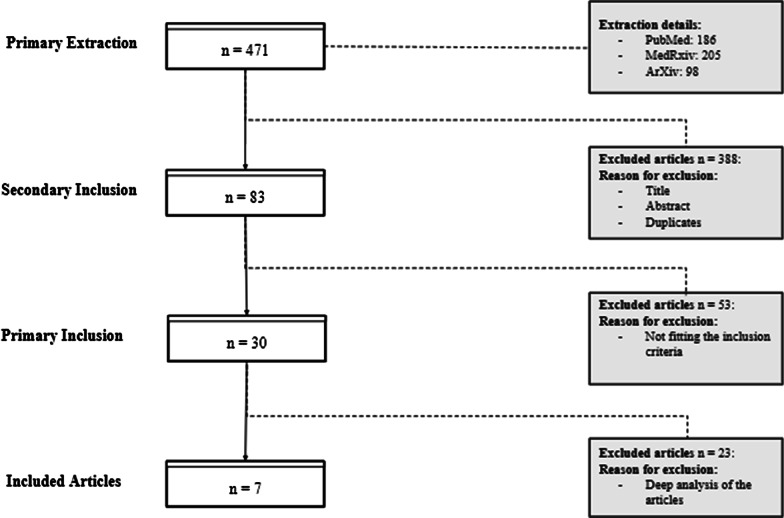
Results: We first obtained 471 unique articles from a search conducted in PubMed, MedRxiv and arXiv databases. 30 of these were effectively reviewed, based on our inclusion and exclusion criteria. 23 articles were excluded in the full review stage, resulting in the analysis of 7 papers that fully correspond to our inclusion criteria. Included papers pursued a variety of objectives and used distinct methods to evaluate their embeddings and to visualize them. Visualization also served heterogeneous purposes, being alternatively used as a way to explore the embeddings, to evaluate them or to merely illustrate properties otherwise formally assessed.
Conclusions: Visualization helps to explore embedding results (further dimensionality reduction, synthetic representation). However, it does not exhaust the information conveyed by the embeddings nor constitute a self-sustaining evaluation method of their pertinence.
Keywords: Data mining; Deep learning; Medical; Natural language processing; Visualization; Word embeddings.
© 2022. The Author(s).
Conflict of interest statement
The authors declare that they have no competing interests.
References
Publication types
MeSH terms
LinkOut - more resources
Full Text Sources
