


Does Weight-Motivation for Exercise Predict Physical Activity Levels Across the Life Course From Adolescence to Adulthood?
- PMID: 35351352
- PMCID: PMC9232887
- DOI: 10.1016/j.jadohealth.2022.02.002
Does Weight-Motivation for Exercise Predict Physical Activity Levels Across the Life Course From Adolescence to Adulthood?
Abstract
Healthcare professionals may motivate their patients to exercise to lose weight, but it is unknown how weight-focused motivations influence young peoples' PA trajectories.
Purpose: To examine if weight-motivated exercise predicts moderate-to-vigorous physical activity (MVPA) from adolescence to adulthood in a population-based sample and if this relationship differs by age and body mass index (BMI).
Methods: Participants (N = 1,428; 13-18 years at baseline; 48.6% female; 49.0% white) responded to surveys in the 15-year longitudinal study, Project EAT (Eating and Activity in Teens and Young Adults). Weight-motivated exercise was examined as a predictor of MVPA across the life course at five-year intervals using linear regression generalized estimating equations and adjusting for demographics (age modeled continuously), BMI (modeled continuously), weight-related intentions, and prior MVPA.
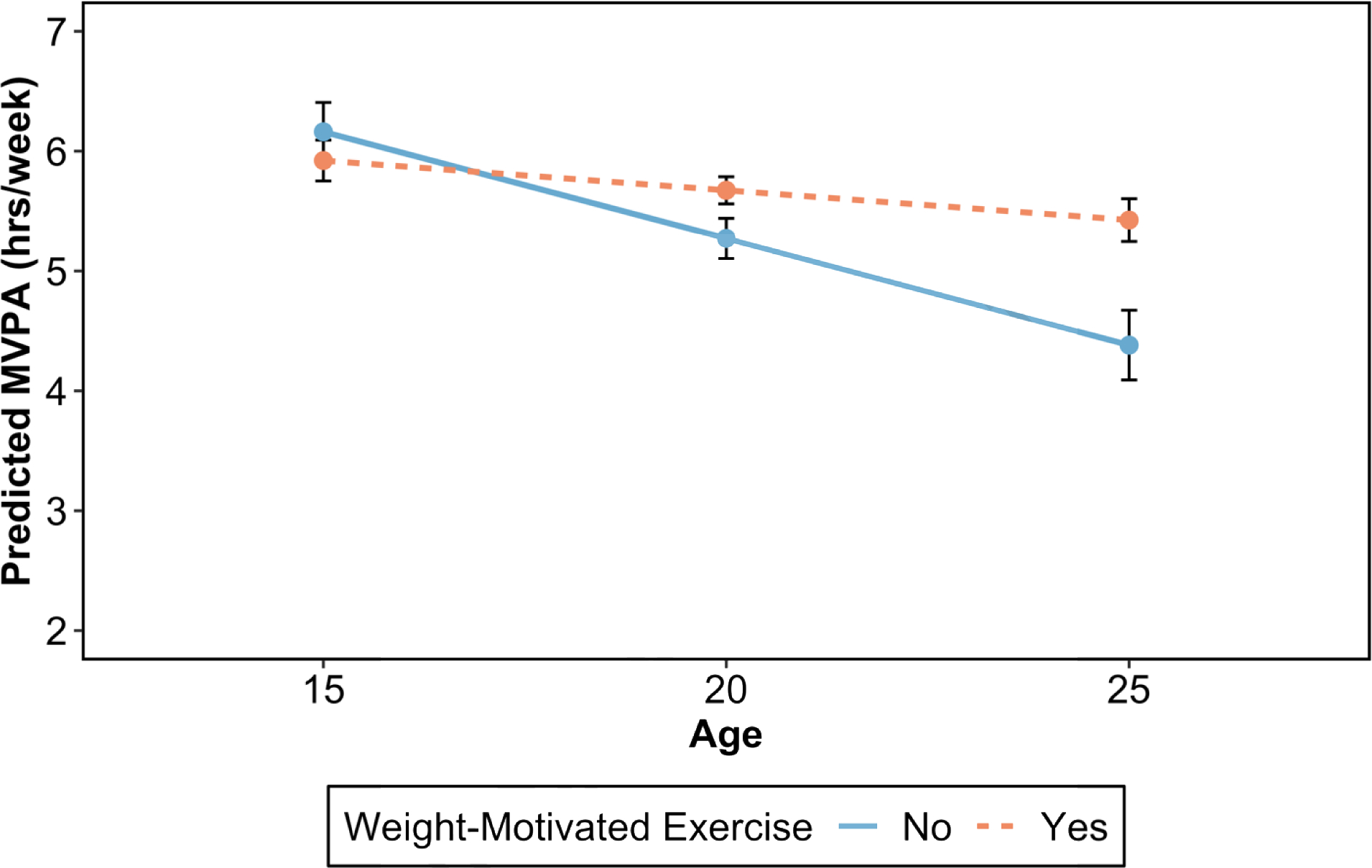
Results: Weight-motivated exercise predicted higher subsequent MVPA at five-year intervals among females (B = .57, 95% CI:0.13, 1.00) but not males (B = .31, 95% CI:-.09, .72). The association differed by BMI in females (p = .02); weight-motivated exercise was associated with higher subsequent MVPA at lower BMI but lower subsequent MVPA at higher BMI. The association also differed by age in males (p = .008), such that older males who reported weight-motivated exercise had higher subsequent MVPA, whereas this association was not present in younger males.
Conclusion: Weight-motivated exercise may have a deleterious influence on MVPA for females with higher BMI and may have an advantageous influence on older males. Understanding how motivations for exercise may influence PA trajectories can inform PA promotion over the life course by providing more nuanced guidance by age, BMI, and sex.
Keywords: Exercise; Motivation; Physical activity; adolescent; weight stigma.
Copyright © 2022 Society for Adolescent Health and Medicine. Published by Elsevier Inc. All rights reserved.
Figures

Comment in
-
Validity of Inverse Probability Weighting and Recall Bias Concerning the Article by Falk et al.J Adolesc Health. 2022 Sep;71(3):373. doi: 10.1016/j.jadohealth.2022.05.022. J Adolesc Health. 2022. PMID: 35988952 No abstract available.
References
-
- Summary Health Statistics: National Health Interview Survey, 2018.; 2018:Table A-14a, p 1–12. Accessed January 22, 2021. https://ftp.cdc.gov/pub/Health_Statistics/NCHS/NHIS/SHS/2018_SHS_Table_A...
-
- Caspersen CJ, Pereira MA, Curran KM. Changes in physical activity patterns in the United States, by sex and cross-sectional age. In: Center for Disease Control and Prevention.; 2000:1601–1609. - PubMed
Publication types
MeSH terms
Grants and funding
LinkOut - more resources
Full Text Sources
