Essential Principles and Recent Progress in the Development of TSPO PET Ligands for Neuroinflammation Imaging
- PMID: 35352645
- PMCID: PMC10080361
- DOI: 10.2174/0929867329666220329204054
Essential Principles and Recent Progress in the Development of TSPO PET Ligands for Neuroinflammation Imaging
Abstract
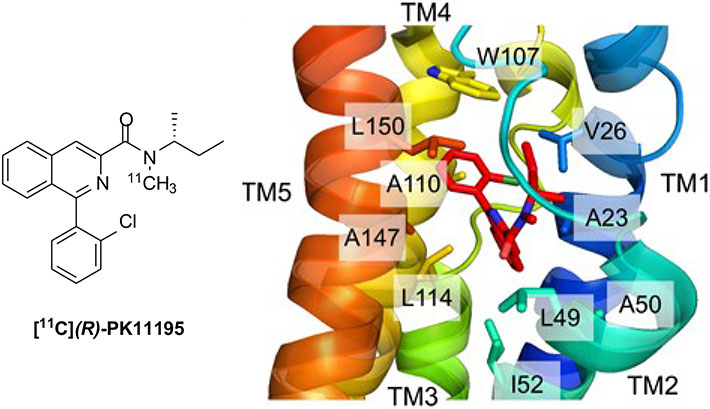
The translocator protein 18kDa (TSPO) is expressed in the outer mitochondrial membrane and is implicated in several functions, including cholesterol transport and steroidogenesis. Under normal physiological conditions, TSPO is present in very low concentrations in the human brain but is markedly upregulated in response to brain injury and inflammation. This upregulation is strongly associated with activated microglia. Therefore, TSPO is particularly suited for assessing active gliosis associated with brain lesions following injury or disease. For over three decades, TSPO has been studied as a biomarker. Numerous radioligands for positron emission tomography (PET) that target TSPO have been developed for imaging inflammatory progression in the brain. Although [11C]PK11195, the prototypical first-generation PET radioligand, is still widely used for in vivo studies, mainly now as its single more potent R-enantiomer, it has severe limitations, including low sensitivity and poor amenability to quantification. Second-generation radioligands are characterized by higher TSPO specific signals but suffer from other drawbacks, such as sensitivity to the TSPO single nucleotide polymorphism (SNP) rs6971. Therefore, their applications in human studies have the burden of needing to genotype subjects. Consequently, recent efforts are focused on developing improved radioligands that combine the optimal features of the second generation with the ability to overcome the differences in binding affinities across the population. This review presents essential principles in the design and development of TSPO PET ligands and discusses prominent examples among the main chemotypes.
Keywords: PET; TSPO; diagnostic marker; drug development; imaging; neuroinflammation; radioligand.
Copyright© Bentham Science Publishers; For any queries, please email at epub@benthamscience.net.
Conflict of interest statement
CONFLICT OF INTEREST
The authors declares no conflict of interest, financial or otherwise.
Figures



References
-
- Papadopoulos V; Baraldi M; Guilarte TR; Knudsen TB; Lacapère JJ; Lindemann P; Norenberg MD; Nutt D; Weizman A; Zhang MR; Gavish M Translocator protein (18kDa): New nomenclature for the peripheral-type benzodiazepine receptor based on its structure and molecular function. Trends Pharmacol. Sci, 2006, 27(8), 402–409. 10.1016/j.tips.2006.06.005 - DOI - PubMed
Publication types
MeSH terms
Substances
Grants and funding
- Z01 MH002793/ImNIH/Intramural NIH HHS/United States
- ZIA MH002793/ImNIH/Intramural NIH HHS/United States
- PRIN 2017MT3993/Italian Ministero dell’Istruzione, dell’Università e della Ricerca (MIUR), Progetti di Ricerca di Interesse Nazionale
- ZIA MH002793 /National Institutes of Health (National Institute of Mental Health)
LinkOut - more resources
Full Text Sources