


Association between benzodiazepine receptor agonist use and mortality in patients hospitalised for COVID-19: a multicentre observational study
- PMID: 35352674
- PMCID: PMC8967698
- DOI: 10.1017/S2045796021000743
Association between benzodiazepine receptor agonist use and mortality in patients hospitalised for COVID-19: a multicentre observational study
Abstract
Aims: To examine the association between benzodiazepine receptor agonist (BZRA) use and mortality in patients hospitalised for coronavirus disease 2019 (COVID-19).
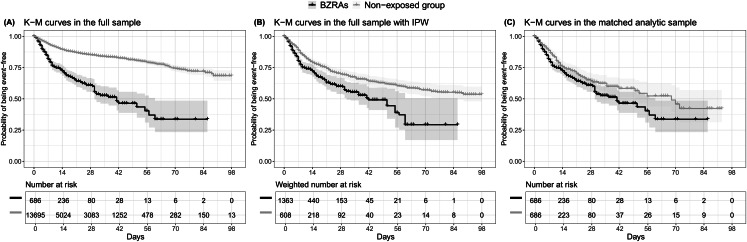
Methods: A multicentre observational study was performed at Greater Paris University hospitals. The sample involved 14 381 patients hospitalised for COVID-19. A total of 686 (4.8%) inpatients received a BZRA at hospital admission at a mean daily diazepam-equivalent dose of 19.7 mg (standard deviation (s.d.) = 25.4). The study baseline was the date of admission, and the primary endpoint was death. We compared this endpoint between patients who received BZRAs and those who did not in time-to-event analyses adjusted for sociodemographic characteristics, medical comorbidities and other medications. The primary analysis was a Cox regression model with inverse probability weighting (IPW).
Results: Over a mean follow-up of 14.5 days (s.d. = 18.1), the primary endpoint occurred in 186 patients (27.1%) who received BZRAs and in 1134 patients (8.3%) who did not. There was a significant association between BZRA use and increased mortality both in the crude analysis (hazard ratio (HR) = 3.20; 95% confidence interval (CI) = 2.74-3.74; p < 0.01) and in the IPW analysis (HR = 1.61; 95% CI = 1.31-1.98, p < 0.01), with a significant dose-dependent relationship (HR = 1.55; 95% CI = 1.08-2.22; p = 0.02). This association remained significant in sensitivity analyses. Exploratory analyses indicate that most BZRAs may be associated with an increased mortality among patients hospitalised for COVID-19, except for diazepam, which may be associated with a reduced mortality compared with any other BZRA treatment.
Conclusions: BZRA use may be associated with an increased mortality among patients hospitalised for COVID-19, suggesting the potential benefit of decreasing dose or tapering off gradually these medications when possible.
Keywords: Benzodiazepine; COVID-19; SARS-CoV-2; mortality.
Conflict of interest statement
NH, MS-R, MA, EG, JK, AC and FL are inventors of a patent application related to methods of treating COVID-19, filled by Assistance Publique – Hôpitaux de Paris in France. Other authors declare no conflict of interest related to this work.
Figures
References
-
- Ashton CH (2002) Benzodiazepines: how they work and how to withdraw. The Ashton Manual, August.
-
- Austin PC (2009) Using the standardized difference to compare the prevalence of a binary variable between two groups in observational research. Communications in Statistics-Simulation and Computation 38, 1228–1234.
-
- Belleville G (2010) Mortality hazard associated with anxiolytic and hypnotic drug use in the national population health survey. The Canadian Journal of Psychiatry 55, 558–567. - PubMed
-
- Carpinteiro A, Edwards MJ, Hoffmann M, Kochs G, Gripp B, Weigang S, Adams C, Carpinteiro E, Gulbins A, Keitsch S, Sehl C, Soddemann M, Wilker B, Kamler M, Bertsch T, Lang KS, Patel S, Wilson GC, Walter S, Hengel H, Pöhlmann S, Lang PA, Kornhuber J, Becker KA, Ahmad SA, Fassbender K and Gulbins E (2020) Pharmacological inhibition of acid sphingomyelinase prevents uptake of SARS-CoV-2 by epithelial cells. Cell Reports Medicine 1, 100142. - PMC - PubMed
-
- Carpinteiro A, Gripp B, Hoffmann M, Pöhlmann S, Hoertel N, Edwards MJ, Kamler M, Kornhuber J, Becker KA and Gulbins E (2021) Inhibition of acid sphingomyelinase by ambroxol prevents SARS-CoV-2 entry into epithelial cells. Journal of Biological Chemistry 296, 100701. doi: 10.1016/j.jbc.2021.100701 - DOI - PMC - PubMed
Publication types
MeSH terms
Substances
LinkOut - more resources
Full Text Sources
Medical
Miscellaneous
