


Birthweight and isolated congenital heart defects - A systematic review and meta-analysis
- PMID: 35352871
- PMCID: PMC9542320
- DOI: 10.1111/1471-0528.17164
Birthweight and isolated congenital heart defects - A systematic review and meta-analysis
Abstract
Background: Birthweight (BW) is an important prognostic factor in newborns with congenital heart defects (CHD).
Objectives: To give an overview of the literature on BW z-score in children with isolated CHD.
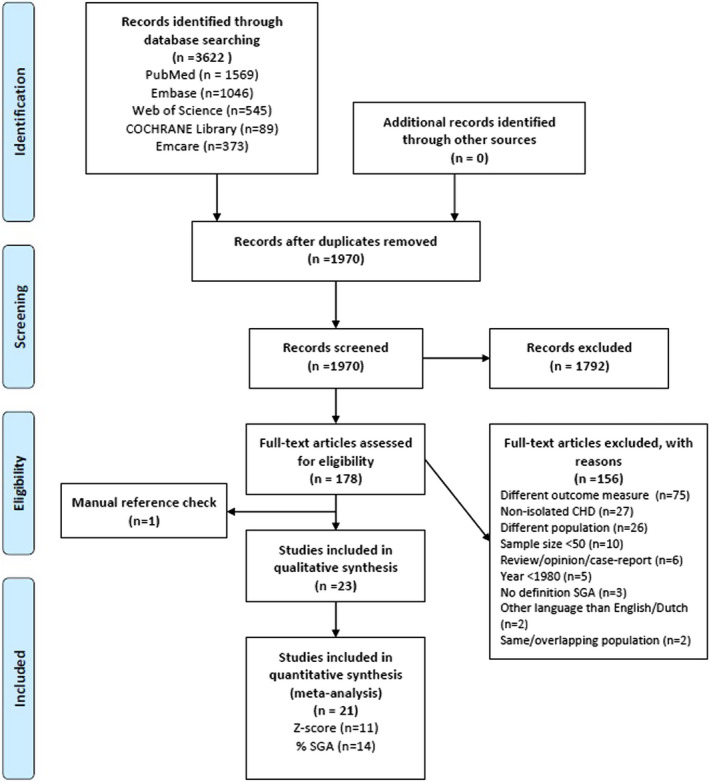
Search strategy: A systematic search was performed on isolated CHD and BW in PubMed, Embase, Web of Science, COCHRANE Library and Emcare.
Selection criteria: Neonates with isolated CHD were included if a BW percentile, BW z-score or % small-or-gestational age (SGA) was reported.
Data collection and analysis: BW z-score and percentage SGA were pooled with random-effect meta-analysis. Quality and risk of bias were assessed using the modified Newcastle Ottawa Scale.
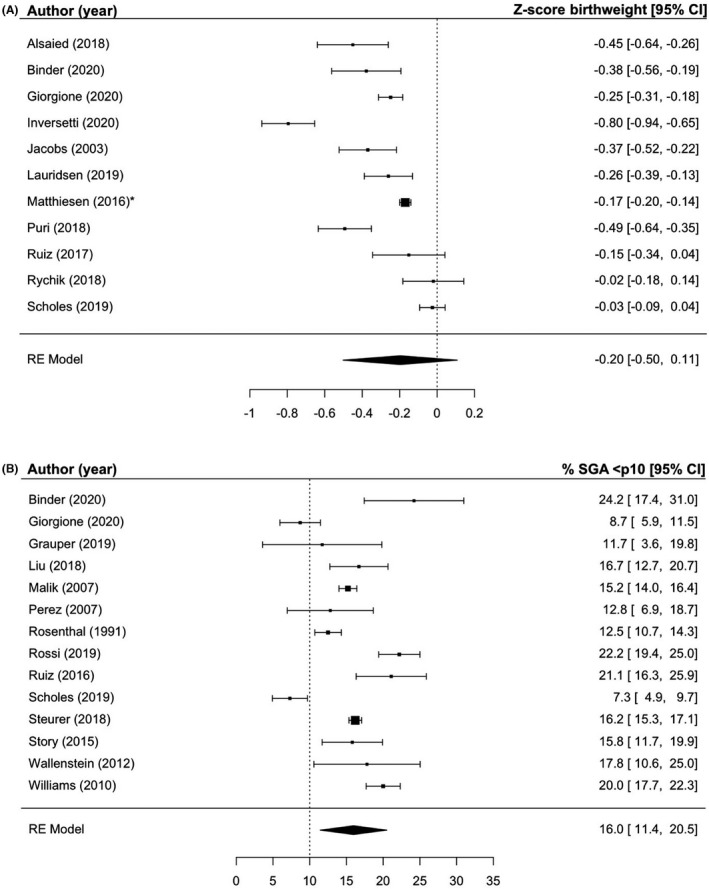
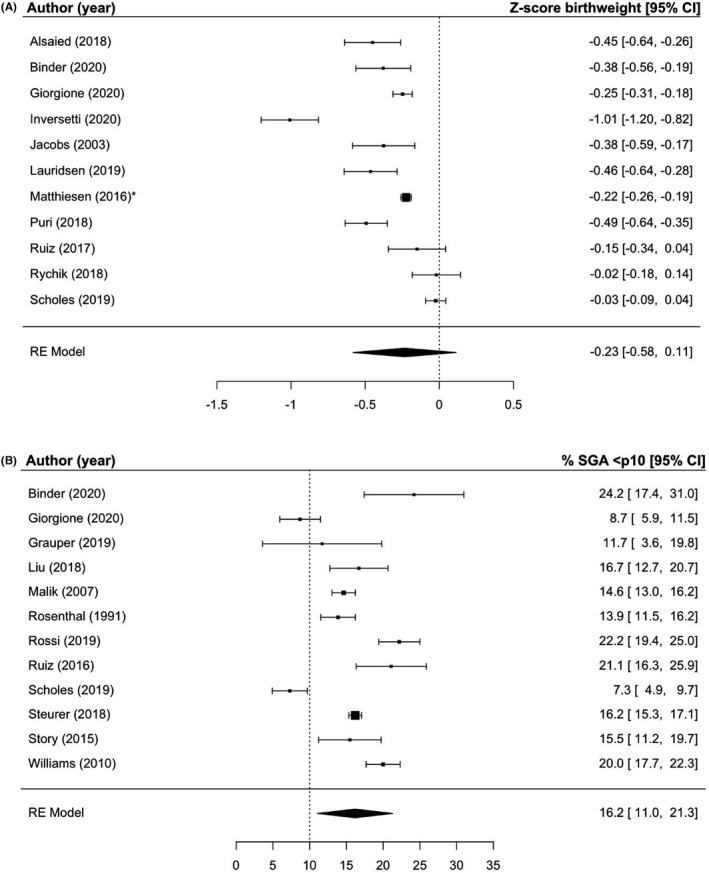
Main results: Twenty-three articles (27 893 cases) were included. BW z-scores were retrieved from 11 articles, resulting in a pooled z-score of -0.20 (95% CI -0.50 to 0.11). The overall pooled prevalence of SGA <10th percentile was 16.0% (95% CI 11.4-20.5; 14 studies). Subgroup analysis of major CHD showed similar results (BW z-score -0.23 and percentage SGA 16.2%).
Conclusions: Overall BW in isolated CHD is within range of normality but impaired, with a 1.6-fold higher risk of SGA, irrespective of the type of CHD (major CHD vs all CHD combined). Our findings underline the association between CHD and BW. The use of BW z-scores provides insight into growth of all fetuses with CHD.
Tweetable abstract: Infants with a congenital heart defect (CHD) have a lower birthweight z-score and a higher incidence of small-for-gestational age (<10th percentile). This was encountered both in the major CHD-group as well as in all-CHD combined group analysis. Future research on the association between birthweight and CHD should include all types of CHDs (including mild cardiac defects) and placental-related disease, such as pre-eclampsia. We advocate the use of international standardised fetal growth and birthweight charts in CHD research.
Keywords: birthweight; congenital heart defects; fetal growth; intrauterine growth; meta-analysis; small for gestational age; systematic review.
© 2022 The Authors. BJOG: An International Journal of Obstetrics and Gynaecology published by John Wiley & Sons Ltd.
Conflict of interest statement
None declared. Completed disclosure of interest forms are available to view online as supporting information..
Figures
References
-
- Hoffman JI, Kaplan S. The incidence of congenital heart disease. J Am Coll Cardiol. 2002;39(12):1890–900. - PubMed
-
- van der Linde D, Konings EE, Slager MA, Witsenburg M, Helbing WA, Takkenberg JJ, et al. Birth prevalence of congenital heart disease worldwide: a systematic review and meta‐analysis. J Am Coll Cardiol. 2011;58(21):2241–7. - PubMed
-
- Marino BS, Lipkin PH, Newburger JW, Peacock G, Gerdes M, Gaynor JW, et al. Neurodevelopmental outcomes in children with congenital heart disease: evaluation and management: a scientific statement from the American Heart Association. Circulation. 2012;126(9):1143–72. - PubMed
Publication types
MeSH terms
LinkOut - more resources
Full Text Sources
Medical
