


Depression Symptoms and Olfactory-related Quality of Life
- PMID: 35353380
- PMCID: PMC9544892
- DOI: 10.1002/lary.30122
Depression Symptoms and Olfactory-related Quality of Life
Abstract
Objectives: Patients with olfactory dysfunction (OD) frequently report symptoms of depression. The objective of this study was to determine how clinical characteristics and olfactory-related quality of life (QoL) measures associate with the likelihood for major depressive disorders (MDDs).
Methods: A total of 192 OD patients were included. Olfactory function was measured using all three subtests of the Sniffn' Sticks test. Olfactory-related quality of life (QoL) was evaluated using the Questionnaires of Olfactory Dysfunction (QOD)-negative (NS) and -positive statement (PS). The likelihood for MDD was assessed using the Patients Health Questionnaire-2 (PHQ-2). Demographics and disease-specific variables (etiology and duration of OD) were collected. Univariate and multivariable analyses were used to associate disease-specific variables and the QOD with the outcome of the PHQ-2. Additionally, the predictive ability of the QOD-NS to predict depressive symptoms was calculated.
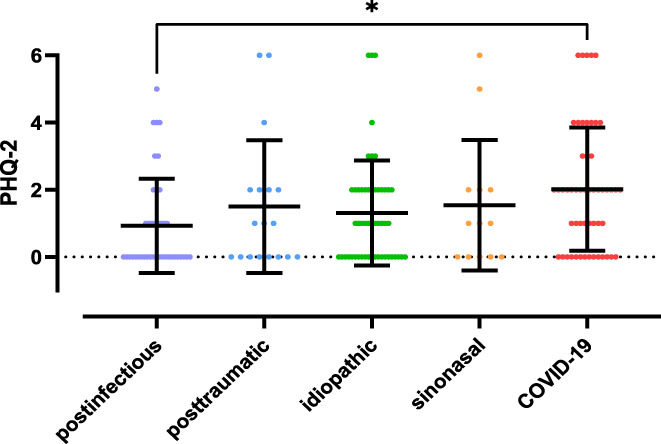
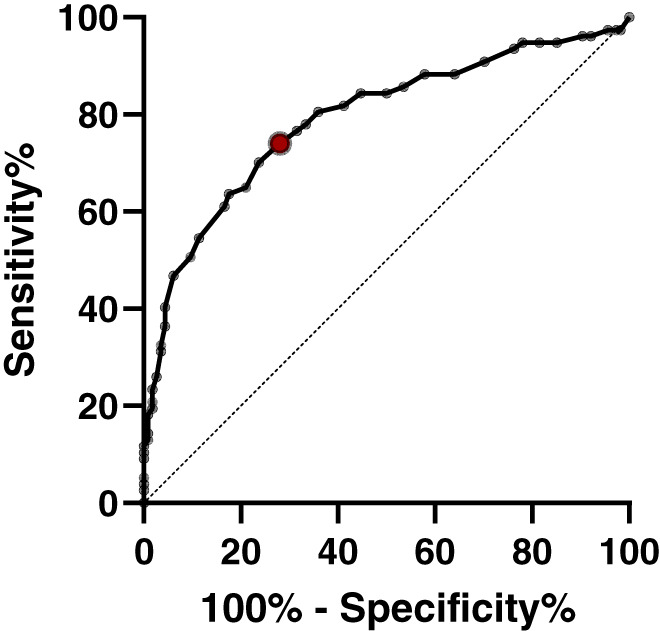
Results: In univariate analysis, COVID-19 related smell loss, the QOD-NS, and the QOD-PS were significantly associated with the PHQ-2. In multivariable analyses adjusting for QoL measures, the QOD-NS (ß = 0.532, p < 0.001) and sinonasal OD (compared with postinfectious OD) were significantly associated with the PHQ-2 (ß = 0.146, p = 0.047). When omitting QoL measures from multivariable analyses, only COVID-19 related OD (compared with postinfectious OD) was significantly associated with the PHQ-2 (ß = 0.287, p = 0.009). A QOD-NS score > 20.5 had 70.13% sensitivity and 76.32% specificity for detecting symptoms of depression.
Conclusion: Our results suggest that COVID-19 related OD might be associated with a higher likelihood for MDD. Furthermore, we showed that the QOD-NS score might be helpful to predict symptoms of depression in OD patients.
Level of evidence: 4 Laryngoscope, 132:1829-1834, 2022.
Keywords: PROM; anosmia; depression; hyposmia; olfactory dysfunction; quality of life; smell loss.
© 2022 The Authors. The Laryngoscope published by Wiley Periodicals LLC on behalf of The American Laryngological, Rhinological and Otological Society, Inc.
Conflict of interest statement
The authors declare that there are no conflicts of interest regarding the publication of this paper.
Figures
References
-
- Croy I, Nordin S, Hummel T. Olfactory disorders and quality of life‐an updated review. Chem Senses. 2014;39(3):185‐194. - PubMed
-
- Liu DT, Prem B, Besser G, Renner B, Mueller CA. Olfactory‐related quality of life adjustments in smell loss during the Coronavirus‐19 pandemic. Am J Rhinol Allergy. 2021;36(2):253‐260. - PubMed
-
- Hummel T, Whitcroft KL, Andrews P, et al. Position paper on olfactory dysfunction. Rhinol Suppl. 2017;54(26):1‐30. - PubMed
MeSH terms
LinkOut - more resources
Full Text Sources
Medical
Research Materials
Miscellaneous
