


Severe headache trajectory following aneurysmal subarachnoid hemorrhage: the association with lower sodium levels
- PMID: 35353644
- PMCID: PMC9177668
- DOI: 10.1080/02699052.2022.2055146
Severe headache trajectory following aneurysmal subarachnoid hemorrhage: the association with lower sodium levels
Abstract
Background: A clinical hallmark of aneurysmal SAH (aSAH) is headache. Little is known about post-aSAH headache factors which may point to underlying mechanisms. In this study, we aimed to characterize the severity and trajectory of headaches in relation to clinical features of patients with aSAH.
Methods: This is a retrospective longitudinal study of adult patients admitted to an academic tertiary care center between 2012 and 2019 with aSAH who could verbalize pain scores. Factors recorded included demographics, aneurysm characteristics, analgesia, daily morning serum sodium concentration, and occurrence of vasospasm. Group-based trajectory modeling was used to identify headache pain trajectories, and clinical factors were compared between trajectories.
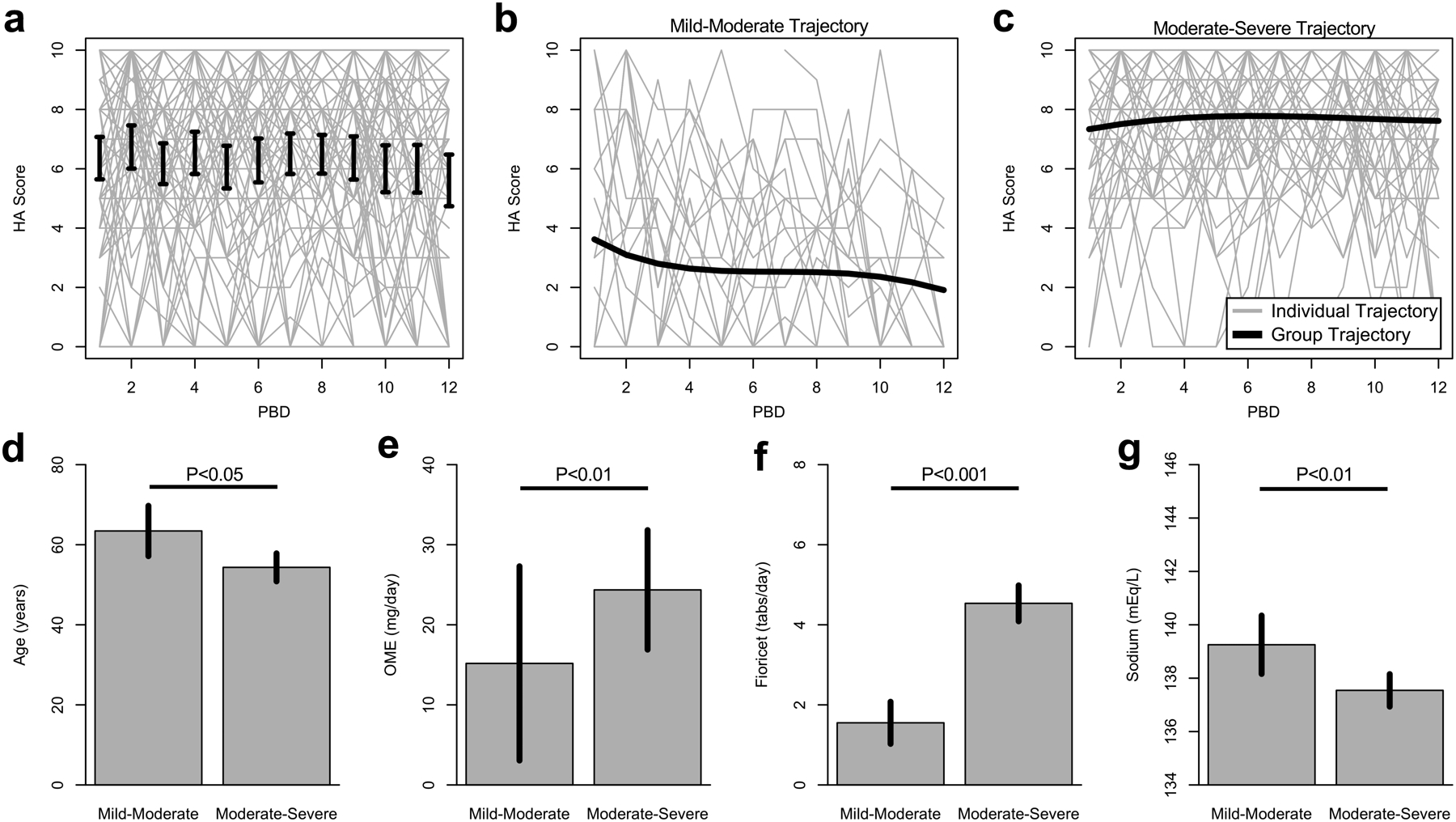
Results: Of 91 patients included in the analysis, mean age was 57 years and 20 (22%) were male. Headache score trajectories clustered into two groups: patients with mild-moderate and moderate-severe pain. Patients in the moderate-severe pain group were younger (P<0.05), received more opioid analgesia (P<0.001), and had lower sodium concentrations (P<0.001) than patients in the mild-moderate pain group.
Conclusion: We identified two distinct post-aSAH headache pain trajectory cohorts and identified an association with age, analgesia, and sodium levels. Future prospective studies considering sodium homeostasis and volume status under standardized analgesic regimens are warranted.
Keywords: Aneurysmal subarachnoid hemorrhage; SIADH; headache; hyponatremia; opioids; sodium; vasospasm.
Figures
References
-
- Glisic EK, Gardiner L, Josti L, Dermanelian E, Ridel S, Dziodzio J, et al. (2016): Inadequacy of headache management after subarachnoid hemorrhage. Am J Crit Care 25: 136–143. - PubMed
-
- Gerner ST, Reichl J, Custal C, Brandner S, Eyüpoglu IY, Lücking H, et al. (2020): Long-Term Complications and Influence on Outcome in Patients Surviving Spontaneous Subarachnoid Hemorrhage. Cerebrovasc Dis 49: 307–315. - PubMed
-
- Kwon OK (2019): Headache and Aneurysm. Neuroimaging Clin N Am 29: 255–260. - PubMed
-
- Swope R, Glover K, Gokun Y, Fraser JF, Cook AM (2014): Evaluation of headache severity after aneurysmal subarachnoid hemorrhage. Interdiscip Neurosurg 1: 119–122.
Publication types
MeSH terms
Substances
Grants and funding
LinkOut - more resources
Full Text Sources
