Higher-Dose Primaquine to Prevent Relapse of Plasmodium vivax Malaria
- PMID: 35353962
- PMCID: PMC9132489
- DOI: 10.1056/NEJMoa2104226
Higher-Dose Primaquine to Prevent Relapse of Plasmodium vivax Malaria
Abstract
Background: In most of the Americas, the recommended treatment to prevent relapse of Plasmodium vivax malaria is primaquine at a total dose of 3.5 mg per kilogram of body weight, despite evidence of only moderate efficacy.
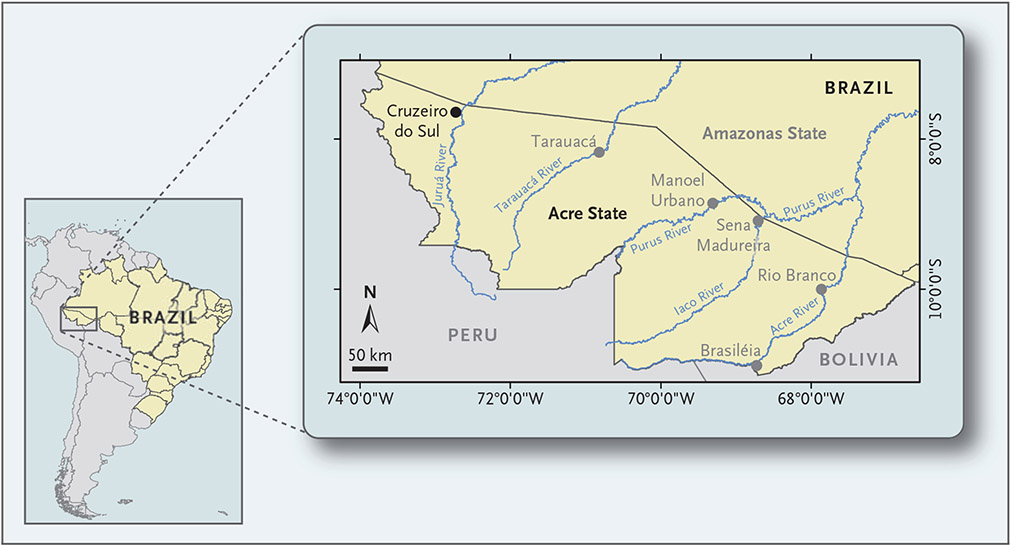
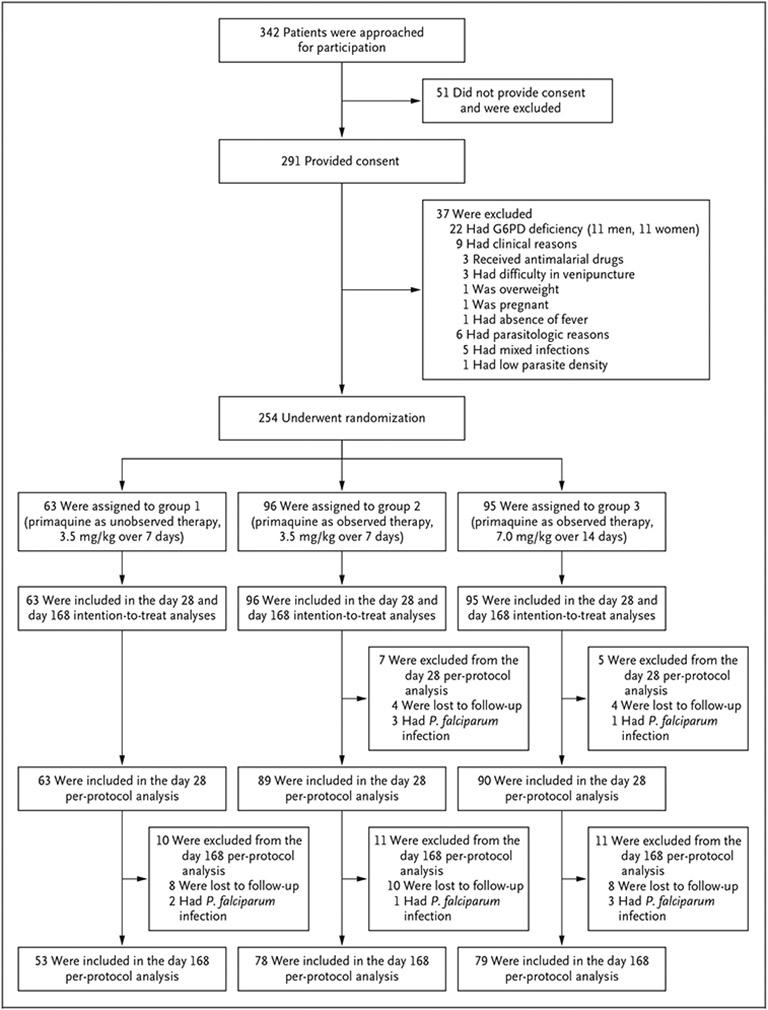
Methods: In this trial conducted in Brazil, we evaluated three primaquine regimens to prevent relapse of P. vivax malaria in children at least 5 years of age and in adults with microscopy-confirmed P. vivax monoinfection. All the patients received directly observed chloroquine for 3 days (total dose, 25 mg per kilogram). Group 1 received a total primaquine dose of 3.5 mg per kilogram (0.5 mg per kilogram per day) over 7 days with unobserved administration; group 2 received the same regimen as group 1 but with observed administration; and group 3 received a total primaquine dose of 7.0 mg per kilogram over 14 days (also 0.5 mg per kilogram per day) with observed administration. We monitored the patients for 168 days.
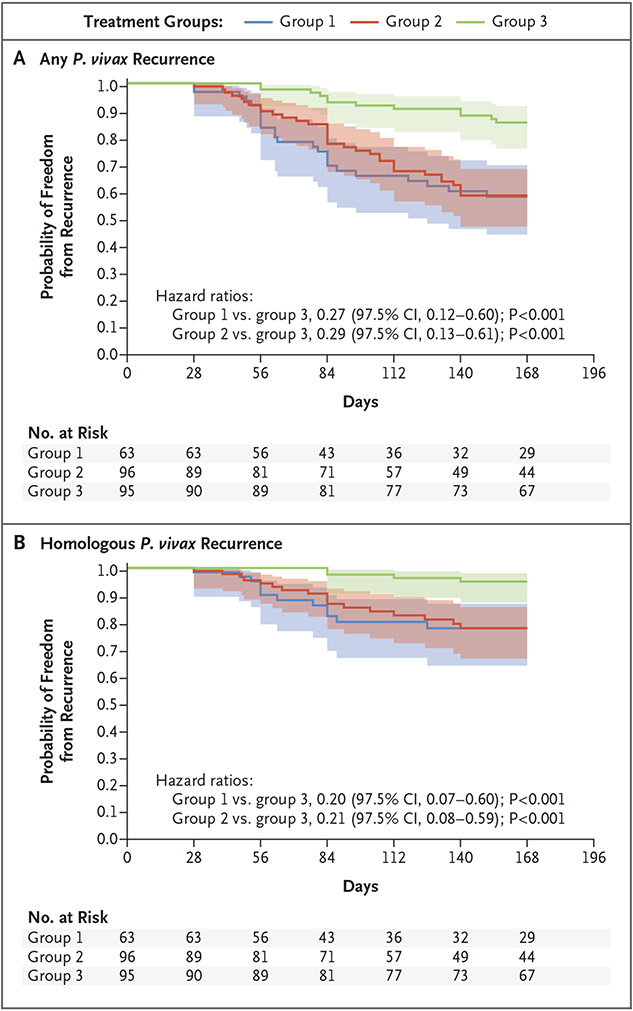
Results: We enrolled 63 patients in group 1, 96 in group 2, and 95 in group 3. The median age of the patients was 22.4 years (range, 5.4 to 79.8). By day 28, three P. vivax recurrences were observed: 2 in group 1 and 1 in group 2. By day 168, a total of 70 recurrences had occurred: 24 in group 1, 34 in group 2, and 12 in group 3. No serious adverse events were noted. On day 168, the percentage of patients without recurrence was 58% (95% confidence interval [CI], 44 to 70) in group 1, 59% (95% CI, 47 to 69) in group 2, and 86% (95% CI, 76 to 92) in group 3. Survival analysis showed a difference in the day 168 recurrence-free percentage of 27 percentage points (97.5% CI, 10 to 44; P<0.001) between group 1 and group 3 and a difference of 27 percentage points (97.5% CI, 12 to 42; P<0.001) between group 2 and group 3.
Conclusions: The administration of primaquine at a total dose of 7.0 mg per kilogram had higher efficacy in preventing relapse of P. vivax malaria than a total dose of 3.5 mg per kilogram through day 168. (Supported by the U.S. Agency for International Development; ClinicalTrials.gov number, NCT03610399.).
Copyright © 2022 Massachusetts Medical Society.
Figures
Comment in
-
Primaquine and Plasmodium vivax Malaria Recurrence in Brazil.N Engl J Med. 2022 Mar 31;386(13):1282-1283. doi: 10.1056/NEJMe2201725. N Engl J Med. 2022. PMID: 35353968 No abstract available.
-
Higher-Dose Primaquine to Prevent Relapse of Plasmodium vivax Malaria.N Engl J Med. 2022 Jul 21;387(3):282. doi: 10.1056/NEJMc2205922. N Engl J Med. 2022. PMID: 35857668 No abstract available.
-
Higher-Dose Primaquine to Prevent Relapse of Plasmodium vivax Malaria.N Engl J Med. 2022 Jul 21;387(3):282-283. doi: 10.1056/NEJMc2205922. N Engl J Med. 2022. PMID: 35857669 Free PMC article. No abstract available.
References
-
- Ministério da Saúde. Dados para o cidadão: Malária — Brasil, Sivep-malária e Sinan. (https://public.tableau.com/app/profile/mal.ria.brasil/viz/Dadosparacidad...). (In Portuguese.)
-
- Centers for Disease Control and Prevention. Malaria treatment (United States). November 2, 2020. (https://www.cdc.gov/Malaria/Diagnosis_Treatment/Treatment.Html).
-
- World Health Organization. Guidelines for the treatment of malaria, third edition. 2015. (https://www.afro.who.int/publications/guidelines-treatment-malaria-third...). - PubMed
-
- Hill DR, Baird JK, Parise ME, Lewis LS, Ryan ET, Magill AJ. Primaquine: report from CDC expert meeting on malaria chemoprophylaxis I. Am J Trop Med Hyg 2006;75:402–15. - PubMed
Publication types
MeSH terms
Substances
Associated data
Grants and funding
LinkOut - more resources
Full Text Sources
Medical