. 2021 Jul 15;22(4):1000-1009.
doi: 10.5811/westjem.2021.4.50884.

Emergency Absentee Voting for Hospitalized Patients and Voting During COVID-19: A 50-State Study

Affiliations

Emergency Absentee Voting for Hospitalized Patients and Voting During COVID-19: A 50-State Study

Oliver Y Tang et al. West J Emerg Med. .

Abstract

Introduction: Voters facing illness or disability are disproportionately under-represented in terms of voter turnout. Earlier research has indicated that enfranchisement of these populations may reinforce the implementation of policies improving health outcomes and equity. Due to the confluence of the coronavirus 2019 (COVID-19) pandemic and the 2020 election, we aimed to assess emergency absentee voting processes, which allow voters hospitalized after regular absentee deadlines to still obtain an absentee ballot, and election changes due to COVID-19 in all 50 states.

Methods: We performed a cross-sectional study collecting 34 variables pertaining to emergency voting processes and COVID-19-related election changes, including deadlines, methods of submission for applications and ballots, and specialized services for patients. Data were obtained from, in order of priority, state boards of elections websites, poll worker manuals, application forms, and state legislation. We verified all data through direct correspondence with state boards of elections.

Results: Emergency absentee voting processes are in place in 39 states, with the remaining states having universal vote-by-mail (n = 5) or extended regular absentee voting deadlines (n = 6). The emergency absentee period most commonly began within 24 hours following the normal absentee application deadline, which was often seven days before an election (n = 11). Unique aspects of emergency voting processes included patients designating an "authorized agent" to deliver their applications and ballots (n = 38), electronic ballot delivery (n = 5), and in-person teams that deliver ballots directly to patients (n = 18). Documented barriers in these processes nationwide include unavailable online information (n = 11), restrictions mandating agents to be family members (n = 7), physician affidavits or signatures (n = 9), and notary or witness signature requirements (n = 15). For the November 2020 presidential election, 12 states expanded absentee eligibility to allow COVID-19 as a reason to request an absentee ballot, and 18 states mailed absentee ballot applications or absentee ballots to all registered voters.

Conclusion: While 39 states operate emergency absentee voting processes for hospitalized voters, there are considerable areas for improvement and heterogeneity in guidelines for these protocols. For future election cycles, information on emergency voting and broader election reforms due to COVID-19 may be useful for emergency providers and patients alike to improve the democratic participation of voters experiencing illness.


Conflict of interest statement

Conflicts of Interest: By the WestJEM article submission agreement, all authors are required to disclose all affiliations, funding sources and financial or management relationships that could be perceived as potential sources of bias. No author has professional or financial relationships with any companies that are relevant to this study. There are no conflicts of interest or sources of funding to declare.

Figures

Figure 1
Figure 1
Nationwide map of state absentee voting practices. A. Nationwide distribution of absentee voting categories (universal vote-by-mail, no-excuse absentee voting, or absentee voting requiring an excuse). B. States with emergency absentee voting processes. C. States with absentee voting processes also applying to family members of hospitalized patients. D. States with absentee voting processes also applying to healthcare workers. E. States incorporating the use of an authorized agent for the voter. F. States using in-person ballot delivery teams.
Figure 2
Figure 2
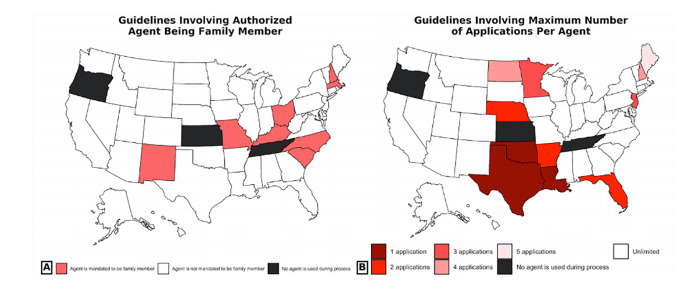
Statewide rules for voter’s authorized agent. A. Rules concerning whether a voter’s authorized agent is mandated to be a family member. B. Rules concerning the maximum number of applications or ballots that a single agent can handle during an election. aThis regulation may vary county by county within the state. bIn Florida, the maximum limit of two applications per agent does not include immediate family members of the agent.
Figure 3
Figure 3
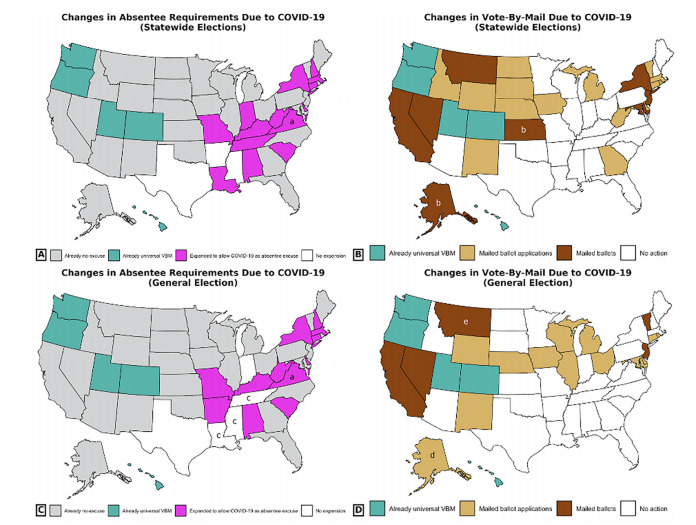
Nationwide map of election process changes due to COVID-19. A. Expansion of absentee voting eligibility during state-level elections before November 2020. B. Expansion of mail-in ballots and application during state-level elections before November. C: Expansion of absentee voting eligibility for the November general election. D: Expansion of mail-in ballots and applications for the November general election. a Virginia was already deliberating legislation to make absentee voting no-excuse before the COVID-19 pandemic, with an anticipated start date of July 1, 2020, but the state implemented this change earlier for its May municipal elections. b These changes only applied to a presidential primary for a specific party and were not made by the state government. c While absentee voting was not expanded to no-excuse in Louisiana, Tennessee, and Mississippi, these three states introduced absentee eligibility for voters under quarantine, serving as caretakers for others under quarantine, or belonging to a high-risk group for COVID-19. d Absentee ballot applications were only mailed to voters above the age of 65. e Montana allowed individual counties to make the choice to mail voters absentee ballots. VBM, vote-by-mail.

Similar articles

References

    1. Blakely TA, Kennedy BP, Kawachi I. Socioeconomic inequality in voting participation and self-rated health. Am J Public Health. 2001;91(1):99–104. - PMC - PubMed
    1. Brown CL, Raza D, Pinto AD. Voting, health and interventions in healthcare settings: a scoping review. Public Health Rev. 2020;41:16. - PMC - PubMed
    1. Burden BC, Fletcher JM, Herd P, et al. How different forms of health matter to political participation. J Polit. 2017;79(1):166–78. - PMC - PubMed
    1. Rodriguez JM, Geronimus AT, Bound J, et al. Black lives matter: differential mortality and the racial composition of the U.S. electorate, 1970–2004. Soc Sci Med. 2015;136–7:193–9. - PMC - PubMed
    1. Ard K, Colen C, Becerra M, et al. Two mechanisms: the role of social capital and industrial pollution exposure in explaining racial disparities in self-rated health. Int J Environ Res Public Health. 2016;13(10):1025. - PMC - PubMed