


Geotemporospatial and causal inferential epidemiological overview and survey of USA cannabis, cannabidiol and cannabinoid genotoxicity expressed in cancer incidence 2003-2017: part 3 - spatiotemporal, multivariable and causal inferential pathfinding and exploratory analyses of prostate and ovarian cancers
- PMID: 35354499
- PMCID: PMC8969240
- DOI: 10.1186/s13690-022-00813-6
Geotemporospatial and causal inferential epidemiological overview and survey of USA cannabis, cannabidiol and cannabinoid genotoxicity expressed in cancer incidence 2003-2017: part 3 - spatiotemporal, multivariable and causal inferential pathfinding and exploratory analyses of prostate and ovarian cancers
Abstract
Background: The epidemiology of cannabinoid-related cancerogenesis has not been studied with cutting edge epidemiological techniques. Building on earlier bivariate papers in this series we aimed to conduct pathfinding studies to address this gap in two tumours of the reproductive tract, prostate and ovarian cancer.
Methods: Age-standardized cancer incidence data for 28 tumour types (including "All (non-skin) Cancer") was sourced from Centres for Disease Control and National Cancer Institute using SEER*Stat software across US states 2001-2017. Drug exposure was sourced from the nationally representative household survey National Survey of Drug Use and Health conducted annually by the Substance Abuse and Mental Health Services Administration 2003-2017 with response rate 74.1%. Federal seizure data provided cannabinoid concentration data. US Census Bureau provided income and ethnicity data. Inverse probability weighted mixed effects, robust and panel regression together with geospatiotemporal regression analyses were conducted in R. E-Values were also calculated.
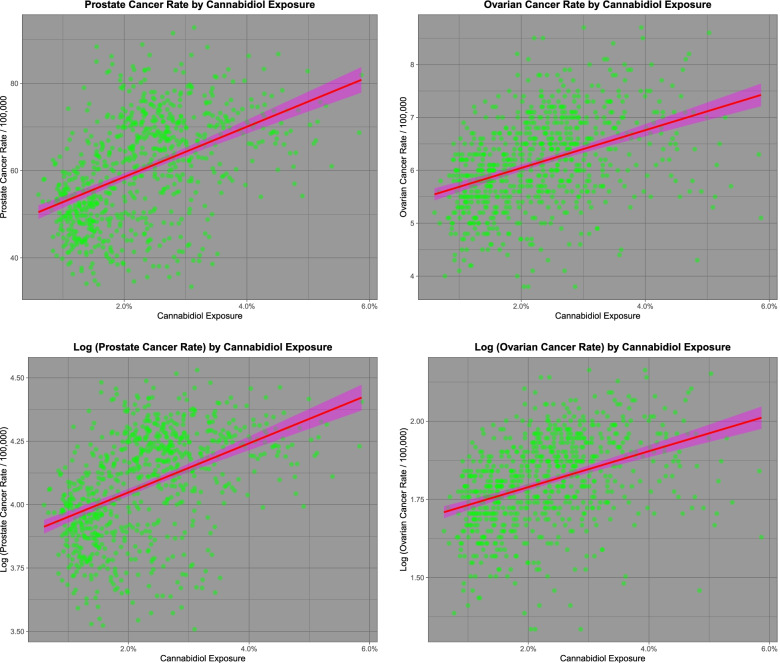
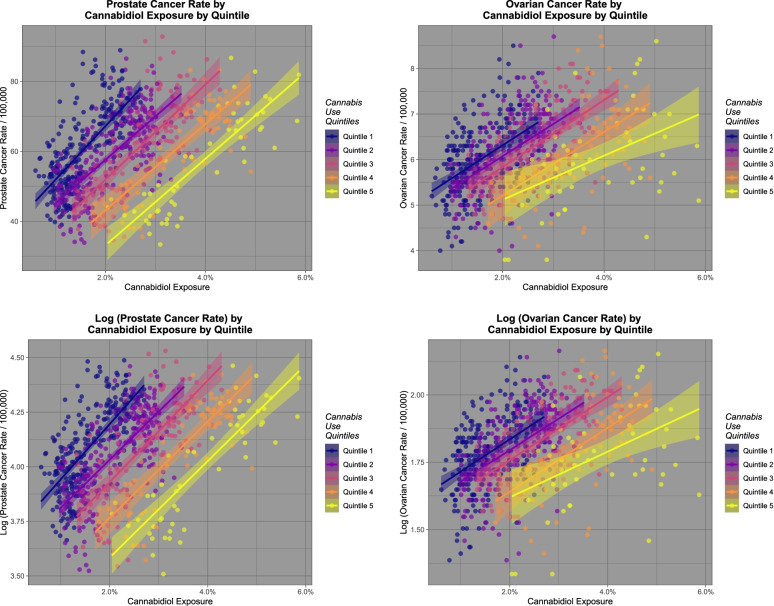
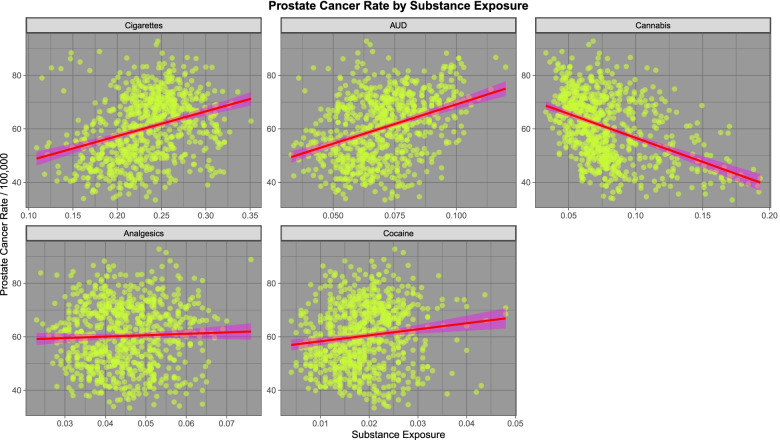
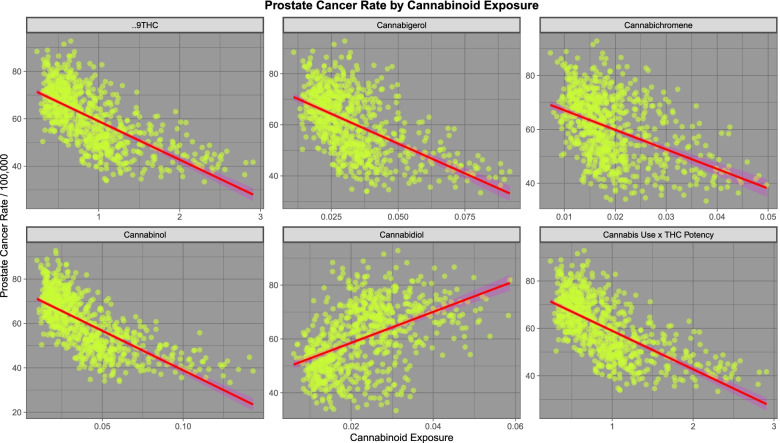
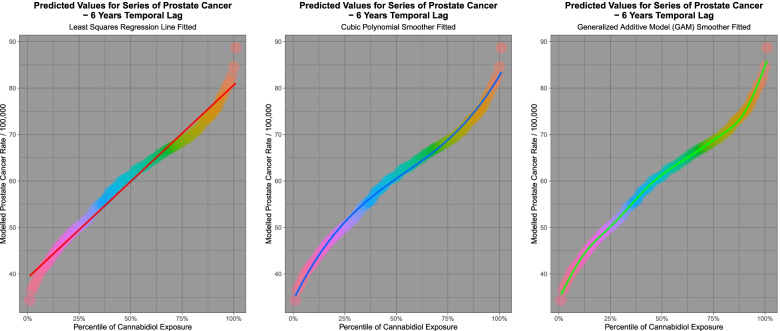
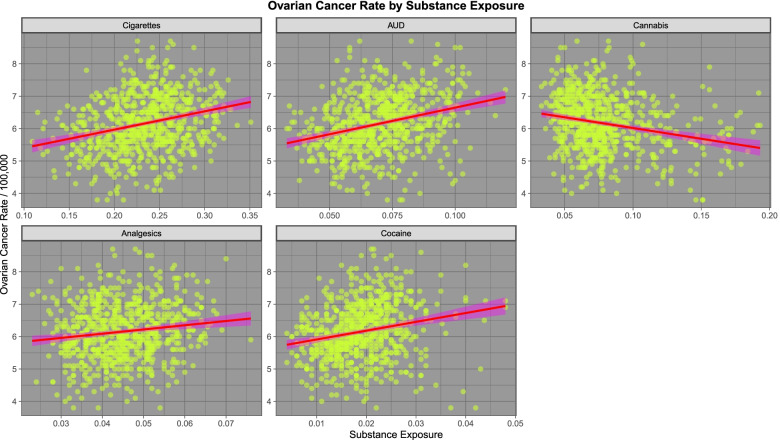
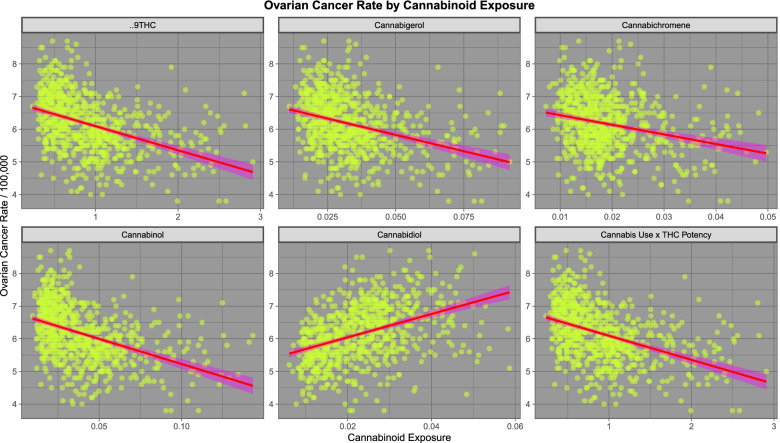
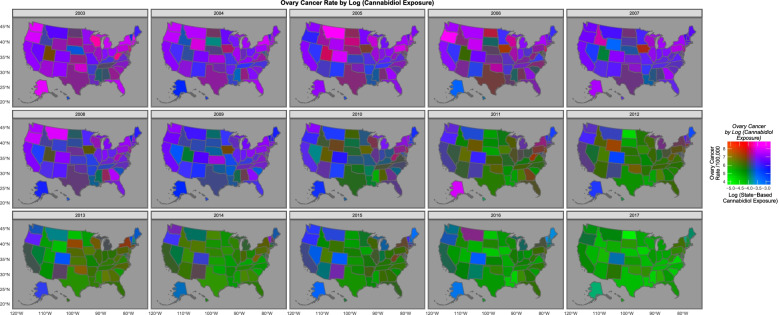
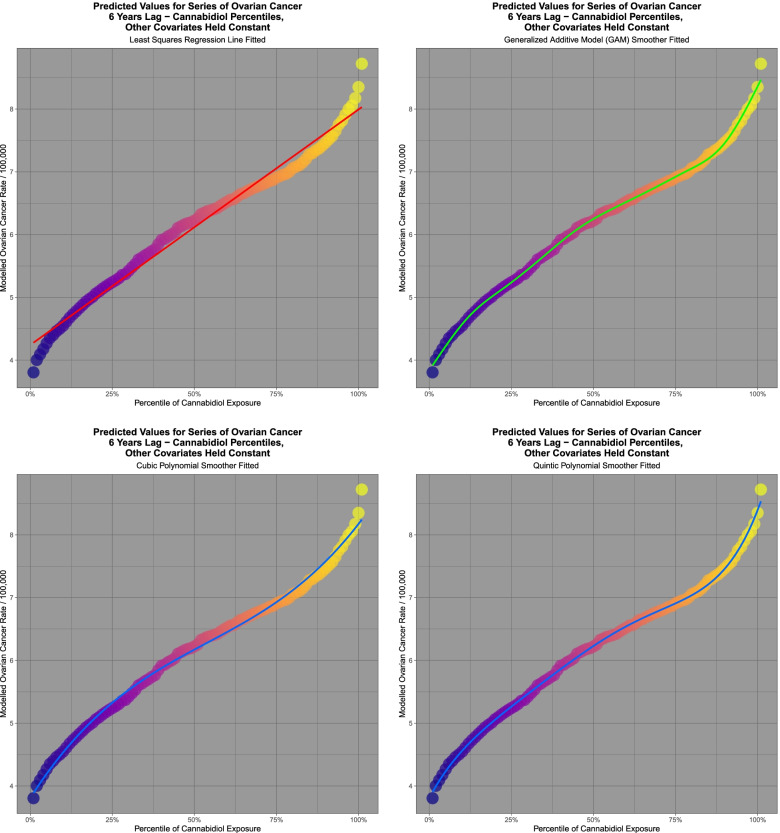
Results: 19,877 age-standardized cancer rates were returned. Based on these rates and state populations this equated to 51,623,922 cancer cases over an aggregated population 2003-2017 of 124,896,418,350. Inverse probability weighted regressions for prostate and ovarian cancers confirmed causal associations robust to adjustment. Cannabidiol alone was significantly associated with prostate cancer (β-estimate = 1.61, (95%C.I. 0.99, 2.23), P = 3.75 × 10- 7). In a fully adjusted geospatiotemporal model at one spatial and two temporal years lags cannabidiol was significantly independently associated with prostate cancer (β-estimate = 2.08, (1.19, 2.98), P = 5.20 × 10- 6). Cannabidiol alone was positively associated with ovarian cancer incidence in a geospatiotemporal model (β-estimate = 0.36, (0.30, 0.42), P < 2.20 × 10- 16). The cigarette: THC: cannabidiol interaction was significant in a fully adjusted geospatiotemporal model at six years of temporal lag (β-estimate = 1.93, (1.07, 2.78), P = 9.96 × 10- 6). Minimal modelled polynomial E-Values for prostate and ovarian cancer ranged up to 5.59 × 1059 and 1.92 × 10125. Geotemporospatial modelling of these tumours showed that the cannabidiol-carcinogenesis relationship was supra-linear and highly sigmoidal (P = 1.25 × 10- 45 and 12.82 × 10- 52 for linear v. polynomial models).
Conclusion: Cannabinoids including THC and cannabidiol are therefore important community carcinogens additive to the effects of tobacco and greatly exceeding those of alcohol. Reproductive tract carcinogenesis necessarily implies genotoxicity and epigenotoxicity of the germ line with transgenerational potential. Pseudoexponential and causal dose-response power functions are demonstrated.
Keywords: Cannabidiol; Cannabigerol; Cannabinoid; Cannabis; Chromosomal toxicity; Congenital anomalies; Dose-response relationship; Epigenotoxicity; Genotoxicity; Mechanisms; Multigenerational genotoxicity; Oncogenesis; Sigmoidal dose-response; Supra-linear dose response; Transgenerational teratogenicity; Δ9-tetrahydrocannabinol.
© 2022. The Author(s).
Conflict of interest statement
The authors declare that they have no competing interests.
Figures
References
-
- Zhang ZF, Morgenstern H, Spitz MR, Tashkin DP, Yu GP, Marshall JR, Hsu TC, Schantz SP. Marijuana use and increased risk of squamous cell carcinoma of the head and neck. Cancer Epidemiol Biomark Prev. 1999;8(12):1071–1078. - PubMed
-
- Hashibe M, Ford DE, Zhang ZF. Marijuana smoking and head and neck cancer. J Clin Pharmacol. 2002;42(11 Suppl):103S–107S. - PubMed
-
- Voirin N, Berthiller J, Benhaim-Luzon V, Boniol M, Straif K, Ayoub WB, Ayed FB, Sasco AJ. Risk of lung cancer and past use of cannabis in Tunisia. J Thorac Oncol. 2006;1(6):577–579. - PubMed
LinkOut - more resources
Full Text Sources
Miscellaneous
