. 2022 Mar 30:376:e069008.
doi: 10.1136/bmj-2021-069008.

Association of computed tomography screening with lung cancer stage shift and survival in the United States: quasi-experimental study

Affiliations

Association of computed tomography screening with lung cancer stage shift and survival in the United States: quasi-experimental study

Alexandra L Potter et al. BMJ. .

Abstract

Objective: To determine the effect of the introduction of low dose computed tomography screening in 2013 on lung cancer stage shift, survival, and disparities in the stage of lung cancer diagnosed in the United States.

Design: Quasi-experimental study using Joinpoint modeling, multivariable ordinal logistic regression, and multivariable Cox proportional hazards modeling.

Setting: US National Cancer Database and Surveillance Epidemiology End Results program database.

Participants: Patients aged 45-80 years diagnosed as having non-small cell lung cancer (NSCLC) between 1 January 2010 and 31 December 2018.

Main outcome measures: Annual per cent change in percentage of stage I NSCLC diagnosed among patients aged 45-54 (ineligible for screening) and 55-80 (potentially eligible for screening), median all cause survival, and incidence of NSCLC; multivariable adjusted odds ratios for year-to-year changes in likelihood of having earlier stages of disease at diagnosis and multivariable adjusted hazard ratios for changes in hazard of death before versus after introduction of screening.

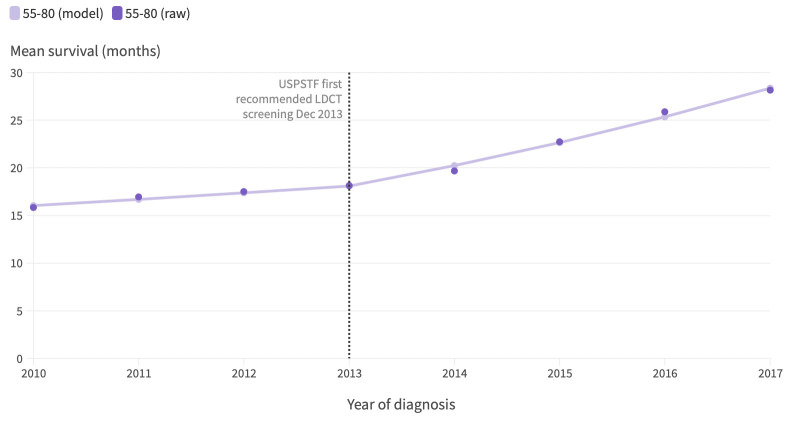
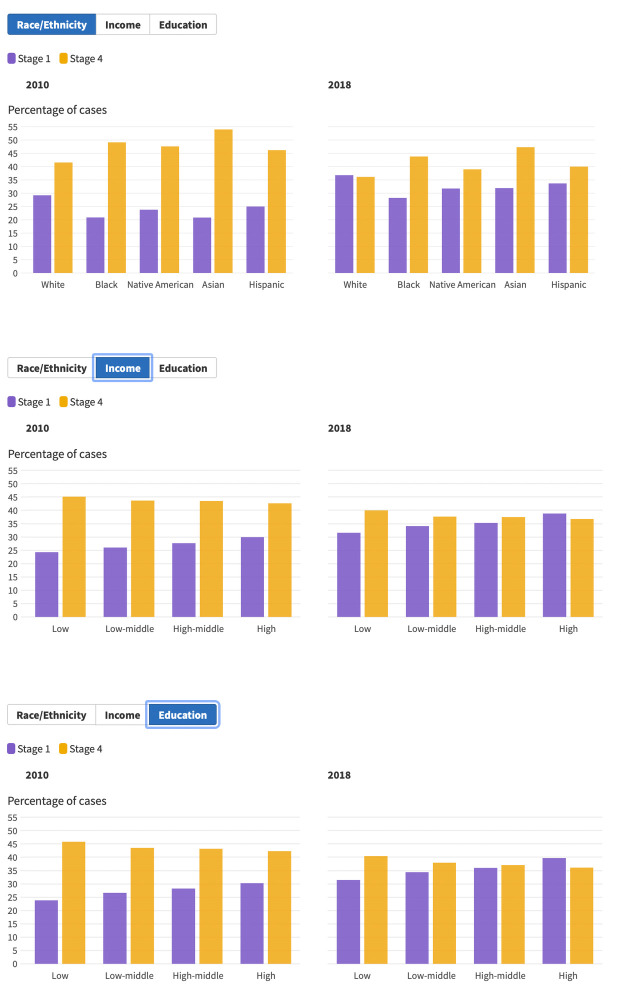
Results: The percentage of stage I NSCLC diagnosed among patients aged 55-80 did not significantly increase from 2010 to 2013 (from 27.8% to 29.4%) and then increased at 3.9% (95% confidence interval 3.0% to 4.8%) per year from 2014 to 2018 (from 30.2% to 35.5%). In multivariable adjusted analysis, the increase in the odds per year of a patient having one lung cancer stage lower at diagnosis during the time period from 2014 to 2018 was 6.2% (multivariable adjusted odds ratio 1.062, 95% confidence interval 1.048 to 1.077; P<0.001) higher than the increase in the odds per year from 2010 to 2013. Similarly, the median all cause survival of patients aged 55-80 did not significantly increase from 2010 to 2013 (from 15.8 to 18.1 months), and then increased at 11.9% (8.9% to 15.0%) per year from 2014 to 2018 (from 19.7 to 28.2 months). In multivariable adjusted analysis, the hazard of death decreased significantly faster after 2014 compared with before 2014 (P<0.001). By 2018, stage I NSCLC was the predominant diagnosis among non-Hispanic white people and people living in the highest income or best educated regions. Non-white people and those living in lower income or less educated regions remained more likely to have stage IV disease at diagnosis. Increases in the detection of early stage disease in the US from 2014 to 2018 led to an estimated 10 100 averted deaths.

Conclusions: A recent stage shift toward stage I NSCLC coincides with improved survival and the introduction of lung cancer screening. Non-white patients and those living in areas of greater deprivation had lower rates of stage I disease identified, highlighting the need for efforts to increase access to screening in the US.


Conflict of interest statement

Competing interests: All authors have completed the ICMJE uniform disclosure form at www.icmje.org/disclosure-of-interest/ and declare: no support from any organization for the submitted work; no financial relationships with any organizations that might have an interest in the submitted work in the previous three years; ALP, ALR, and CJY have leadership roles in the American Lung Cancer Screening Initiative.

Figures
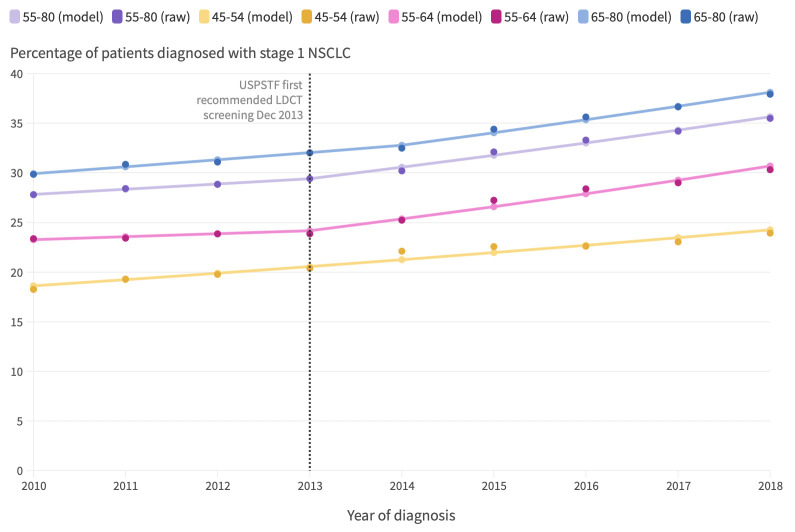
Fig 1
Fig 1
Trends in percentage of patients aged 55-80 and aged 45-54, 55-64, and 65-80 in National Cancer Database with stage I non-small cell lung cancer at diagnosis from 2010 to 2018. Each consecutive annual interval is represented as a point value. Vertical dotted line represents date when United States Preventive Services Task Force (USPSTF) first recommended low dose computed tomography (LDCT) lung cancer screening. Annual percentage changes: 55-80 (2010-13): 1.9%, P=0.06; 55-80 (2013-18): 3.9%, P<0.001; 45-54 (2010-18): 3.4%, P<0.001; 55-64 (2010-13): 1.3%, P=0.30; 55-64 (2013-18): 4.9%, P=0.001; 65-80 (2010-14): 2.3%, P=0.001; 65-80 (2014-18): 3.8%, P<0.001. “Raw” denotes actual percentage of patients with stage I disease at diagnosis each year. “Model” denotes results of joinpoint regression modeling. An interactive version of this graphic is available at https://public.flourish.studio/visualisation/8864567/
Fig 2
Fig 2
Trends in median all cause survival of patients aged 55-80 in National Cancer Database diagnosed as having stage I-IV non-small cell lung cancer from 2010 to 2018. Each consecutive annual interval is represented as a point value. Vertical dotted line represents date when United States Preventive Services Task Force (USPSTF) first recommended low dose computed tomography (LDCT) lung cancer screening. Annual percentage changes: 55-80 (2010-13): 4.1%, P=0.06; 55-80 (2013-17): 11.9%, P=0.001. “Raw” denotes actual median all cause survival of patients each year. “Model” denotes results of joinpoint regression modeling. An interactive version of this graphic is available at https://public.flourish.studio/visualisation/8876375/
Fig 3
Fig 3
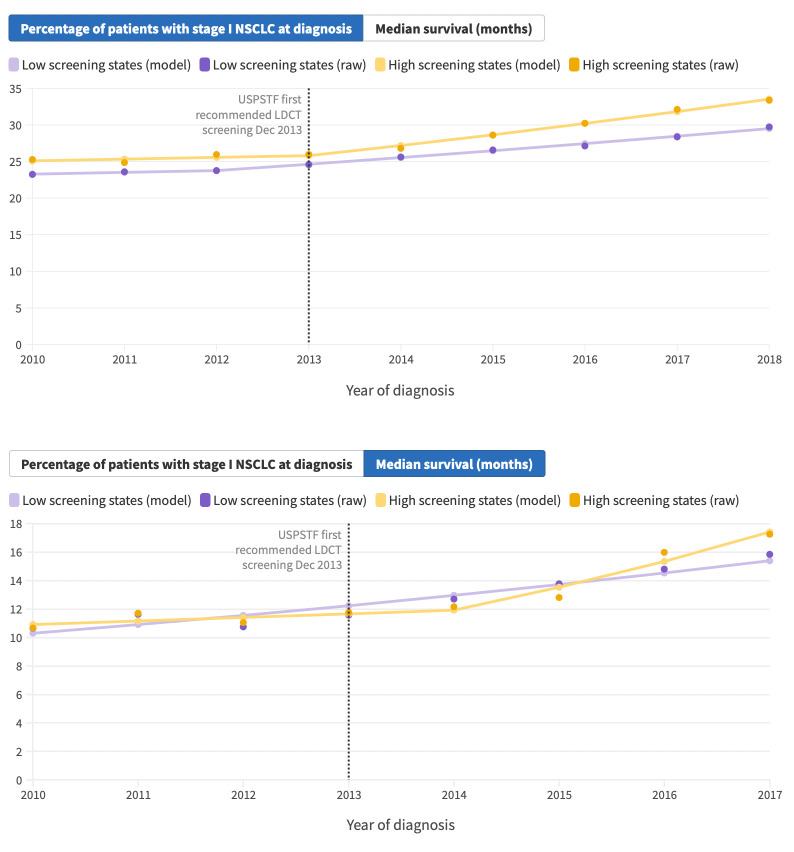
Trends from 2010 to 2018 in percentage of stage I non-small cell lung cancer diagnosed (top) and in median all cause survival (bottom) among patients aged 55-79 in Surveillance Epidemiology End Results Program database living in high screening (US states where lung cancer screening rate is above national average lung cancer screening rate in 2018) and low screening (US states where lung cancer screening rate is below national average lung cancer screening rate in 2018) states. Each consecutive annual interval is represented as a point value. Vertical dotted line represents date when United States Preventive Services Task Force (USPSTF) first recommended low dose computed tomography (LDCT) lung cancer screening. Annual percentage changes were as follows. Low screen, percentage diagnosed 2010-12: 1.0%, P=0.40; 2012-18: 3.7%, P<0.001. High screen, percentage diagnosed 2010-13: 0.9%, P=0.41; 2013-18: 5.4%, P<0.001. Low screen, median survival 2010-17: 5.9%, P<0.001. High screen, median survival 2010-14: 2.2%, P=0.39; 2014-17: 13.4%, P=0.04. “Raw” denotes actual percentage of patients with stage I disease at diagnosis and median all cause survival of patients each year. “Model” denotes results of joinpoint regression modeling. An interactive version of this graphic is available at https://public.flourish.studio/visualisation/8876566/
Fig 4
Fig 4
Percentage of cases of non-small cell lung cancer (NSCLC) diagnosed in National Cancer Database at stage I and stage IV in 2010 versus 2018 by patient’s race/ethnicity, median income of people living in patient’s area of residence, and percentage of people with no high school education living in patient’s area of residence (see supplementary methods for details). Purple bars represent percentage of NSCLC cases diagnosed at stage I. Yellow bars represent percentage of NSCLC cases diagnosed at stage IV. Median income is grouped into low income (<$40 227), middle-low income ($40 227-50 353), middle-high income ($50 354-63 332), and high income (>$63 332). Percentage of people with no high school education living in patient’s area of residence is grouped into low education (≥17.6%), middle-low education (10.9-17.5%), middle-high education (6.3-10.8%), and high education (<6.3%). An interactive version of this graphic is available at https://public.flourish.studio/visualisation/8877224/
Fig 5
Fig 5
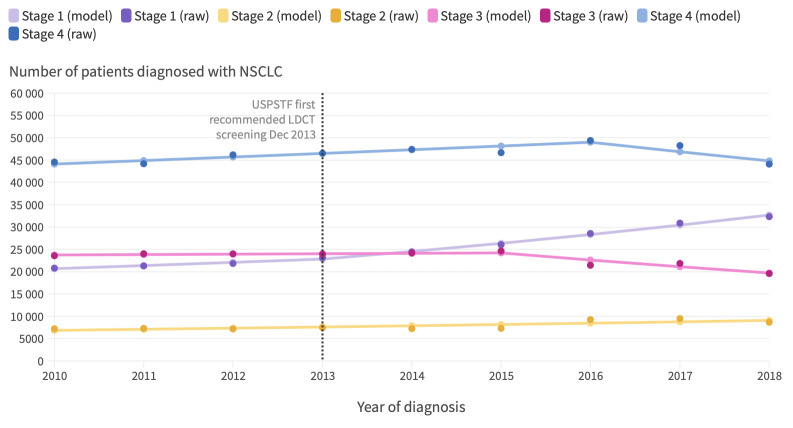
Trends in number of lung cancer cases diagnosed in US among people aged 55-79 from 2010 to 2018 by stage group. Incident lung cancer cases in Surveillance Epidemiology End Results (SEER) Program database were multiplied by 3.57 to obtain total number of lung cancers diagnosed among people aged 55-79 in US by stage group. This estimate assumes that 28% sample of US population included in SEER Program database is unbiased and representative. Each consecutive annual interval is represented as a point value. Vertical dotted line represents date when United States Preventive Services Task Force (USPSTF) first recommended low dose computed tomography (LDCT) lung cancer screening. Annual percentage changes: stage 1 (2010-13): 3.4%, P=0.03; stage 1 (2013-18): 7.4%, P<0.001; stage 2 (2010-18): 3.6%, P=0.009; stage 3 (2010-15): 0.4%, P=0.65; stage 3 (2015-18): –6.6%, P=0.03; stage 4 (2010-16): 1.8%, P=0.01; stage 4 (2016-18): –4.4%, P=0.11. “Raw” denotes actual number of lung cancers by stage group diagnosed each year. “Model” denotes results of joinpoint regression modeling. An interactive version of this graphic is available at https://public.flourish.studio/visualisation/8876872/

Comment in

References

    1. Borghaei H, Paz-Ares L, Horn L, et al. Nivolumab versus Docetaxel in Advanced Nonsquamous Non-Small-Cell Lung Cancer. N Engl J Med 2015;373:1627-39. 10.1056/NEJMoa1507643 - DOI - PMC - PubMed
    1. Howlader N, Forjaz G, Mooradian MJ, et al. The Effect of Advances in Lung-Cancer Treatment on Population Mortality. N Engl J Med 2020;383:640-9. 10.1056/NEJMoa1916623 - DOI - PMC - PubMed
    1. Aberle DR, Adams AM, Berg CD, et al. National Lung Screening Trial Research Team . Reduced lung-cancer mortality with low-dose computed tomographic screening. N Engl J Med 2011;365:395-409. 10.1056/NEJMoa1102873 - DOI - PMC - PubMed
    1. de Koning HJ, van der Aalst CM, de Jong PA, et al. Reduced Lung-Cancer Mortality with Volume CT Screening in a Randomized Trial. N Engl J Med 2020;382:503-13. 10.1056/NEJMoa1911793 - DOI - PubMed
    1. US Preventive Services Task Force. Lung Cancer: Screening. 2021. https://www.uspreventiveservicestaskforce.org/uspstf/recommendation/lung....