Observational Study
. 2022 Mar;10(3):e004421.
doi: 10.1136/jitc-2021-004421.

Mortality after acute kidney injury and acute interstitial nephritis in patients prescribed immune checkpoint inhibitor therapy

Affiliations
Observational Study

Mortality after acute kidney injury and acute interstitial nephritis in patients prescribed immune checkpoint inhibitor therapy

Megan L Baker et al. J Immunother Cancer. 2022 Mar.

Abstract

Background: In patients receiving immune checkpoint inhibitor (ICI) therapy, acute kidney injury (AKI) is common, and can occur either from kidney injury unrelated to ICI use or from immune activation resulting in acute interstitial nephritis (AIN). In this study, we test the hypothesis that occurrence of AIN indicates a favorable treatment response to ICI therapy and therefore among patients who develop AKI while on ICI therapy, those with AIN will demonstrate greater survival compared with others with AKI.

Methods: In this observational cohort study, we included participants initiated on ICI therapy between 2013 and 2019. We tested the independent association of AKI and estimated AIN (eAIN) with mortality up to 1 year after therapy initiation as compared with those without AKI using time-varying Cox proportional hazard models controlling for demographics, comorbidities, cancer type, stage, and therapy, and baseline laboratory values. We defined eAIN as those with a predicted probability of AIN >90th percentile derived from a recently validated diagnostic model.

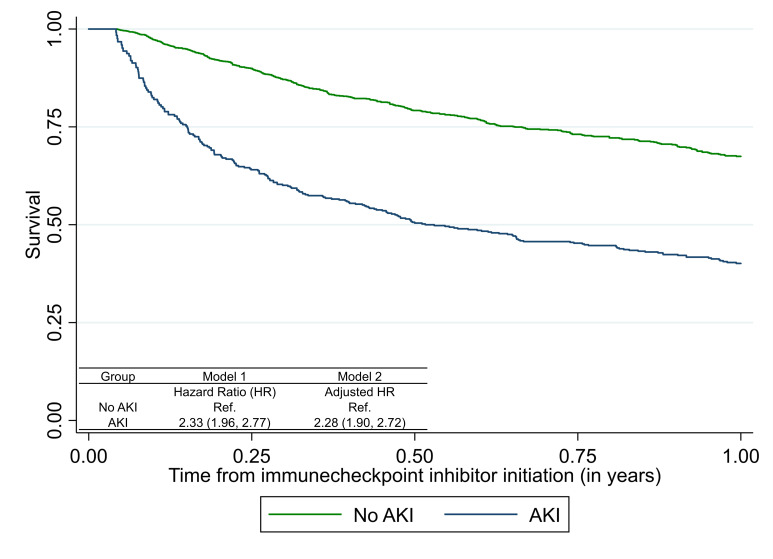
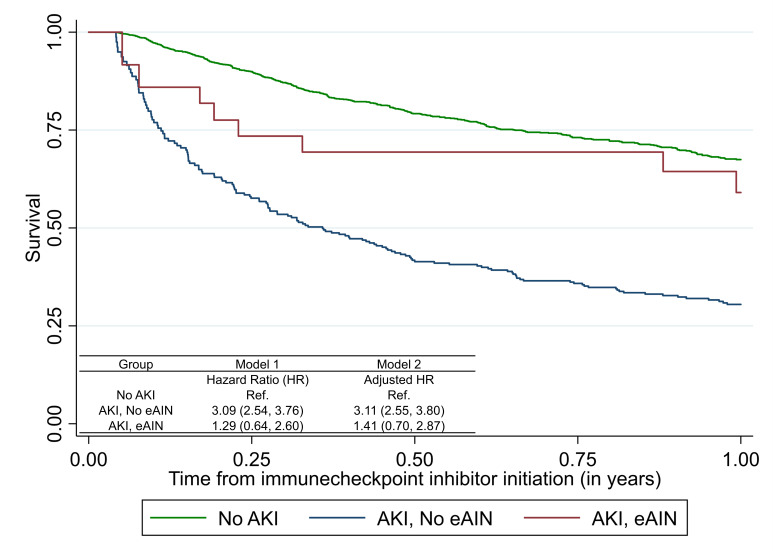
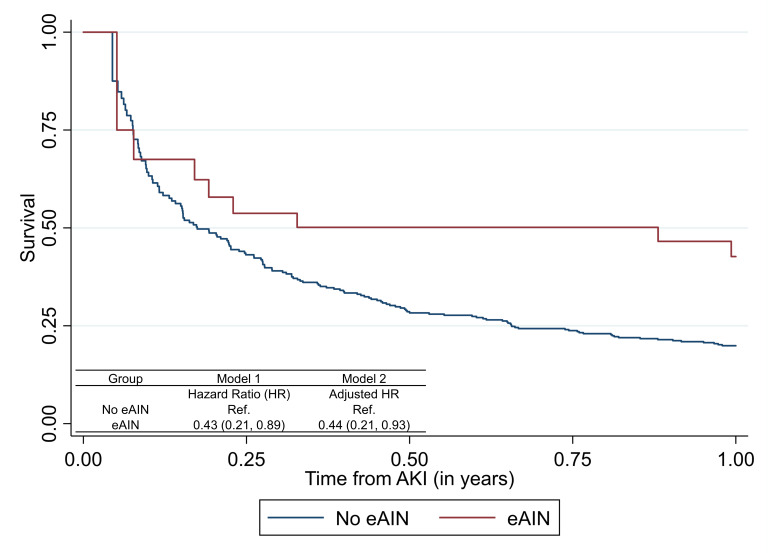
Results: Of 2207 patients initiated on ICIs, 617 (28%) died at 1 year and 549 (25%) developed AKI. AKI was independently associated with higher mortality (adjusted HR, 2.28 (95% CI 1.90 to 2.72)). Those AKI patients with eAIN had more severe AKI as reflected by a higher peak serum creatinine (3.3 (IQR 2.1-6.1) vs 1.4 (1.2-1.9) mg/dL, p<0.001) but exhibited lower mortality than those without eAIN in univariable analysis (HR 0.43 (95% CI 0.21 to 0.89)) and after adjusting for demographics, comorbidities, and cancer type and severity (adjusted HR 0.44 (95% CI 0.21 to 0.93)).

Conclusion: In patients treated with ICI, mortality was higher in those with AKI unrelated to ICI but lower in those where the underlying etiology was AIN. Future studies could evaluate the association of biopsy-proven or biomarker-proven AIN with mortality in those receiving ICI therapy.

Keywords: Biostatistics; Immunotherapy, Active; Translational Medical Research.


Conflict of interest statement

Competing interests: DGM and CRP are coinventors of the pending patent application 'Methods and Systems for Diagnosis of Acute Interstitial Nephritis' that is subject to an option for a license agreement with Renalytix AI.

Figures
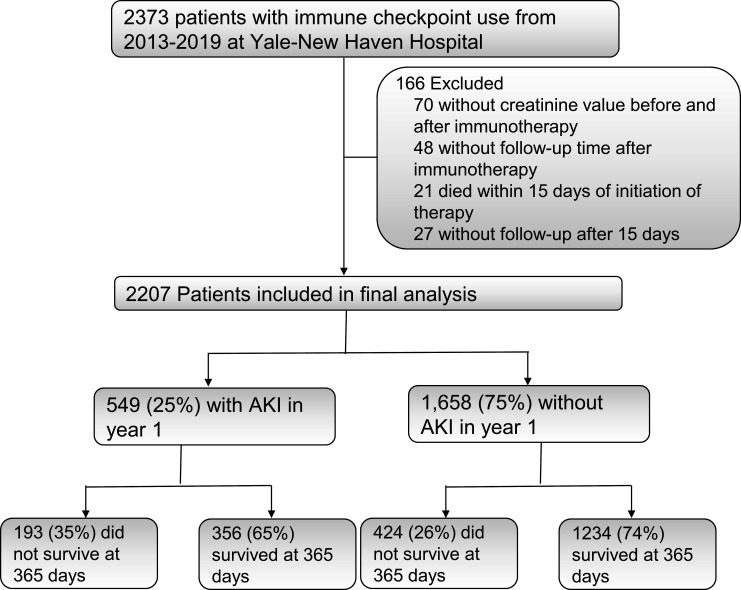
Figure 1
Figure 1
STARD flow diagram. Survival assessed up to 1 year after initiation of immune checkpoint inhibitor therapy. AKI, acute kidney injury.
Figure 2
Figure 2
Association of acute kidney injury (AKI) with mortality after immune checkpoint inhibitor therapy. Association of AKI with mortality in all participants initiated on immune checkpoint inhibitor (ICI) therapy using time-varying Cox proportional hazards models where exposure (AKI) was treated as a time-varying covariate updated once if it occurred and patient considered as exposed for the remainder of the analysis period. Follow-up starts 15 days after initiation of immune checkpoint inhibitor therapy for both analyses. Model 1 tests univariable association of AKI with mortality; model 2 controls for age, sex, race, ethnicity, presence of comorbidities (CKD, CHF, COPD, cirrhosis, diabetes, Elixhauser Comorbidity Score), cancer type (lung, melanoma, other), metastasis, baseline creatinine, and time-updated administration of ICI. Extended Kaplan-Meier curve accounting for time-varying covariate. Mortality rate (per 1000 person-years): no AKI, 445 (404, 489); AKI, 905 (786, 1042); overall, 529 (489, 572). CHF, congestive heart failure; CKD, chronic kidney disease; COPD, chronic obstructive pulmonary disease.
Figure 3
Figure 3
Association of acute interstitial nephritis (AIN) with mortality after immune checkpoint inhibitor therapy. estimated AIN (eAIN) defined as those in the top 10% of AIN probability as determined by the diagnostic model. Model 1 tests univariable association of AKI or eAIN with mortality; model 2 controls for age, sex, race, ethnicity, presence of comorbidities (CKD, CHF, COPD, cirrhosis, diabetes, Elixhauser Comorbidity Score), cancer type (lung, melanoma, other), metastasis, and time-updated administration of immune checkpoint inhibitor (ICI). Association of estimated AIN with mortality in all participants initiated on ICI therapy using time-varying Cox proportional hazards models where exposure (presence or absence of AKI or eAIN) was treated as a time-varying covariate updated once if it occurred and patient considered as exposed for the remainder of the analysis period. Extended Kaplan-Meier curve accounting for time-varying covariate. Follow-up starts at 15 days after initiation of ICI therapy. Mortality rates (per 1000 person-years): no AKI, 498 (452,547); AKI without eAIN, 1487 (1250,1770); AKI with eAIN, 617 (308,1233). CHF, congestive heart failure; CKD, chronic kidney disease; COPD, chronic obstructive pulmonary disease.
Figure 4
Figure 4
Association of acute interstitial nephritis (AIN) with mortality after immune checkpoint inhibitor (ICI) therapy in those with acute kidney injury. estimated AIN (eAIN) defined as those in the top 10% of AIN probability as determined by the diagnostic model. Model 1 tests univariable association of eAIN with mortality; model 2 controls for age, sex, race, ethnicity, presence of comorbidities (CKD, CHF, COPD, cirrhosis, diabetes, Elixhauser Comorbidity Score), cancer type (lung, melanoma, other), metastasis, and time-updated administration of ICI. Follow-up starts at AKI diagnosis. Association of estimated AIN with mortality among those with AKI using time-varying Cox proportional hazards models where exposure (presence or absence of eAIN) was treated as a time-varying covariate updated once if it occurred and patient considered as exposed for the remainder of the analysis period. Extended Kaplan-Meier curve accounting for time-varying covariate. CHF, congestive heart failure; CKD, chronic kidney disease; COPD, chronic obstructive pulmonary disease.

References

    1. Das S, Johnson DB. Immune-related adverse events and anti-tumor efficacy of immune checkpoint inhibitors. J Immunother Cancer 2019;7:306. 10.1186/s40425-019-0805-8 - DOI - PMC - PubMed
    1. Herrmann SM, Perazella MA. Immune checkpoint inhibitors and immune-related adverse renal events. Kidney Int Rep 2020;5:1139–48. 10.1016/j.ekir.2020.04.018 - DOI - PMC - PubMed
    1. Ribas A, Wolchok JD. Cancer immunotherapy using checkpoint blockade. Science 2018;359:1350–5. 10.1126/science.aar4060 - DOI - PMC - PubMed
    1. Perazella MA, Shirali AC. Nephrotoxicity of cancer immunotherapies: past, present and future. J Am Soc Nephrol 2018;29:2039–52. 10.1681/ASN.2018050488 - DOI - PMC - PubMed
    1. Cortazar FB, Marrone KA, Troxell ML, et al. Clinicopathological features of acute kidney injury associated with immune checkpoint inhibitors. Kidney Int 2016;90:638–47. 10.1016/j.kint.2016.04.008 - DOI - PMC - PubMed

Publication types

MeSH terms

LinkOut - more resources