


Cumulative lifetime stressor exposure assessed by the STRAIN predicts economic ambiguity aversion
- PMID: 35354811
- PMCID: PMC8967930
- DOI: 10.1038/s41467-022-28530-2
Cumulative lifetime stressor exposure assessed by the STRAIN predicts economic ambiguity aversion
Erratum in
-
Author Correction: Cumulative lifetime stressor exposure assessed by the STRAIN predicts economic ambiguity aversion.Nat Commun. 2023 Jun 15;14(1):3558. doi: 10.1038/s41467-023-39380-x. Nat Commun. 2023. PMID: 37322231 Free PMC article. No abstract available.
Abstract
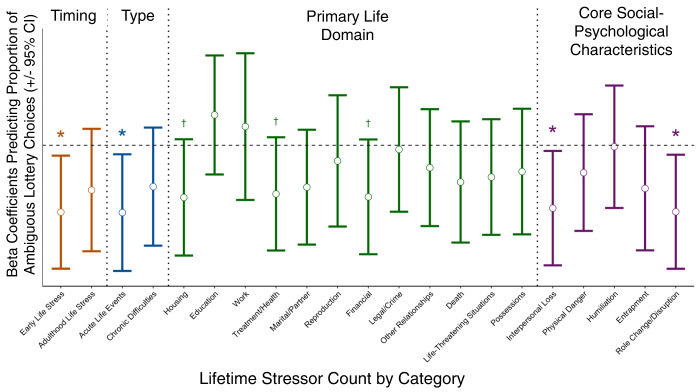
Uncertainty is inherent in most decisions humans make. Economists distinguish between two types of decision-making under non-certain conditions: those involving risk (i.e., known outcome probabilities) and those that involve ambiguity (i.e., unknown outcome probabilities). Prior research has identified individual differences that explain risk preferences, but little is known about factors associated with ambiguity aversion. Here, we hypothesized that cumulative exposure to major psychosocial stressors over the lifespan might be one factor that predicts individuals' ambiguity aversion. Across two studies (Study 1: n = 58, Mage = 25.7; Study 2: n = 188, Mage = 39.81), we used a comprehensive lifetime stressor exposure inventory (i.e., the Stress and Adversity Inventory for Adults, or STRAIN) and a standard economic approach to quantify risk and ambiguity preferences. Greater lifetime stressor exposure as measured by the STRAIN, particularly in early life, was associated with higher aversion to ambiguity but not risk preferences.
© 2022. The Author(s).
Conflict of interest statement
The authors declare no competing interests.
Figures
References
-
- Knight, F. H. Risk, Uncertainty, and Profit. (Boston MA: Hart, Schaffner and Marx; Houghton Mifflin, 1921).
-
- Ellsberg D. Risk, ambiguity, and the savage axioms. Q. J. Econ. 1961;75:643–669. doi: 10.2307/1884324. - DOI
-
- Rustichini A, Dickhaut J, Ghirardato P, Smith K, Pardo JV. A brain imaging study of the choice procedure. Games Econ. Behav. 2005;52:257–282. doi: 10.1016/j.geb.2004.08.005. - DOI
-
- Borghans L, Heckman JJ, Golsteyn BHH, Meijers H. Gender differences in risk aversion and ambiguity aversion. J. Eur. Econ. Assoc. 2009;7:649–658. doi: 10.1162/JEEA.2009.7.2-3.649. - DOI
Publication types
MeSH terms
Grants and funding
LinkOut - more resources
Full Text Sources
