


A risk scoring system to predict progression to severe pneumonia in patients with Covid-19
- PMID: 35354828
- PMCID: PMC8966605
- DOI: 10.1038/s41598-022-07610-9
A risk scoring system to predict progression to severe pneumonia in patients with Covid-19
Abstract
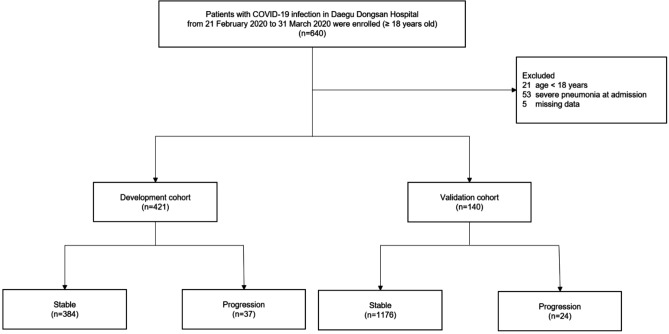
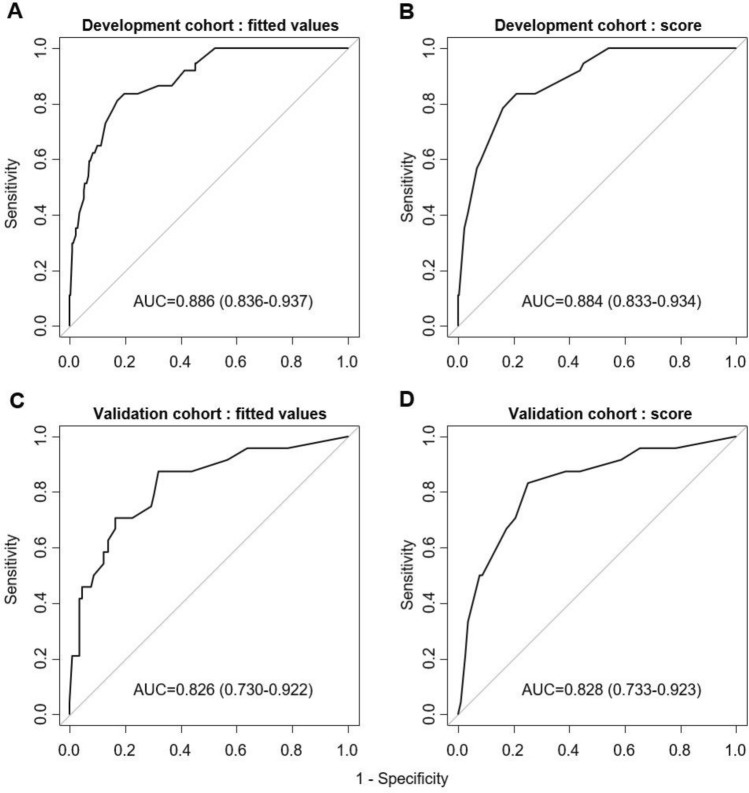
Rapid outbreak of coronavirus disease 2019 (Covid-19) raised major concern regarding medical resource constraints. We constructed and validated a scoring system for early prediction of progression to severe pneumonia in patients with Covid-19. A total of 561 patients from a Covid-19 designated hospital in Daegu, South Korea were randomly divided into two cohorts: development cohort (N = 421) and validation cohort (N = 140). We used multivariate logistic regression to identify four independent risk predictors for progression to severe pneumonia and constructed a risk scoring system by giving each factor a number of scores corresponding to its regression coefficient. We calculated risk scores for each patient and defined two groups: low risk (0 to 8 points) and high risk (9 to 20 points). In the development cohort, the sensitivity and specificity were 83.8% and 78.9%. In the validation cohort, the sensitivity and specificity were 70.8% and 79.3%, respectively. The C-statistics was 0.884 (95% CI 0.833-0.934) in the development cohort and 0.828 (95% CI 0.733-0.923) in the validation cohort. This risk scoring system is useful to identify high-risk group for progression to severe pneumonia in Covid-19 patients and can prevent unnecessary overuse of medical care in limited-resource settings.
© 2022. The Author(s).
Conflict of interest statement
The authors declare no competing interests.
Figures
References
-
- World Health Organization. WHO Director-General's Opening Remarks at the Media Briefing on COVID-19–11 March 2020. (WHO, 2020).
Publication types
MeSH terms
LinkOut - more resources
Full Text Sources
Medical
