


HER2-positive apocrine carcinoma of the breast: a population-based analysis of treatment and outcome
- PMID: 35355162
- PMCID: PMC9090698
- DOI: 10.1007/s10549-022-06578-4
HER2-positive apocrine carcinoma of the breast: a population-based analysis of treatment and outcome
Abstract
Purpose: Apocrine carcinoma of the breast (APO) expresses HER2 in 30-50% of cases. This study explored the clinicopathological features and outcome of HER2+/APO and matched HER2+/NST cohort.
Methods: We used the SEER database to explore the cohorts. Univariate and multivariate analyses were used to assess the survival. Based on ER and PR [steroid receptors/SR/] and HER2 status, we divided the cohorts to match the intrinsic molecular subtypes for comparisons.
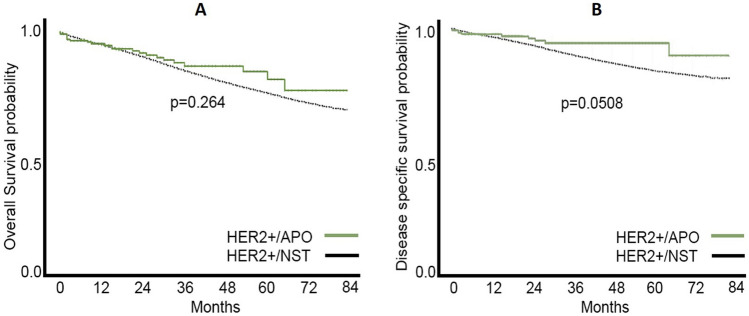
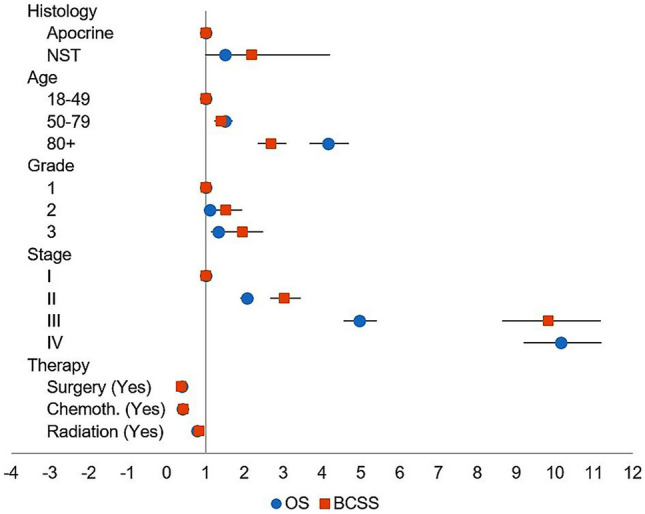
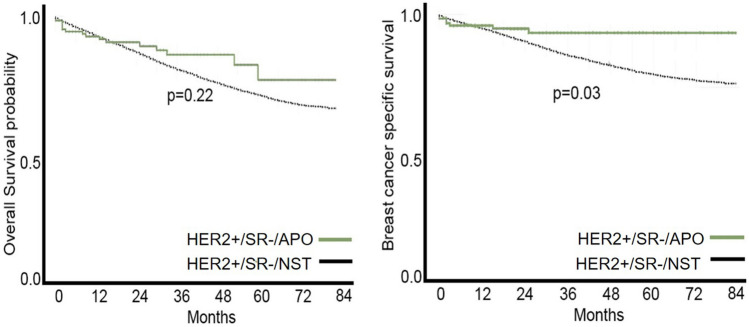
Results: We retrieved 259 cases of HER2+/APO. Most HER2+/APO were SR negative (65%). HER2+/APO were more prevalent in the 80+ age group (24.7% vs. 15.7%, p < 0.001). HER2+/SR-/APO had a significantly lower histological grade than the HER2+/SR-/NST (p < 0.001). Breast cancer-related deaths were more prevalent in HER2+/NST (7.8% vs. 3.9%, p = 0.019). This was particularly evident between SR- subgroups (10.4% in HER2+/SR-/NST vs. 4.2% in HER2+/SR-/APO, p = 0.008) and was reaffirmed in breast cancer-specific survival in univariate analysis (p = 0.03). Other than race and SR status, HER2+/APO subgroups did not differ in clinicopathological parameters.
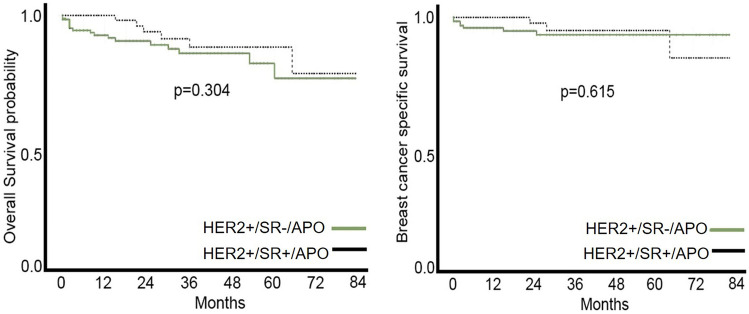
Conclusions: Our study confirms the rarity of the APO and reveals that SR status in APO does not affect these patients' prognosis. HER2+/APO tumors tend to have a less aggressive phenotype and a more favorable outcome despite a markedly lower ER/PR positivity.
Keywords: Apocrine carcinoma; Breast cancer; HER2; Outcome; Special types.
© 2022. The Author(s).
Conflict of interest statement
The authors have no relevant financial or non-financial interests to disclose.
Figures
References
-
- Bonnefoi H, MacGrogan G, Poncet C, Iggo R, Pommeret F, Grellety T, Larsimont D, Becette V, Kerdraon O, Bibeau F, Ghnassia JP, Picquenot JM, Thomas J, Tille JC, Slaets L, Bodmer A, Bergh J, Cameron D, investigators EBs, Molecular apocrine tumours in EORTC 10994/BIG 1–00 phase III study: pathological response after neoadjuvant chemotherapy and clinical outcomes. Br J Cancer. 2019;120:913–921. doi: 10.1038/s41416-019-0420-y. - DOI - PMC - PubMed
-
- D'Arcy C, Quinn CM. Apocrine lesions of the breast: part 2 of a two-part review. Invasive apocrine carcinoma, the molecular apocrine signature and utility of immunohistochemistry in the diagnosis of apocrine lesions of the breast. J Clin Pathol. 2019;72:7–11. doi: 10.1136/jclinpath-2018-205485. - DOI - PubMed
-
- Dellapasqua S, Maisonneuve P, Viale G, Pruneri G, Mazzarol G, Ghisini R, Mazza M, Iorfida M, Rotmensz N, Veronesi P, Luini A, Goldhirsch A, Colleoni M. Immunohistochemically defined subtypes and outcome of apocrine breast cancer. Clin Breast Cancer. 2013;13:95–102. doi: 10.1016/j.clbc.2012.11.004. - DOI - PubMed
-
- Dreyer G, Vandorpe T, Smeets A, Forceville K, Brouwers B, Neven P, Janssens H, Deraedt K, Moerman P, Van Calster B, Christiaens MR, Paridaens R, Wildiers H. Triple negative breast cancer: clinical characteristics in the different histological subtypes. Breast. 2013;22:761–766. doi: 10.1016/j.breast.2013.01.009. - DOI - PubMed
MeSH terms
Substances
LinkOut - more resources
Full Text Sources
Medical
Research Materials
Miscellaneous
