


Intersectional social identities and loneliness: Evidence from a municipality in Switzerland
- PMID: 35355276
- PMCID: PMC9544721
- DOI: 10.1002/jcop.22855
Intersectional social identities and loneliness: Evidence from a municipality in Switzerland
Abstract
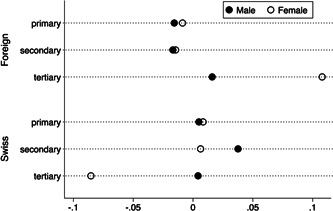
We examined the extent to which intersectional social identities combine to shape risks of loneliness and identified the specific social clusters that are most at risk of loneliness for more precise and targeted interventions to reduce loneliness in a Swiss municipality. Based on data collected using participatory action research, we used the novel multilevel analysis of individual heterogeneity and discriminatory accuracy (MAIHDA) to estimate the predictive power of intersectional social attributes on risk of loneliness. We found that 56% of the between-strata variance was captured by intersectional interaction but was not explained by the additive effect of social identities. We also found that nationality and education had the strongest predictive power for loneliness. Interventions to reduce loneliness may benefit from understanding the resident population's intersectional identities given that individuals with the same combinations of social identities face a common set of social exposures relating to loneliness.
Keywords: community intervention; intersectionality; multilevel modeling; participatory action research; social and emotional isolation; social identity; stratification.
© 2022 The Authors. Journal of Community Psychology published by Wiley Periodicals LLC.
Figures
References
-
- Berkman, L. F. , Glass, T. , Brissette, I. , & Seeman, T. E. (2000). From social integration to health: Durkheim in the new millennium. Social Science & Medicine, 51, 843–857. - PubMed
Publication types
MeSH terms
Grants and funding
LinkOut - more resources
Full Text Sources
