Disparities in oral anticoagulation initiation in patients with schizophrenia and atrial fibrillation: A nationwide cohort study
- PMID: 35355307
- PMCID: PMC9545247
- DOI: 10.1111/bcp.15337
Disparities in oral anticoagulation initiation in patients with schizophrenia and atrial fibrillation: A nationwide cohort study
Abstract
Aims: Schizophrenia is associated with poor anticoagulation control and clinical prognosis in patients with atrial fibrillation (AF). Little is known about initiation of oral anticoagulation therapy (OAC) in this patient population.
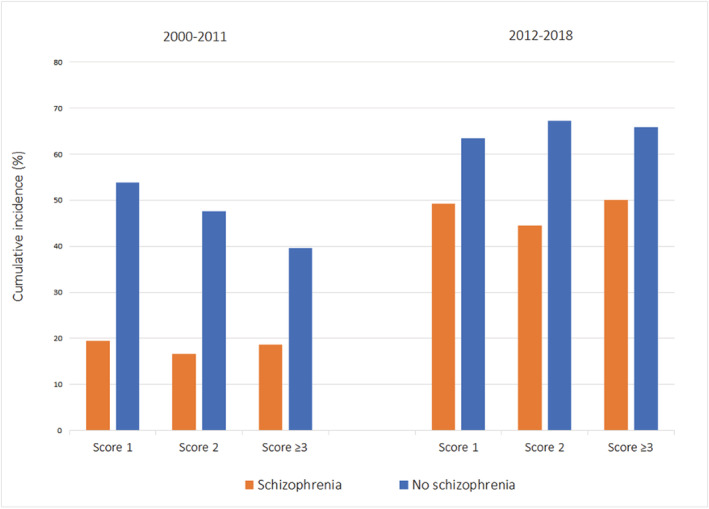
Methods: In the nationwide Danish health registries, we identified all patients with incident AF and schizophrenia with indication for OAC treatment. Patients with schizophrenia (n = 673) were matched 1:5 on sex, age, stroke risk score, and calendar-period to incident AF patients without schizophrenia. We calculated absolute risk and risk difference (RD) of OAC initiation, adjusting for stroke and bleeding risk factors. Analyses were stratified by calendar period (2000-2011 and 2012-2018) to account for changes after the introduction of non-vitamin K OACs (NOAC).
Results: Among patients with schizophrenia (mean age 69.5 years, 50.3% females), 33.7% initiated OAC within the first year after AF diagnosis, compared with 54.4% of patients without schizophrenia, corresponding to an adjusted RD of -20.7 (95% confidence interval [CI]: -24.7 to -16.7). OAC initiation increased over time regardless of schizophrenia status. During 2000-2011, 18.3% of patients with schizophrenia and 42.9% without schizophrenia initiated OAC (adjusted RD -23.6%, 95% CI -28.8 to -18.6). During 2012-2018, this was 48.5% and 65.7%, respectively (adjusted RD -14.4%, 95% CI -20.4 to -8.4).
Conclusion: Initiation of OAC was substantially lower among patients with AF and schizophrenia compared with matched AF peers. These findings accentuate the importance of close attention to disparities in initiation of OAC treatment, and potential missed opportunities for prevention of disabling strokes in AF patients with schizophrenia.
Keywords: anticoagulants; atrial fibrillation; schizophrenia; thrombosis.
© 2022 The Authors. British Journal of Clinical Pharmacology published by John Wiley & Sons Ltd on behalf of British Pharmacological Society.
Conflict of interest statement
Dr. Højen has received speaking fees from MSD and speaking and consulting fees from Bayer and Bristol‐Myers Squibb/Phizer. Prof Larsen has served as an investigator for Janssen Scientific Affairs, LLC and Boehringer Ingelheim and received speaking and consulting fees from Bayer, Bristol‐Myers Squibb/Pfizer, Boehringer Ingelheim, MSD and AstraZeneca. Dr. Nilsen has received speaking fees from Boehringer Ingelheim and BMS/Pfizer; consulting fees from Bayer and Daiichi‐Sankyo; and grant support from BMS/Pfizer and Daiichi‐Sankyo. Prof. Lip reports consultancy and speaker fees from BMS/Pfizer, Boehringer Ingelheim and Daiichi‐Sankyo. Dr. Søgaard has received consulting fees from Bayer. The other authors declare no conflicts of interest.
Figures


References
-
- Søgaard M, Skjøth F, Kjældgaard JN, Larsen TB, Hjortshøj SP, Riahi S. Atrial fibrillation in patients with severe mental disorders and the risk of stroke, fatal thromboembolic events and bleeding: a nationwide cohort study. BMJ Open. 2017;7(12):e018209. doi:10.1136/bmjopen-2017-018209 - DOI - PMC - PubMed
MeSH terms
Substances
LinkOut - more resources
Full Text Sources
Medical
Miscellaneous