


Exploring Factors and Associate Responses for Anxiety in the Coronavirus Disease 2019 Pandemic: A Web-Based Survey in Japan
- PMID: 35356596
- PMCID: PMC8959138
- DOI: 10.3389/fpsyg.2021.795219
Exploring Factors and Associate Responses for Anxiety in the Coronavirus Disease 2019 Pandemic: A Web-Based Survey in Japan
Abstract
Background and objectives: Anxiety plays an important role in psychology. An exploration of anxiety and its associated reactions may provide insight into measures for addressing mental health problems caused by the coronavirus disease 2019 (COVID-19) pandemic. Data from this study provide potential correlational responses to anxiety.
Methods: A cross-sectional study using data collected via an online self-reported questionnaire was conducted in Japan during the COVID-19 pandemic. Using the State-Trait Anxiety Inventory (STAI-6), we assessed anxiety levels and explored the relationship between anxiety STAI-6 score, sources of COVID-19 information, the influences of COVID-19, social anxiety symptoms, discrimination, and evaluation of the government.
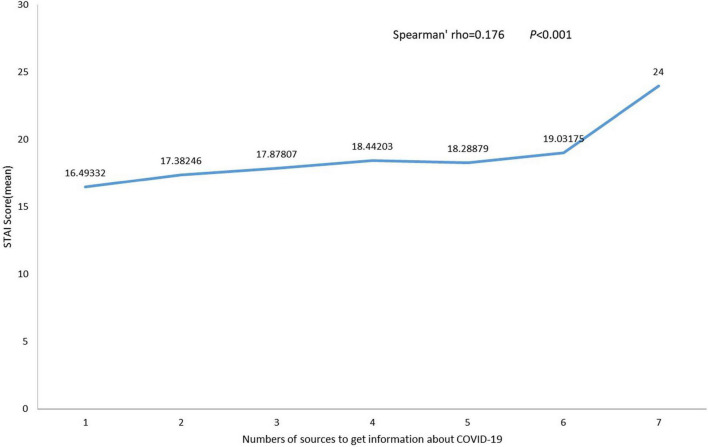
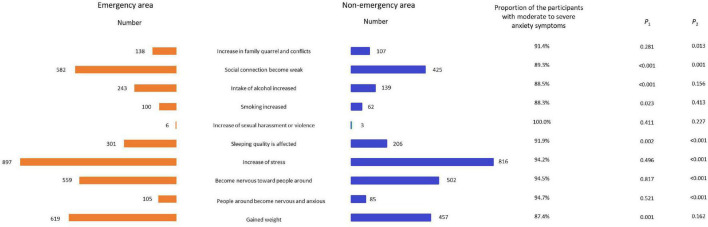
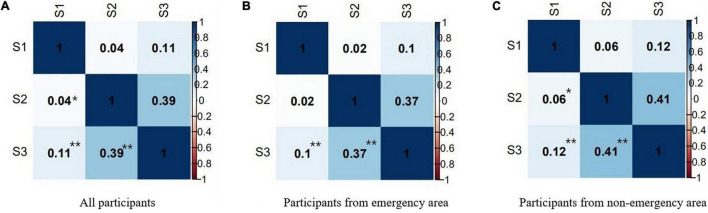
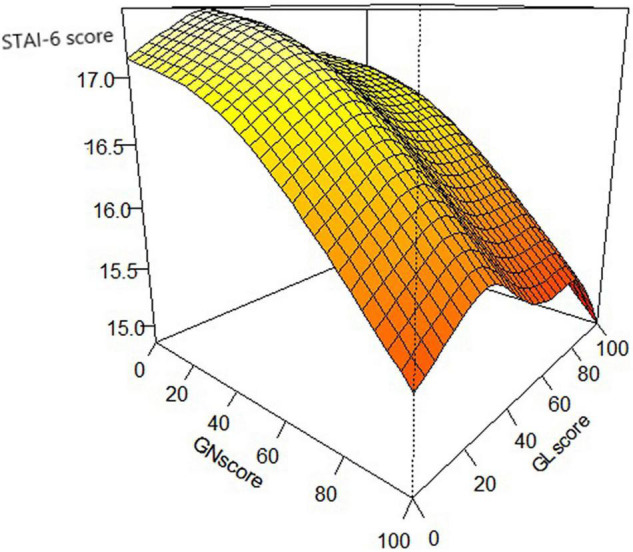
Results: A total of 4,127 participants were included in the analysis. The level of anxiety was not equally distributed across the general population with respect to age, gender, educational level, occupation, income, presence of underlying disease, and location (p < 0.05). The number of sources of information on COVID-19 had a positive correlation with the STAI-6 score (Spearman's rho = 0.176, p < 0.001). The influence of the pandemic was correlated with moderate-severe anxiety. A high level of anxiety added to social anxiety (Spearman's rho = 0.04, p < 0.05) and discriminatory behavior (Spearman's rho = 0.11, p < 0.01). Being female (Estimate = 0.926) and from a non-emergency area (Estimate = -0.308) was related to higher STAI scores, and higher education (Estimate = -0.305), and income (Estimate = -0.168) decreased the STAI score. The respondents who had a lower evaluative score of the preventive activities undertaken by the national and local governments had higher STAI-6 scores.
Conclusion: Our findings provide statistical evidence for the associated reaction of anxiety and that anxiety reactions may vary in predictable ways. Further studies should focus on the strategic interventions that may decrease the associated responses to anxiety, to address mental health issues due to the pandemic.
Keywords: COVID-19; STAI-6; anxiety; associate response; mental health.
Copyright © 2022 Zhuang, Cai, Lu, Xu, Lin, Wong, Hu, Yamamoto, Morita, Aoyagi and He.
Conflict of interest statement
The authors declare that the research was conducted in the absence of any commercial or financial relationships that could be construed as a potential conflict of interest.
Figures
References
-
- Cai G., Lin Y., Lu Y., He F., Morita K., Yamamoto T., et al. (2021). Behavioural responses and anxiety symptoms during the coronavirus disease 2019 (COVID-19) pandemic in Japan: a large scale cross-sectional study. J. Psychiatr. Res. 136 296–305. 10.1016/j.jpsychires.2021.02.008 - DOI - PMC - PubMed
LinkOut - more resources
Full Text Sources
