


Catalytic Reaction Model of Suicide
- PMID: 35356712
- PMCID: PMC8959568
- DOI: 10.3389/fpsyt.2022.817224
Catalytic Reaction Model of Suicide
Abstract
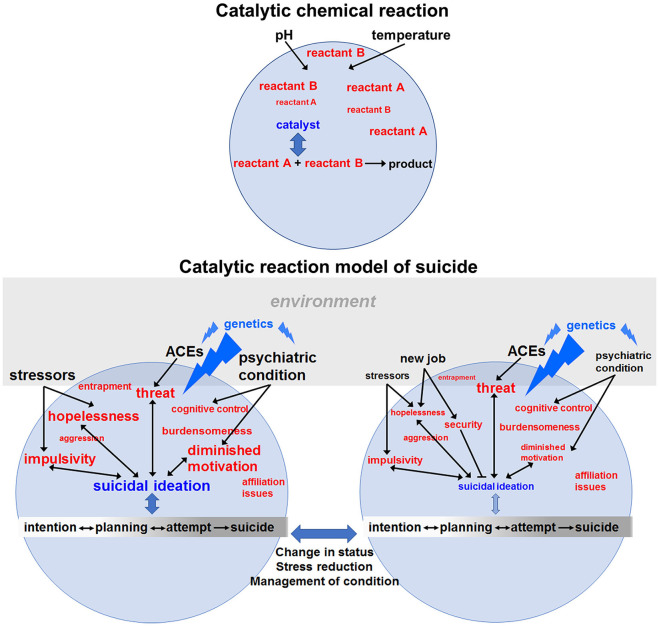
Suicide is a devastating outcome of unresolved issues that affect mental health, general wellbeing and socioeconomic stress. The biology of suicidal behavior is still poorly understood, although progress has been made. Suicidal behavior runs in families and genetic studies have provided initial glimpses into potential genes that contribute to suicide risk. Here, we attempt to unify the biology and behavioral dimensions into a model that can guide research in this area. The proposed model envisions suicidal behavior as a catalytic reaction that may result in suicide depending on the conditions, analogously to enzyme catalysis of chemical reactions. A wide array of substrates or reactants, such as hopelessness, depression, debilitating illnesses and diminished motivation can mobilize suicidal thoughts and behaviors (STBs), which can then catalyze the final step/act of suicide. Here, we focus on three biological substrates in particular: threat assessment, motivation to engage in life and impulsivity. Genetic risk factors can affect each of these processes and tilt the balance toward suicidal behavior when existential crises (real or perceived) emerge such as loss of a loved one, sudden changes in social status or serious health issues. Although suicide is a uniquely human behavior, many of the fundamental biological processes are evolutionarily conserved. Insights from animal models may help to shape our understanding of suicidal behavior in man. By examining counterparts of the major biological processes in other organisms, new ideas about the role of genetic risk factors may emerge along with possible therapeutic interventions or preventive measures.
Keywords: diminished motivation; impulsivity; suicidal ideation (SI); suicide; threat assessment.
Copyright © 2022 McPherson, Sall, Santos, Thompson and Dwyer.
Conflict of interest statement
The authors declare that the research was conducted in the absence of any commercial or financial relationships that could be construed as a potential conflict of interest.
Figures
References
-
- World Health Organization. World Health Statistics. (2021). Available online at: https://www.who.int/news-room/fact-sheets/detail/suicide (accessed November 11, 2021).
Publication types
LinkOut - more resources
Full Text Sources
