


STAT3 pathway in cancers: Past, present, and future
- PMID: 35356799
- PMCID: PMC8942302
- DOI: 10.1002/mco2.124
STAT3 pathway in cancers: Past, present, and future
Erratum in
-
Erratum.MedComm (2020). 2022 Apr 20;3(2):e135. doi: 10.1002/mco2.135. eCollection 2022 Jun. MedComm (2020). 2022. PMID: 35474947 Free PMC article.
Abstract
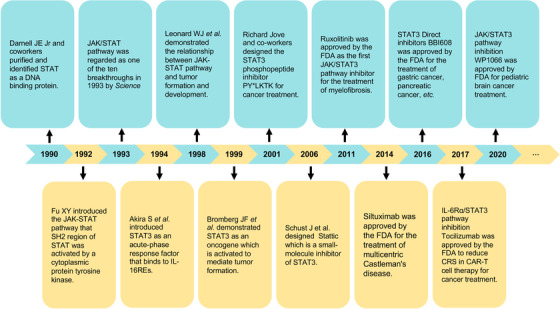
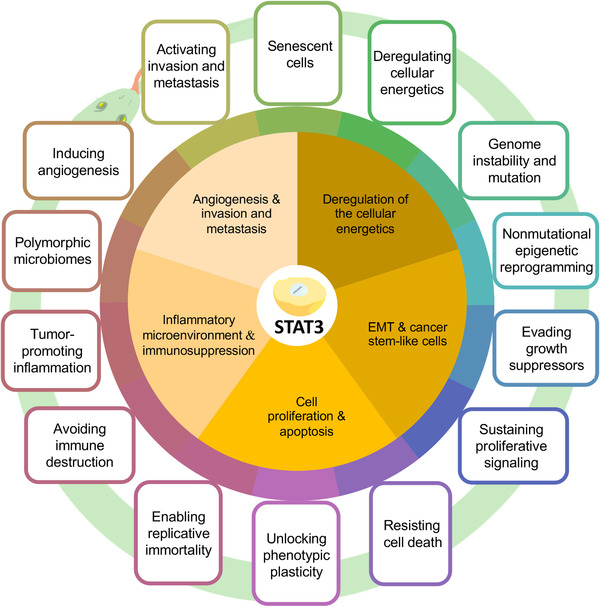
Signal transducer and activator of transcription 3 (STAT3), a member of the STAT family, discovered in the cytoplasm of almost all types of mammalian cells, plays a significant role in biological functions. The duration of STAT3 activation in normal tissues is a transient event and is strictly regulated. However, in cancer tissues, STAT3 is activated in an aberrant manner and is induced by certain cytokines. The continuous activation of STAT3 regulates the expression of downstream proteins associated with the formation, progression, and metastasis of cancers. Thus, elucidating the mechanisms of STAT3 regulation and designing inhibitors targeting the STAT3 pathway are considered promising strategies for cancer treatment. This review aims to introduce the history, research advances, and prospects concerning the STAT3 pathway in cancer. We review the mechanisms of STAT3 pathway regulation and the consequent cancer hallmarks associated with tumor biology that are induced by the STAT3 pathway. Moreover, we summarize the emerging development of inhibitors that target the STAT3 pathway and novel drug delivery systems for delivering these inhibitors. The barriers against targeting the STAT3 pathway, the focus of future research on promising targets in the STAT3 pathway, and our perspective on the overall utility of STAT3 pathway inhibitors in cancer treatment are also discussed.
Keywords: STAT3; STAT3 pathway inhibitors; cancer hallmarks; cancer treatment.
© 2022 The Authors. MedComm published by Sichuan International Medical Exchange & Promotion Association (SCIMEA) and John Wiley & Sons Australia, Ltd.
Conflict of interest statement
The authors have no conflict of interest to declare.
Figures
References
-
- Sung H, Ferlay J, Siegel RL, et al. Global cancer statistics 2020: gLOBOCAN estimates of incidence and mortality worldwide for 36 cancers in 185 countries. CA Cancer J Clin. 2021;71(3):209‐249. - PubMed
-
- World Health Organization . World Health Statistics 2021: Monitoring Health for the SDGs, Sustainable Development Goals. World Health Organization; 2021.
Publication types
LinkOut - more resources
Full Text Sources
Miscellaneous