Meta-Analysis
. 2022 Mar 1;5(3):e224506.
doi: 10.1001/jamanetworkopen.2022.4506.

Off-Label Use of Tenecteplase for the Treatment of Acute Ischemic Stroke: A Systematic Review and Meta-analysis

Affiliations
Meta-Analysis

Off-Label Use of Tenecteplase for the Treatment of Acute Ischemic Stroke: A Systematic Review and Meta-analysis

Aristeidis H Katsanos et al. JAMA Netw Open. .

Abstract

Importance: Tenecteplase is being evaluated as an alternative thrombolytic agent for the treatment of acute ischemic stroke (AIS) within ongoing randomized clinical trials (RCTs). In addition, nonrandomized clinical experiences with off-label use of tenecteplase vs alteplase for AIS treatment are being published.

Objective: To evaluate the available evidence on the safety and efficacy of intravenous tenecteplase compared with intravenous alteplase provided by nonrandomized studies.

Data sources: Eligible studies were identified by searching MEDLINE and Scopus databases. No language or other restrictions were imposed. The literature search was conducted on October 12, 2021. This meta-analysis used the Preferred Reporting Items for Systematic Reviews and Meta-Analyses (PRISMA) guidelines and was written according to the Meta-analysis of Observational Studies in Epidemiology (MOOSE) proposal.

Study selection: Nonrandomized studies (prospective or retrospective) comparing intravenous tenecteplase (at any dose) with intravenous alteplase in patients with AIS were included in the analysis.

Data extraction and synthesis: The crude odds ratios (ORs) and 95% CIs were calculated for the association of tenecteplase vs alteplase with the outcomes of interest and adjusted ORs were extracted if provided. Estimates using random-effects models were pooled.

Main outcomes and measures: The primary outcome was the probability of good functional outcome (modified Rankin scale [mRS] score, 0-2) at 90 days.

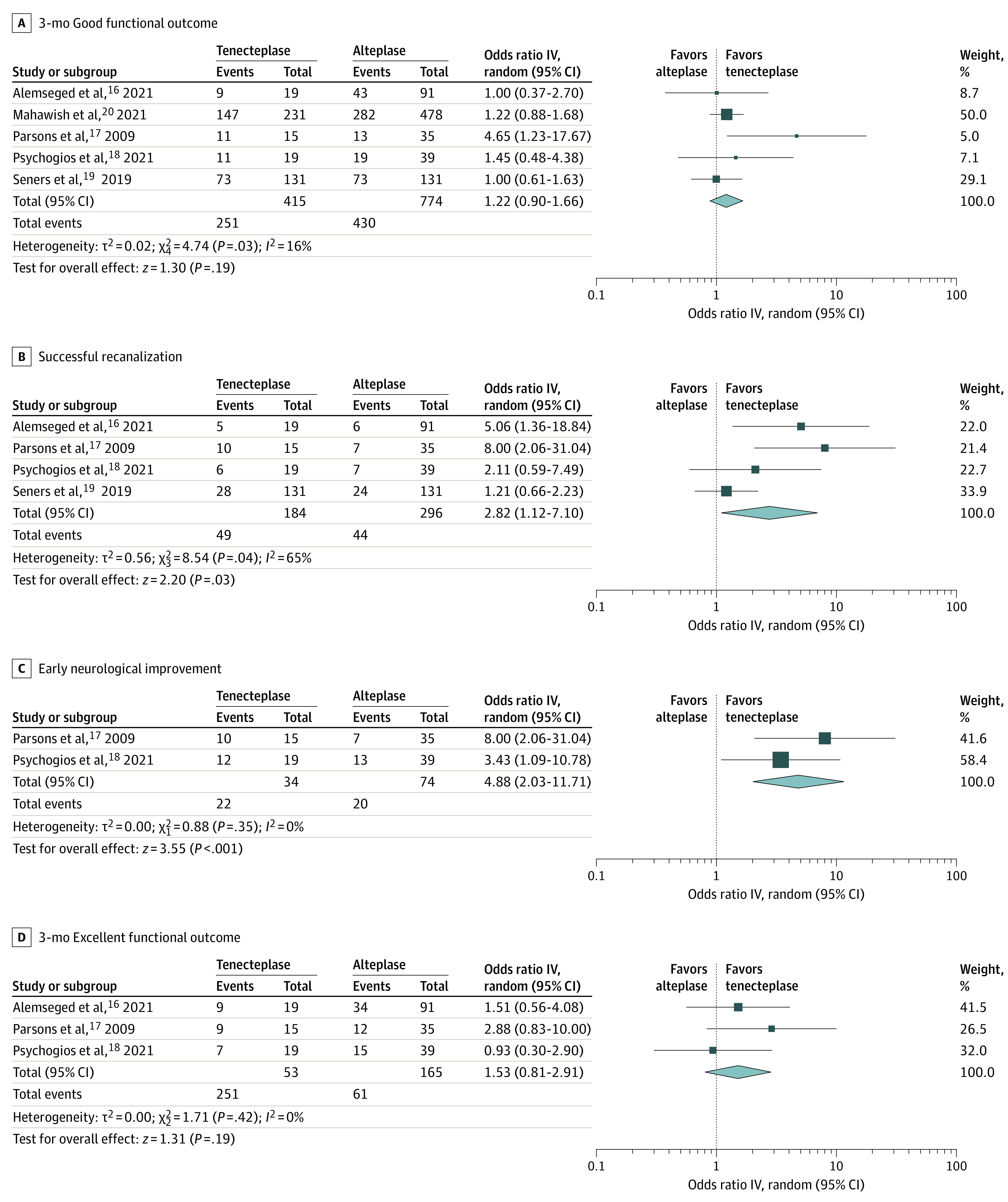
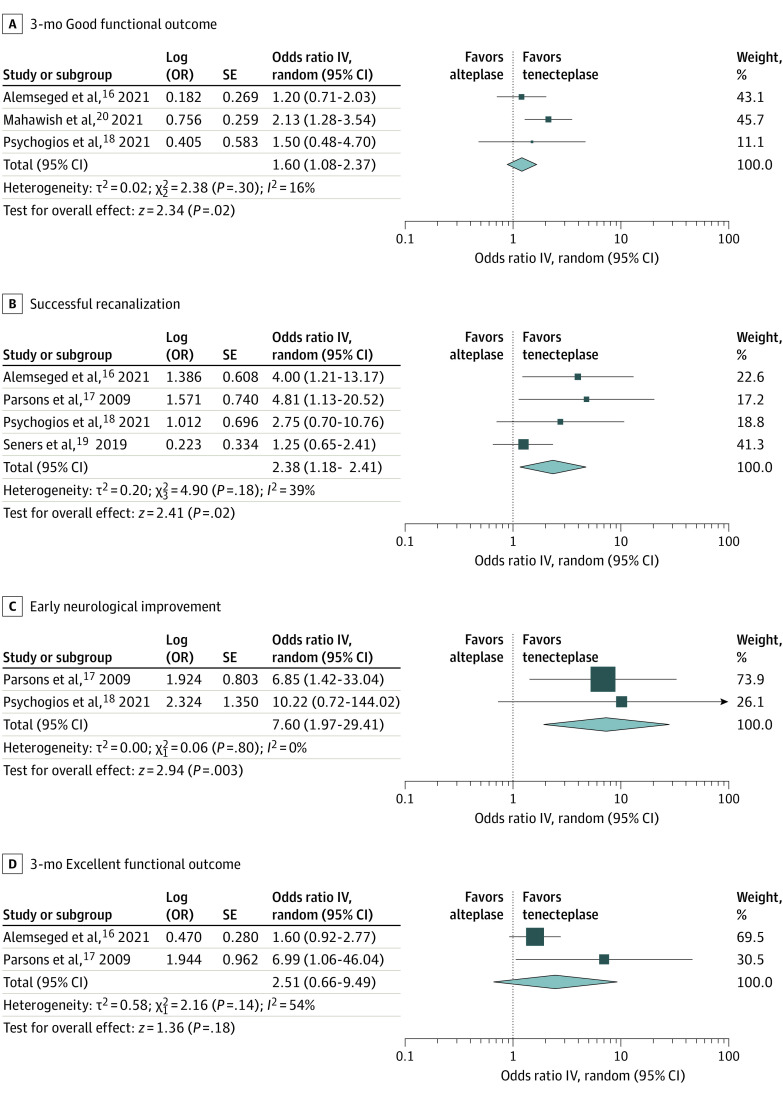
Results: Six studies were identified including a total of 1820 patients (618 [34%] treated with tenecteplase). Patients receiving tenecteplase had higher odds of 3-month good functional outcome (crude odds ratio [OR], 1.22; 95% CI, 0.90-1.66; adjusted OR, 1.60, 95% CI, 1.08-2.37), successful recanalization (crude OR, 2.82; 95% CI, 1.12-7.10; adjusted OR, 2.38; 95% CI, 1.18-4.81), and early neurological improvement (crude OR, 4.88; 95% CI, 2.03-11.71; adjusted OR, 7.60; 95% CI, 1.97-29.41). No significant differences were detected in 3-month excellent functional outcome proportions (mRS score 0-1; crude OR, 1.53; 95% CI, 0.81-2.91; adjusted OR, 2.51; 95% CI, 0.66- 9.49), symptomatic intracranial hemorrhage (crude OR, 0.97; 95% CI, 0.44-2.16; adjusted OR, 1.16; 95% CI, 0.13-10.50), or parenchymal hematoma (crude OR, 1.20; 95% CI, 0.24-5.95).

Conclusions and relevance: Evidence from nonrandomized studies suggests tenecteplase is as safe as alteplase and potentially associated with improved functional outcomes compared with alteplase. Based on these findings, enrollment in the ongoing RCTs appears to be appropriate.


Conflict of interest statement

Conflict of Interest Disclosures: Dr Katsanos reported participating as an investigator for the Alteplase Compared to Tenecteplase in Patients With Acute Ischemic Stroke trial and being supported by an Internal Career Award from the Department of Medicine, McMaster University. Dr Sacco reported receiving speaker and advisory board participation fees from Allergan, Novartis, Teva, and Eli Lilly and Co; fees for advisory board participation from Lundbeck, AstraZeneca, and Novo-Nordisc for advisory board participation; and speaker fees from Abbott during the conduct of the study. Dr Aguiar de Sousa reported receiving personal fees for AstraZeneca advisory board participation, travel support from Boehringer Ingelheim, and speaking fees from Bayer outside the submitted work. Dr De Marchis reported serving as an unpaid steering committee member of the Tenecteplase in Wake Up Stroke trial. Dr Ahmed reported being chairman of SITS International, which receives a grant from Boehringer Ingelheim for the SITS-International Stroke Thrombolysis Register outside the submitted work. Dr Sarraj reported receiving grants from Stryker Neurovascular and consultant fees from Stryker Neurovascular and AstraZeneca outside the submitted work. Dr Menon reported serving as chief medical officer and director of Circle NVI, holding stock and options, outside the submitted work. No other disclosures were reported.

Figures

Figure 1.
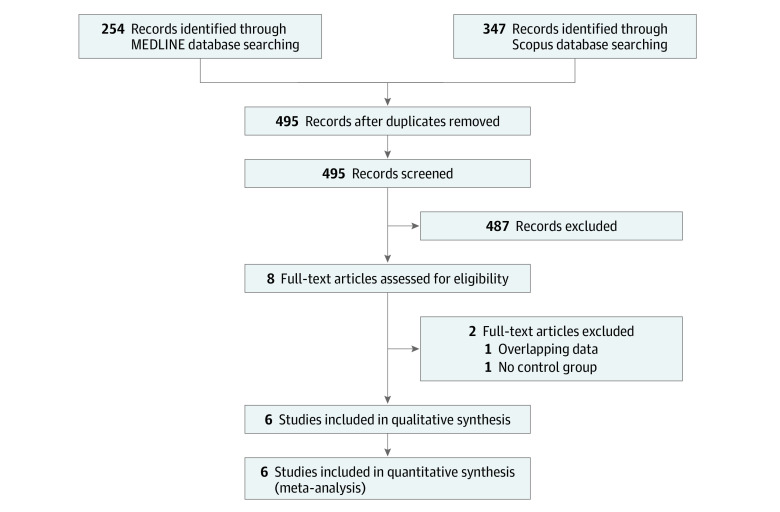
Figure 1.. Selection of Eligible Studies
Figure 2.
Figure 2.. Unadjusted Analyses on the Comparison Between Intravenous Tenecteplase and Alteplase
Outcomes of (A) 3-month good functional outcome (modified Rankin scale 0-2), (B) successful recanalization, (C) early neurological improvement, and (D) 3-month excellent functional outcome (modified Rankin Scale 0-1). The size of squares is proportional to the weight of each study. Horizontal lines indicate the 95% CI of each study; diamond, the pooled estimate with 95% CI.
Figure 3.
Figure 3.. Adjusted Analyses on the Comparison Between Intravenous Tenecteplase and Alteplase for the Outcomes of 3-Month Good Functional Outcome (Modified Rankin Scale 0-2), Successful Recanalization, Early Neurological Improvement, and 3-Month Excellent Functional Outcome (Modified Rankin Scale 0-1)
The size of squares is proportional to the weight of each study. Horizontal lines indicate the 95% CI of each study; diamond, the pooled estimate with 95% CI.

References

    1. Putaala J, Saver JL, Nour M, Kleindorfer D, McDermott M, Kaste M. Should tenecteplase be given in clinical practice for acute ischemic stroke thrombolysis? Stroke. 2021;52(9):3075-3080. doi: 10.1161/STROKEAHA.121.034244 - DOI - PubMed
    1. Baird AE, Jackson R, Jin W. Tenecteplase for acute ischemic stroke treatment. Semin Neurol. 2021;41(1):28-38. doi: 10.1055/s-0040-1722722 - DOI - PubMed
    1. Katsanos AH, Safouris A, Sarraj A, et al. Intravenous thrombolysis with tenecteplase in patients with large vessel occlusions: systematic review and meta-analysis. Stroke. 2021;52(1):308-312. doi: 10.1161/STROKEAHA.120.030220 - DOI - PubMed
    1. Stroke Foundation . Clinical guidelines for stroke management (2021). Accessed October 12, 2021. https://informme.org.au/guidelines/clinical-guidelines-for-stroke-manage...

    1. Berge E, Whiteley W, Audebert H, et al. European Stroke Organisation (ESO) guidelines on intravenous thrombolysis for acute ischaemic stroke. Eur Stroke J. 2021;6(1):I-LXII. doi: 10.1177/2396987321989865 - DOI - PMC - PubMed