


The importance of the Peritoneal Cancer Index (PCI) to predict surgical outcome after neoadjuvant chemotherapy in advanced ovarian cancer
- PMID: 35357582
- PMCID: PMC9519707
- DOI: 10.1007/s00404-022-06527-y
The importance of the Peritoneal Cancer Index (PCI) to predict surgical outcome after neoadjuvant chemotherapy in advanced ovarian cancer
Abstract
Purpose: Achieving complete cytoreduction (CCR) is crucial for a patient's prognosis with advanced epithelial ovarian cancer (EOC). So far, prognostic predictors have failed to predict surgical outcome after neoadjuvant chemotherapy (NACT). In clinical trials, scores were used to predict operability in recurrent ovarian cancer (Harter et al. in N Engl J Med 385(23):2123-2131, 2021) but there is no known prediction score for CCR after NACT. The Peritoneal Cancer Index (PCI) is an established tool to predict surgical outcome in primary setting (Lampe et al. in 25:135-144, 2015). We now examined the predictive power of the PCI to achieve CCR after NACT.
Methods: In this single-center study, the data of patients with advanced stage EOC (FIGO > IIIb) treated between 01/2015 and 12/2020 were analyzed retrospectively. Inclusion criteria were a mandatory staging laparoscopy, a PCI score > 25, and NACT. CT scans were analyzed in blinded fashion according to RECIST criteria (Borgani et al. in 237; 93-99, 2019) Reaction of PCI after NACT was compared with the analysis of radiologic imaging and CA-125 levels.
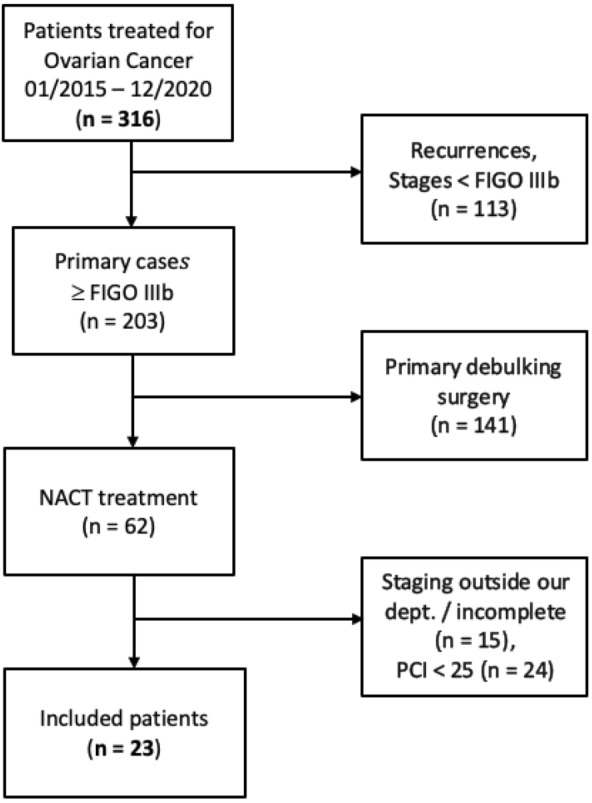
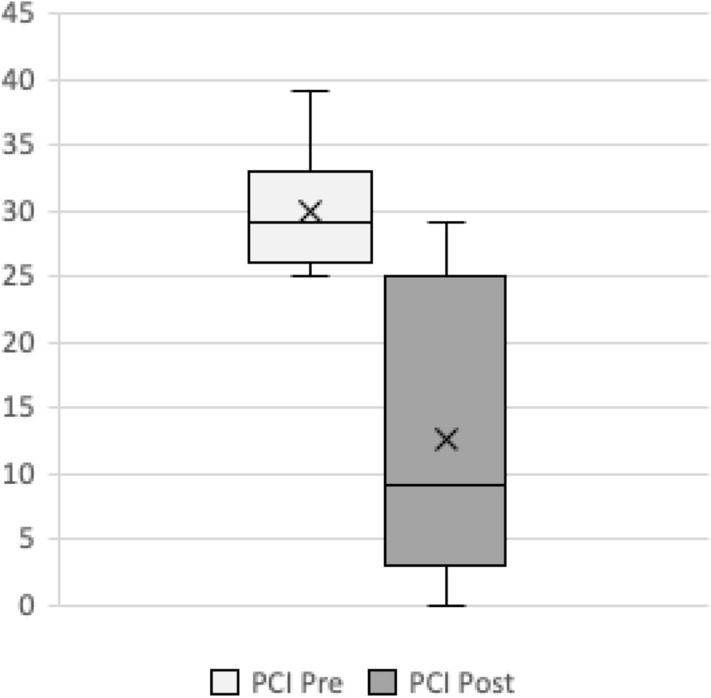
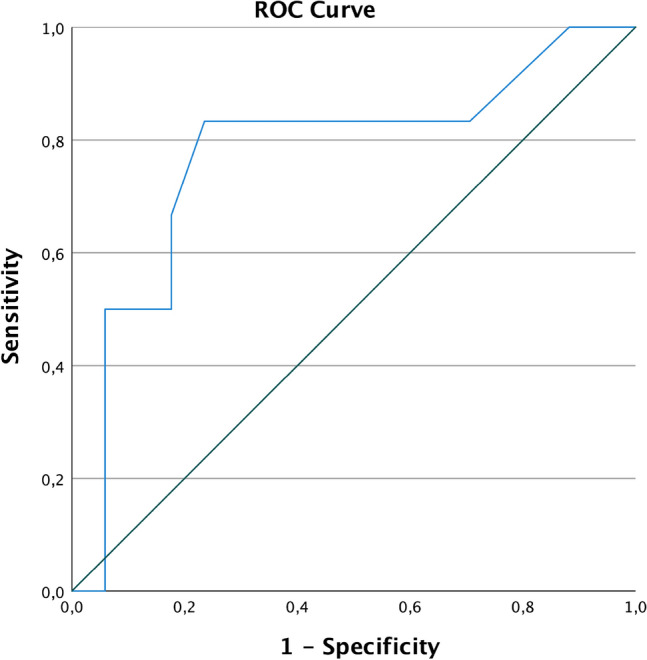
Results: Three hundred and sixteen patients were screened, 62 were treated with NACT, and 23 were included in our analysis. 87% of cases presented with an FIGO IIIc stadium. The reduction of PCI itself after NACT showed to be the most powerful predictor for achieving CCR. The reduction of the initial PCI score by minimum of 8.5 points was a better predictor for CCR than reaching a PCI < 25. In contrast to data deriving from patients undergoing primary debulking surgery (PDS), we found a PCI of 17, rather than 25, to be a more valuable cut-off for CCR in neoadjuvant-treated patients.
Conclusion: The extend of PCI reduction after NACT is a better predictor for achieving CCR compared with CA125 levels and radiologic imaging. The PCI must be assessed differently in neoadjuvant setting than in a primary situation. CCR was most likely for a post-NACT PCI < 17.
Keywords: Complete cytoreductive surgery; Neoadjuvant chemotherapy; Ovarian cancer; PCI score; Peritoneal Carcinomatosis Index; Prognostic score.
© 2022. The Author(s).
Conflict of interest statement
The authors have no relevant financial or non-financial interests to disclose.
Figures


References
-
- Leitlinienprogramm Onkologie. S3-Leitlinie Diagnostik, Therapie und Nachsorge maligner Ovarialtumoren, Langversion 4.0, AWMF-Registriernummer: 032/035OL. 2020:1–153. https://www.leitlinienprogramm-onkologie.de/fileadmin/user_upload/Downlo....
MeSH terms
Substances
LinkOut - more resources
Full Text Sources
Medical
Research Materials
Miscellaneous
