


Critical Illness-induced Corticosteroid Insufficiency: What It Is Not and What It Could Be
- PMID: 35358303
- PMCID: PMC9202732
- DOI: 10.1210/clinem/dgac201
Critical Illness-induced Corticosteroid Insufficiency: What It Is Not and What It Could Be
Abstract
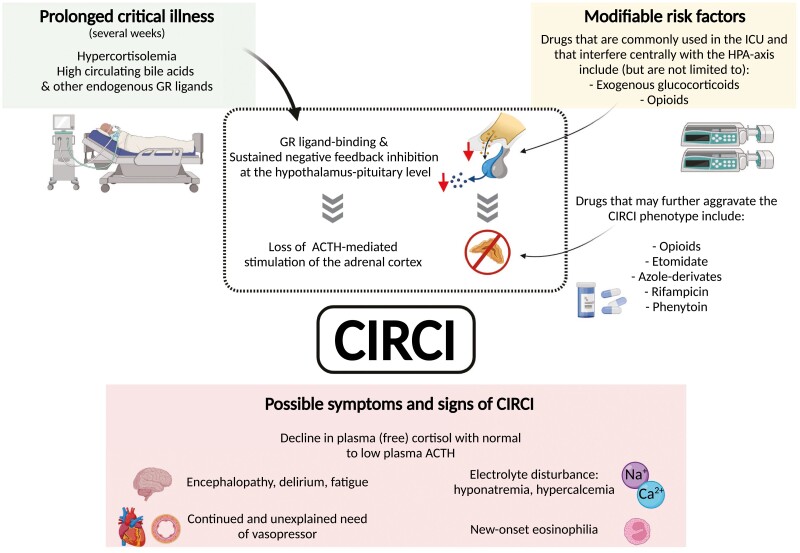
Critical illnesses are hallmarked by increased systemic cortisol availability, a vital part of the stress response. Acute stress may trigger a life-threatening adrenal crisis when a disease of the hypothalamic-pituitary-adrenal (HPA) axis is present and not adequately treated with stress doses of hydrocortisone. Stress doses of hydrocortisone are also used to reduce high vasopressor need in patients suffering from septic shock, in the absence of adrenal insufficiency. Research performed over the last 10 years focusing on the HPA axis during critical illness has led to the insight that neither of these conditions can be labeled "critical illness-induced corticosteroid insufficiency" or CIRCI. Instead, these data suggested using the term CIRCI for a condition that may develop in prolonged critically ill patients. Indeed, when patients remain dependent on vital organ support for weeks, they are at risk of acquiring central adrenal insufficiency. The sustained increase in systemic glucocorticoid availability, mainly brought about by suppressed circulating cortisol-binding proteins and suppressed hepatic/renal cortisol metabolism, exerts negative feedback inhibition at the hypothalamus/pituitary, while high levels of other glucocorticoid receptor ligands, such as bile acids, and drugs, such as opioids, may further suppress adrenocorticotropic hormone (ACTH) secretion. The adrenal cortex, depleted from ACTH-mediated trophic signaling for weeks, may become structurally and functionally impaired, resulting in insufficient cortisol production. Such a central HPA axis suppression may be maladaptive by contributing to lingering vasopressor need and encephalopathy, hence preventing recovery. Here, we review this concept of CIRCI and we advise on how to recognize and treat this poorly understood condition.
Keywords: CIRCI; adrenal; critical illness; hypercortisolemia; sepsis.
© The Author(s) 2022. Published by Oxford University Press on behalf of the Endocrine Society.
Figures

References
-
- Brown-Séquard C-E. Recherches experimentales sur la physiologie et la pathologie des capsules surrenales. C r hebd séances Acad sci. 1856;43(8):422-425.
-
- Russell G, Lightman S. The human stress response. Nat Rev Endocrinol. 2019;15(9):525-534. - PubMed
-
- Peeters B, Langouche L, Van den Berghe G. Adrenocortical stress response during the course of critical illness. Compr Physiol 2017;8(1):283-298. - PubMed
