Review
. 2022 Mar 14:12:846917.
doi: 10.3389/fonc.2022.846917. eCollection 2022.

Bioelectric Dysregulation in Cancer Initiation, Promotion, and Progression

Affiliations
Review

Bioelectric Dysregulation in Cancer Initiation, Promotion, and Progression

Maulee Sheth et al. Front Oncol. .

Abstract

Cancer is primarily a disease of dysregulation - both at the genetic level and at the tissue organization level. One way that tissue organization is dysregulated is by changes in the bioelectric regulation of cell signaling pathways. At the basis of bioelectricity lies the cellular membrane potential or Vmem, an intrinsic property associated with any cell. The bioelectric state of cancer cells is different from that of healthy cells, causing a disruption in the cellular signaling pathways. This disruption or dysregulation affects all three processes of carcinogenesis - initiation, promotion, and progression. Another mechanism that facilitates the homeostasis of cell signaling pathways is the production of extracellular vesicles (EVs) by cells. EVs also play a role in carcinogenesis by mediating cellular communication within the tumor microenvironment (TME). Furthermore, the production and release of EVs is altered in cancer. To this end, the change in cell electrical state and in EV production are responsible for the bioelectric dysregulation which occurs during cancer. This paper reviews the bioelectric dysregulation associated with carcinogenesis, including the TME and metastasis. We also look at the major ion channels associated with cancer and current technologies and tools used to detect and manipulate bioelectric properties of cells.

Keywords: bioelectricity; carcinogenesis; extracellular vesicles; membrane potential; piezo channels; tumor microenvironment.


Conflict of interest statement

The authors declare that the research was conducted in the absence of any commercial or financial relationships that could be construed as a potential conflict of interest.

Figures
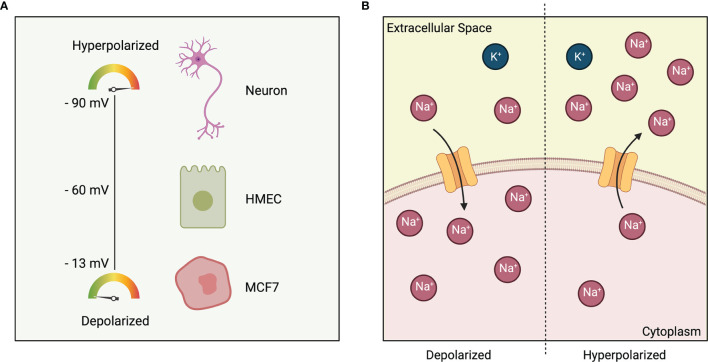
Figure 1
Figure 1
(A) Polarization of cells based on cell type. Excitable cell such as neurons have a membrane potential of -90 mV. Non-excitable cells such as HMEC: Human Mammary Epithelial Cell and MCF7: Estrogen-receptor-positive breast cancer cell line are at -60 mV and -13 mV respectively. (B) Depolarized cell state (left) indicated by a more positive charge in the cytoplasm relative to the extracellular space. Hyperpolarized cell state (right) indicated by a less positive charge in the cytoplasm relative to the extracellular space.
Figure 2
Figure 2
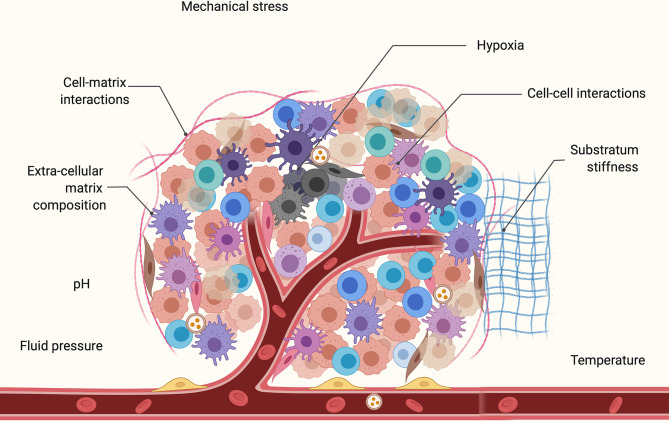
Key components of the tumor microenvironment (TME) which comprises of multiple cell types including cancer cells, immune cells, endothelial cells, and cancer associated fibroblasts. This includes mechanical components such as fluid pressure, substratum stiffness, mechanical stress, cell-cell, and cell-matrix interactions. Also shown are some chemical components of the microenvironment such as pH, temperature, and hypoxic core of the tumor. Cell-cell and cell-TME communication is mediated by a variety of bioactive molecules during carcinogenesis.
Figure 3
Figure 3
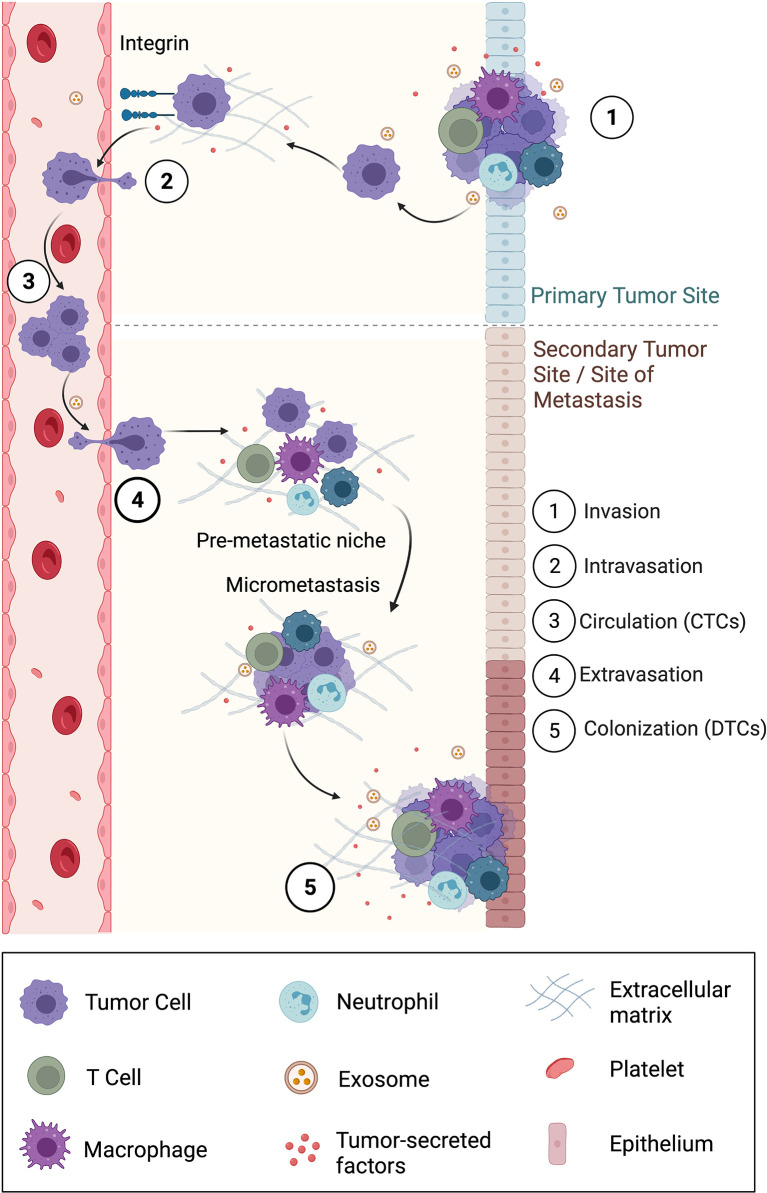
Overview of the five-step metastatic cascade involving local invasion, intravasation into surrounding vasculature, circulation, extravasation, and finally colonization in a secondary location. Also shown is the formation of a pre-metastatic niche that supports the survival of disseminated tumor cells (DTCs) into a successful metastasis. Exosomes, a subpopulation of EVs play a primary role in carrying information from the primary site to the secondary site or site of metastasis, especially to form the pre-metastatic niche.
Figure 4
Figure 4
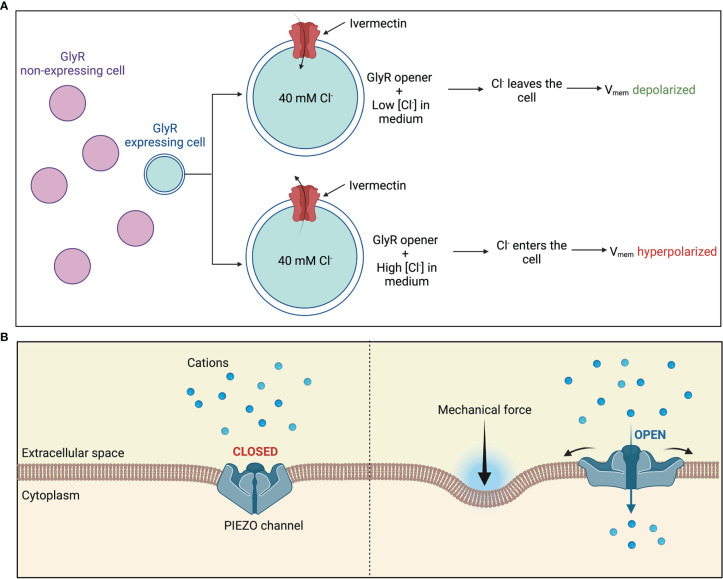
Manipulating bioelectric properties of cells (A) Manipulation of endogenous chloride channels as a means of manipulating Vmem of a select group of cells. Treatment with ivermectin causes chloride channels in GlyR-expressing cells to open. External chloride levels are then manipulated to regulate movement of chloride flux into or out of the cytoplasm (B) Piezo1 and Piezo2 are mechanically activated cation channels. Application of a mechanical force causes the central pore to open, allowing an influx of positive charge into the cell.

References

    1. Hanahan D, Weinberg RA. Hallmarks of Cancer: The Next Generation. Cell (2011) 144:646–74. doi: 10.1016/j.cell.2011.02.013 - DOI - PubMed
    1. Vaux DL. In Defense of the Somatic Mutation Theory of Cancer. Bioessays (2011) 33:341–3. doi: 10.1002/bies.201100022 - DOI - PubMed
    1. Mally A, Chipman JK. Non-Genotoxic Carcinogens: Early Effects on Gap Junctions, Cell Proliferation and Apoptosis in the Rat. Toxicology (2002) 180:233–48. doi: 10.1016/s0300-483x(02)00393-1 - DOI - PubMed
    1. Versteeg R. Cancer: Tumours Outside the Mutation Box. Nature (2014) 506:438–9. doi: 10.1038/nature13061 - DOI - PubMed
    1. Sonnenschein C, Soto AM. Theories of Carcinogenesis: An Emerging Perspective. Semin Cancer Biol (2008) 18:372–7. doi: 10.1016/j.semcancer.2008.03.012 - DOI - PMC - PubMed

LinkOut - more resources