Review
. 2022 Mar 14:10:819044.
doi: 10.3389/fcell.2022.819044. eCollection 2022.

Genetic Regulation of N6-Methyladenosine-RNA in Mammalian Gametogenesis and Embryonic Development

Affiliations
Review

Genetic Regulation of N6-Methyladenosine-RNA in Mammalian Gametogenesis and Embryonic Development

Yuguang Chang et al. Front Cell Dev Biol. .

Abstract

Emerging evidence shows that m6A is the most abundant modification in eukaryotic RNA molecules. It has only recently been found that this epigenetic modification plays an important role in many physiological and pathological processes, such as cell fate commitment, immune response, obesity, tumorigenesis, and relevant for the present review, gametogenesis. Notably the RNA metabolism process mediated by m6A is controlled and regulated by a series of proteins termed writers, readers and erasers that are highly expressed in germ cells and somatic cells of gonads. Here, we review and discuss the expression and the functional emerging roles of m6A in gametogenesis and early embryogenesis of mammals. Besides updated references about such new topics, readers might find in the present work inspiration and clues to elucidate epigenetic molecular mechanisms of reproductive dysfunction and perspectives for future research.

Keywords: embryo development; epigenetics; m6A; oogenesis; spermatogenesis.


Conflict of interest statement

The authors declare that the research was conducted in the absence of any commercial or financial relationships that could be construed as a potential conflict of interest.

Figures
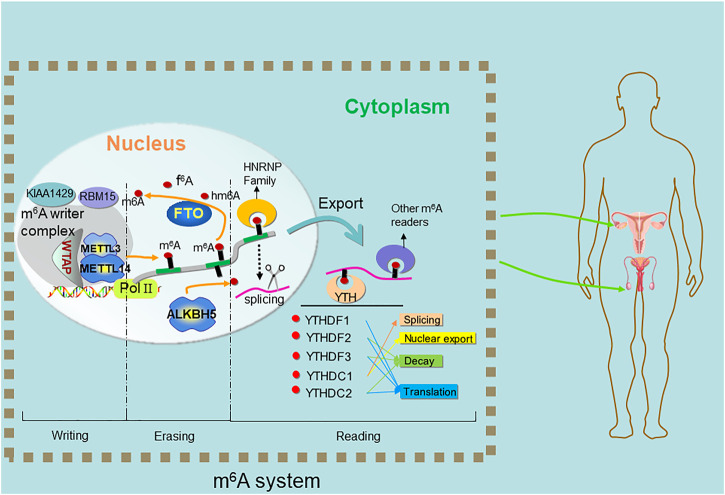
FIGURE 1
FIGURE 1
Methylation and demethylation of m6A on RNA. The N 6-methyladenosine (m6A) modification is imposed by a heterocomplex of two methyltransferases METTL3-METTL14 termed “writers”, assisted by WTAP. ALKBH5 and FTO, termed “erasers” catalyzes the direct removal of m6A. YTH family proteins termed “readers” recognize the m6A to carry out subsequent functions.
FIGURE 2
FIGURE 2
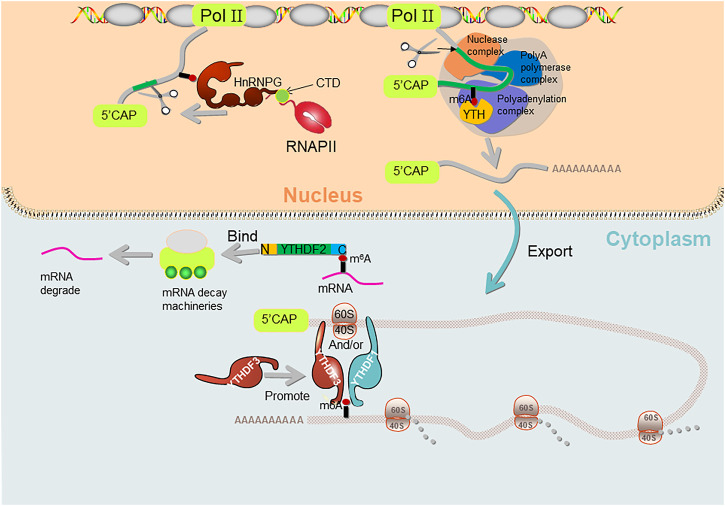
The molecular mechanisms of how m6A affects splicing/polyadenylation/translation. YTHDF1 and YTHDF3 regulate m6A both individually and together. hnRNPG binds to m6A-containing 3′-terminal mRNA and interacts with 40S and 60S ribosomal subunits to regulate mRNA translation, and YTHDF3 also facilitates this process. hnRNPG binds to m6a-containing pre-mRNA and interacts with RNA polymerase II (RNAP II) phosphorylated carboxy-terminal domain (CTD) of RNA polymerase II, which in turn regulates alternative splicing of mRNAs. C-YTHDF2 selectively recognizes m6A-containing mRNAs, while N-YTHDF2 on the other side binds to mRNA decay machineries and regulates mRNA degradation. YTH domain binds to the m6A-containing pre-mRNA and regulates the length of the 3′ UTR through polyadenylation complexes.
FIGURE 3
FIGURE 3
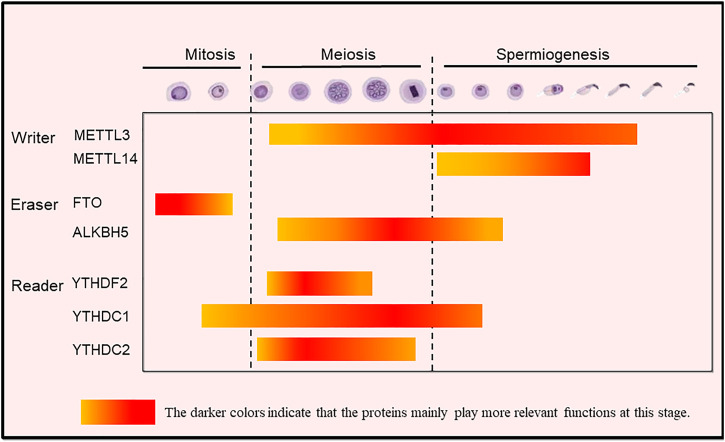
The m6A modification-related proteins exerting stage-dependent functions during spermatogenesis in mammals. Writers: METTL3 (and at lesser extent METTL14) regulates mainly spermatogonial homeostasis; METTL3/METTL14 complexes regulate spermiogenesis, namely the formation of flagellum; METTL16 inhibits spermatogonia proliferation and ensures normal germ cell differentiation; Erasers: FTO regulates cell-cycle in spermatogonia; ALKBH5 improves translation efficiency and rapid protein turnover mainly during spermiogenesis; Readers: YTHDF2 regulates meiotic progression; YTHDC1 is involved in co-transcriptional and/or post-transcriptional regulations in spermatogonia, spermatocytes, and round spermatids; YTHDC2 promotes translation and plays an essential role in gene expression and promotes translation during meiosis. The highlighted color indicates that the proteins mainly play functions at this stage.
FIGURE 4
FIGURE 4
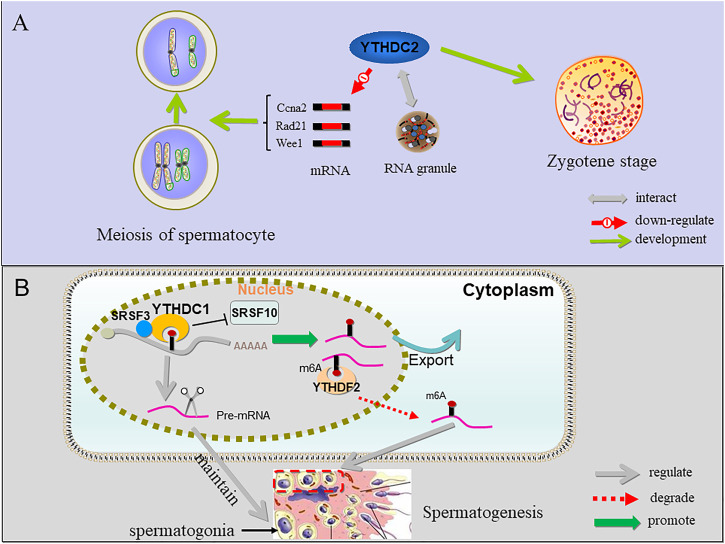
The function of YTHDC1, YTHDC2 and YTHDF2 in sperm cells. (A) YTHDC2 binds multiple transcripts including Ccna2 and other mitotic transcripts and interacts with RNA granule components, suggesting that proper progression of germ cells through meiosis is licensed by YTHDC2 through post-transcriptional regulation; when YTHDC2 is inactivated, spermatocytes do not pass the zygotene stage. (B) YTHDC1 can recruit SRSF3 and block SRSF10 to regulate alternative splicing of pre-mRNA crucial for maintaining spermatogonia. In addition, YTHDC1 can also promote the output of m6A-containing mRNA. YTHDF2 binds to the m6A site and degrade RNAs containing m6A involved in controlling migration and proliferation of spermatogonia.
FIGURE 5
FIGURE 5
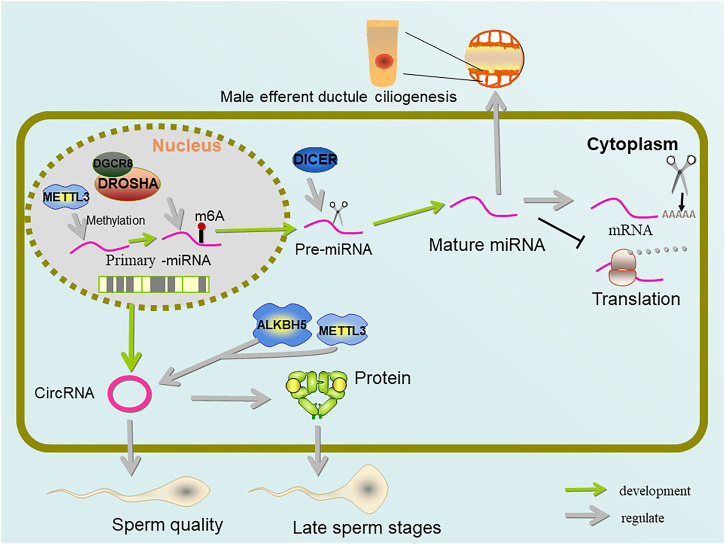
Regulation of miRNA and circRNA by METTL3 and ALKBH5. Pre-miRNA methylated by METTL3 shortens the mRNA poly(A) tail, inhibits mRNA translation, and forms output tubule cilia. METTL3 and ALKBH5 jointly control the amount of m6A on circRNA, which is important for sperm quality and protein supplementation in late sperm stages.
FIGURE 6
FIGURE 6
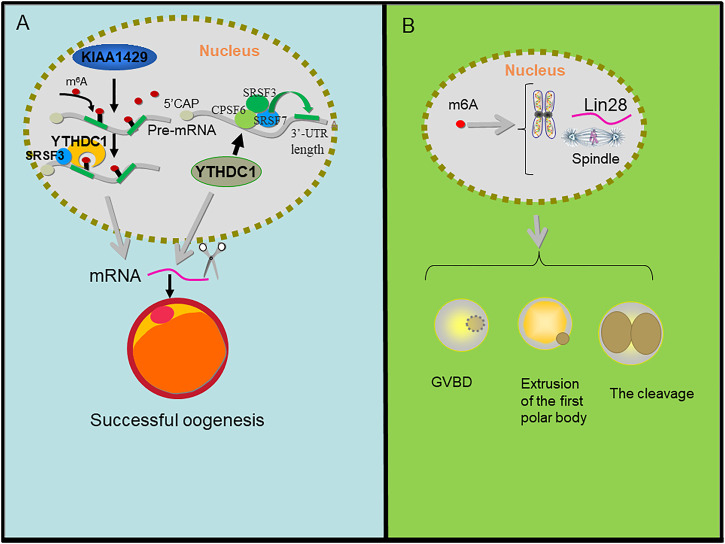
m6A regulation in oogenesis. (A) KIAA1429 mediates the m6A modification on pre-mRNA, then YTHDC1 recognizes the m6A signal and recruits SRSF3 to the binding regions on the KIAA1429-mediated pre-mRNA and YTHDC1 alters 3′ UTR length through associating with pre-mRNA 3′ end processing factors CPSF6, SRSF3, and SRSF7 which results in splicing of mRNA and then promotes oogenesis. (B) m6A affected gene abundance of pluripotent marker Lin28. It interferes with pluripotent regulation of chromosome/spindle tissue and regulates GVBD, PB1 extrusion, cleavage, and blastocyst development of parthenogenesis.
FIGURE 7
FIGURE 7
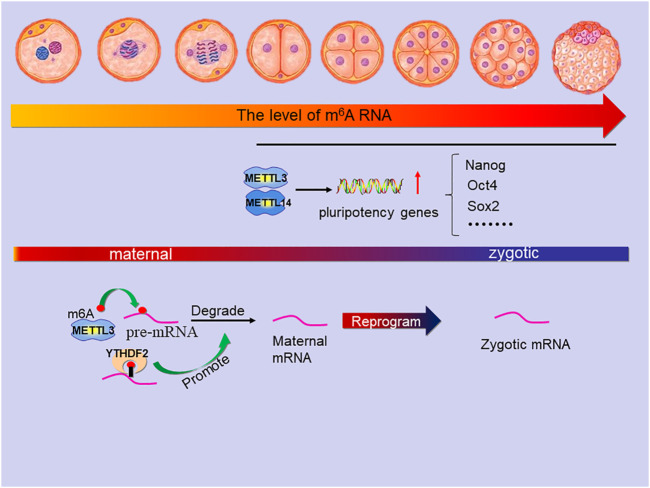
The main role of m6A in the stage of embryonic development. The level of m6A modification increased slowly in mouse 2-cell, 4-cell and 8-cell embryos but suddenly increased significantly in the transition period from morula to blastocyst which is due to the METTL3 and METTL14 active transcription of many pluripotency genes (includes Nanog, Oct4, Sox2 and so on). In the MZT, METTL3 mediates the m6A modification on pre-mRNA to degrade maternal mRNA and YTHDF2 can promote the process, which is reprogramming zygotic mRNA for zygotic development.

References

    1. Abby E., Tourpin S., Ribeiro J., Daniel K., Messiaen S., Moison D., et al. (2016). Implementation of Meiosis Prophase I Programme Requires a Conserved Retinoid-independent Stabilizer of Meiotic Transcripts. Nat. Commun. 7, 10324. 10.1038/ncomms10324 - DOI - PMC - PubMed
    1. Alarcón C. R., Goodarzi H., Lee H., Liu X., Tavazoie S., Tavazoie S. F. (2015a). HNRNPA2B1 Is a Mediator of m6A-dependent Nuclear RNA Processing Events. Cell 162, 1299–1308. 10.1016/j.cell.2015.08.011 - DOI - PMC - PubMed
    1. Alarcón C. R., Lee H., Goodarzi H., Halberg N., Tavazoie S. F. (2015b). N6-methyladenosine marks Primary microRNAs for Processing. Nature 519, 482–485. 10.1038/nature14281 - DOI - PMC - PubMed
    1. Ambros V., Bartel B., Bartel D. P., Burge C. B., Carrington J. C., Chen X., et al. (2003). A Uniform System for microRNA Annotation. Rna 9, 277–279. 10.1261/rna.2183803 - DOI - PMC - PubMed
    1. Asami M., Lam B. Y. H., Ma M. K., Rainbow K., Braun S., Vermilyea M. D., et al. (2021). Human Embryonic Genome Activation Initiates at the One-Cell Stage. Cell Stem Cell 29 (2), 209–216. e4. 10.1016/j.stem.2021.11.012 - DOI - PMC - PubMed

LinkOut - more resources