


Effectiveness of pre-emptive nerve block on opioid consumption in patients undergoing nasal surgery under general anaesthesia: A double-blinded randomised controlled study
- PMID: 35359478
- PMCID: PMC8963222
- DOI: 10.4103/ija.ija_813_21
Effectiveness of pre-emptive nerve block on opioid consumption in patients undergoing nasal surgery under general anaesthesia: A double-blinded randomised controlled study
Abstract
Background and aims: The efficacy of bilateral nasociliary and maxillary nerve blocks combined with general anaesthesia on intraoperative opioids consumption, emergence and recovery outcomes in adult patients is not well established. We conducted this study to test the hypothesis that the above blocks, combined with general anaesthesia, decrease the intraoperative opioid consumption following nasal surgery.
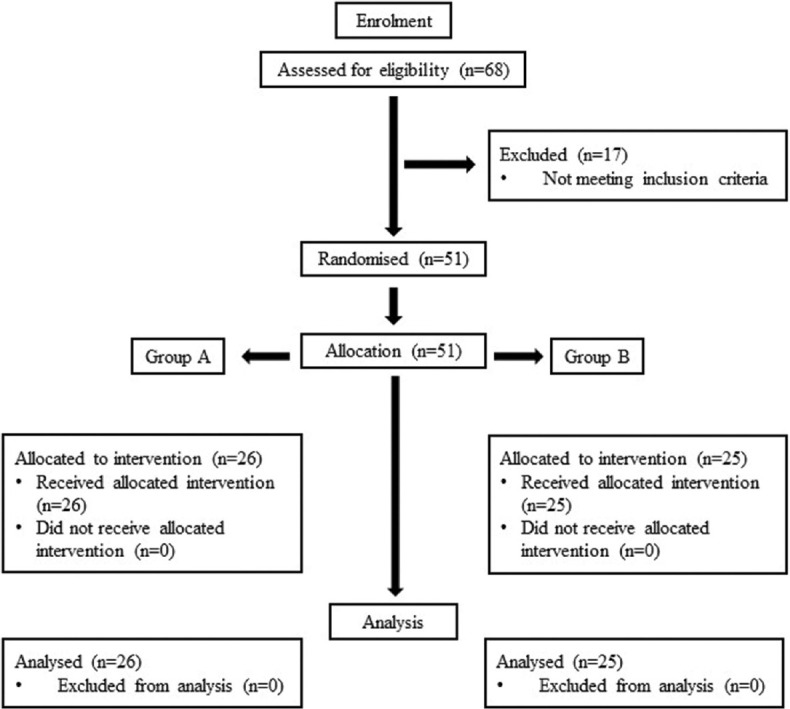
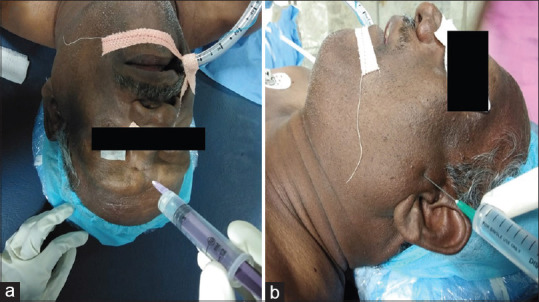
Methods: In this prospective, double-blinded, randomised controlled study, 51 adult patients undergoing elective nasal surgery under general anaesthesia were randomised into one of two groups. Group A (n = 26) received bilateral nasociliary and maxillary nerve blocks with 12 mL of equal volumes of 0.5% bupivacaine and 2% lignocaine after induction of general anaesthesia. Group B (n = 25) did not receive any block (control group). The primary endpoint was the total intraoperative dose of fentanyl consumed. The secondary endpoints were the grade of cough, emergence agitation, the grade of post-operative nausea and vomiting, time to the first analgesia and time to post-anaesthesia care unit discharge.
Results: The mean total intraoperative fentanyl dose (μg) was significantly lower in group A than in group B (2.31 ± 11.76 vs. 41.20 ± 31.00, P = 0.00). The incidence of emergence agitation was lower in group A than group B (11.5% vs. 88%, P = 0.00). The time to the first analgesia was significantly longer in group A than group B (543.27 vs. 199.84 min, P = 0.017).
Conclusion: The pre-emptive administration of bilateral nasociliary and maxillary nerve block for nasal surgery is an effective technique for reducing the intraoperative dose of fentanyl and emergence agitation.
Keywords: Anaesthesia; maxillary; nasal surgery; nasociliary; nerve blocks; pre-emptive.
Copyright: © 2022 Indian Journal of Anaesthesia.
Conflict of interest statement
There are no conflicts of interest.
Figures
References
-
- Gerbershagen HJ, Aduckathil S, van Wijck AJM, Peelen LM, Kalkman CJ, Meissner W. Pain intensity on the first day after surgery: A prospective cohort study comparing 179 surgical procedures. Anesthesiology. 2013;118:934–44. - PubMed
-
- Wittekindt D, Wittekindt C, Schneider G, Meissner W, Guntinas-Lichius O. Postoperative pain assessment after septorhinoplasty. Eur Arch Otorhinolaryngol. 2012;269:1613–21. - PubMed
-
- Lepousé C, Lautner CA, Liu L, Gomis P, Leon A. Emergence delirium in adults in the post-anaesthesia care unit. Br J Anaesth. 2006;96:747–53. - PubMed
-
- Yu D, Chai W, Sun X, Yao L. Emergence agitation in adults: Risk factors in 2,000 patients. Can J Anaesth. 2010;57:843–8. - PubMed
-
- Kissin I. Preemptive analgesia. Anesthesiology. 2000;93:1138–43. - PubMed
LinkOut - more resources
Full Text Sources
Medical