Review
. 2022 Mar 9:11:6.
doi: 10.12703/r/11-6. eCollection 2022.

Ca2+ regulation of constitutive vesicle trafficking

Affiliations
Review

Ca2+ regulation of constitutive vesicle trafficking

John Sargeant et al. Fac Rev. .

Abstract

Constitutive vesicle trafficking is the default pathway used by all cells for movement of intracellular cargoes between subcellular compartments and in and out of the cell. Classically, constitutive trafficking was thought to be continuous and unregulated, in contrast to regulated secretion, wherein vesicles are stored intracellularly until undergoing synchronous membrane fusion following a Ca2+ signal. However, as shown in the literature reviewed here, many continuous trafficking steps can be up- or down-regulated by Ca2+, including several steps associated with human pathologies. Notably, we describe a series of Ca2+ pumps, channels, Ca2+-binding effector proteins, and their trafficking machinery targets that together regulate the flux of cargo in response to genetic alterations as well as baseline and agonist-dependent Ca2+ signals. Here, we review the most recent advances, organized by organellar location, that establish the importance of these components in trafficking steps. Ultimately, we conclude that Ca2+ regulates an expanding series of distinct mechanistic steps. Furthermore, the involvement of Ca2+ in trafficking is complex. For example, in some cases, the same Ca2+ effectors regulate surprisingly distinct trafficking steps, or even the same trafficking step with opposing influences, through binding to different target proteins.

Keywords: Golgi; apoptosis-linked gene 2 (ALG-2); calcium; calcium channel; calcium signaling; endoplasmic reticulum; late endosomes; lysosomes; secretion; vesicle coat; vesicle trafficking.


Conflict of interest statement

The authors declare that they have no competing interests.No competing interests were disclosed.No competing interests were disclosed.

Figures
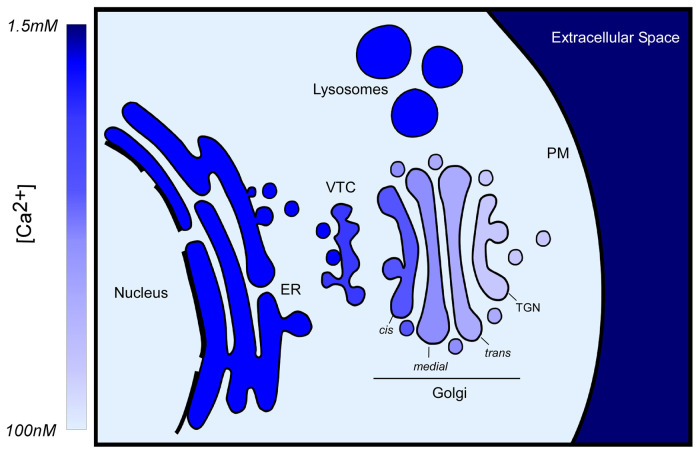
Figure 1.
Figure 1.. Ca2+ concentrations in constitutive trafficking.
Of the Ca2+ pools depicted, the low end is the cytosol, with a free [Ca2+] of about 100 nM. The concentration of Ca2+ decreases from the endoplasmic reticulum (ER) (~500 µM) to the cis-Golgi (~300 µM) to the trans-Golgi network (TGN) (50–100 µM),, in the same direction as anterograde secretion. Lysosomes contain a similar [Ca2+] to the ER,. At the high end is the extracellular space with typical [Ca2+] of 1.2 to 1.5 mM. PM, plasma membrane; VTC, vesicular tubular cluster.
Figure 2.
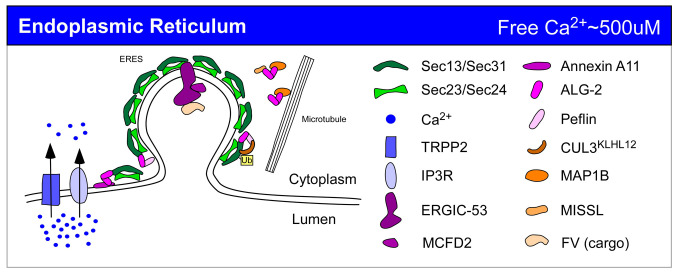
Figure 2.. Ca2+ regulation of constitutive secretion at the endoplasmic reticulum.
Prominent examples from the text are depicted and color-coded at an example endoplasmic reticulum exit site (ERES). Greens: trafficking machinery; pinks/purples: Ca2+-binding proteins; blues: Ca2+ pumps or channels; oranges: accessory proteins or cargo. Ub, monoubiquitination.
Figure 3.
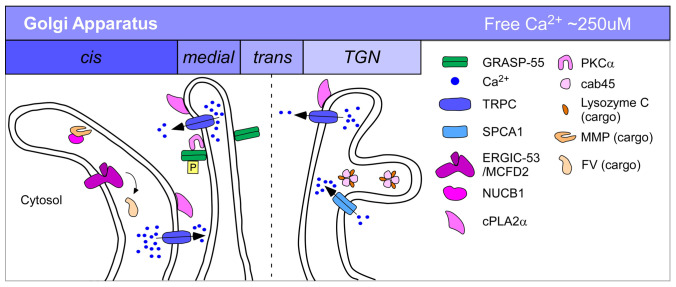
Figure 3.. Ca2+ regulation of constitutive secretion through the Golgi and trans-Golgi network (TGN).
Prominent examples from the text are depicted and color-coded in various Golgi compartments. Greens: trafficking machinery; pinks/purples: Ca2+-binding proteins; blues: Ca2+ pumps or channels; oranges: accessory proteins or cargo. P, phosphorylation.
Figure 4.
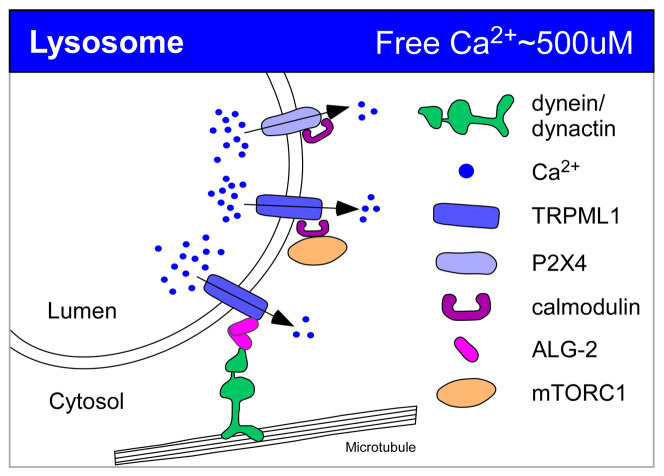
Figure 4.. Ca2+ regulation of constitutive secretion at the lysosome.
Prominent examples from the text are depicted and color-coded. Greens: trafficking machinery; pinks/purples: Ca2+-binding proteins; blues: Ca2+ pumps or channels; oranges: accessory proteins or cargo.

References

    1. Lowe M, Rabouille C, Nakamura N, et al. : Cdc2 Kinase Directly Phosphorylates the cis-Golgi Matrix Protein GM130 and Is Required for Golgi Fragmentation in Mitosis. Cell. 1998; 94(6): 783–93. 10.1016/s0092-8674(00)81737-7 - DOI - PubMed
    1. van Anken E, Romijn EP, Maggioni C, et al. : Sequential Waves of Functionally Related Proteins Are Expressed When B Cells Prepare for Antibody Secretion. Immunity. 2003; 18(2): 243–53. 10.1016/s1074-7613(03)00024-4 - DOI - PubMed
    1. Berridge MJ, Lipp P, Bootman MD: The versatility and universality of calcium signalling. Nat Rev Mol Cell Biol. 2000; 1(1): 11–21. 10.1038/35036035 - DOI - PubMed
    1. Chen JL, Ahluwalia JP, Stamnes M: Selective effects of calcium chelators on anterograde and retrograde protein transport in the cell. J Biol Chem. 2002; 277(38): 35682–7. 10.1074/jbc.M204157200 - DOI - PubMed
    1. Peters C, Mayer A: Ca2+/calmodulin signals the completion of docking and triggers a late step of vacuole fusion. Nature. 1998; 396(6711): 575–80. 10.1038/25133 - DOI - PubMed

LinkOut - more resources