


A Longitudinal Nine-Year Study of the Molecular Epidemiology of Carbapenemase-Producing Enterobacterales Isolated From a Regional Hospital in Taiwan: Predominance of Carbapenemase KPC-2 and OXA-48
- PMID: 35359715
- PMCID: PMC8963713
- DOI: 10.3389/fmicb.2022.703113
A Longitudinal Nine-Year Study of the Molecular Epidemiology of Carbapenemase-Producing Enterobacterales Isolated From a Regional Hospital in Taiwan: Predominance of Carbapenemase KPC-2 and OXA-48
Abstract
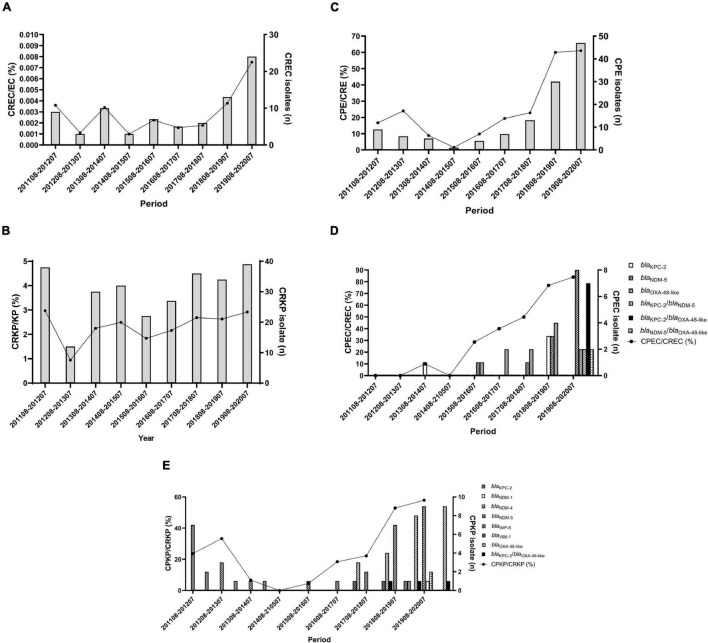
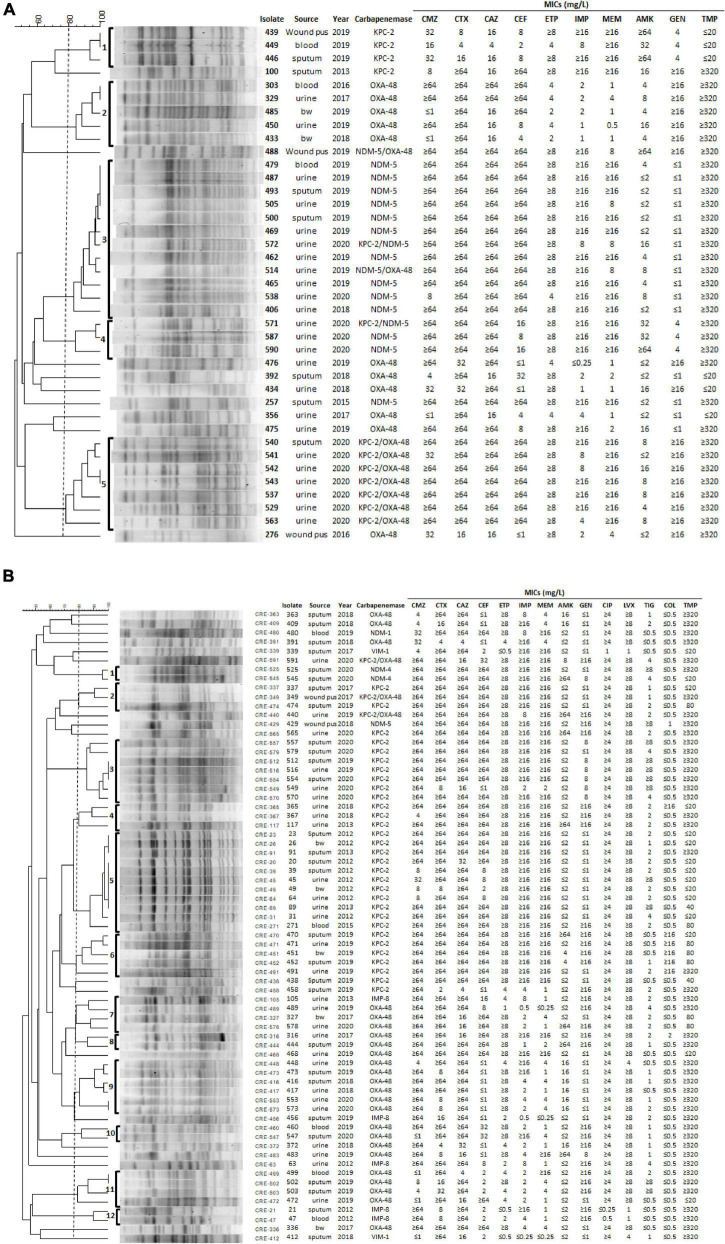
Enterobacterales clinical isolates are now being resistant to clinically achievable concentrations of most commonly used antibiotics that makes treatment of hospitalized patients very challenging. We hereby determine the molecular characteristics of carbapenemase genes in carbapenem-resistant Enterobacterales (CRE) isolates in Taiwan. A total of 455 CRE isolates were identified between August 2011 to July 2020. Minimum inhibitory concentrations for selected carbapenems were tested using Vitek 2, and carbapenemase genes were determined using polymerase chain reaction in combination with sequencing. Phenotypic detection of carbapenemase was determined by modified carbapenem inactivation method (mCIM) and EDTA-modified carbapenem inactivation method (eCIM) to validate our PCR screening results. Pulsed-field gel electrophoresis (PFGE) was used to determine the clonality of carbapenemase-producing Enterobacterales (CPE) isolates, and the transferability of carbapenemase-carrying plasmids was determined by conjugation assays. A slight increase in carbapenem-resistant E. coli (CREC) was observed, however, the prevalence of carbapenem-resistant K. pneumoniae (CRKP) was steady, during 2011-2020. The dominant species among our CRE was K. pneumoniae (270/455, 59.3%), followed by E. coli (81/455, 17.8%), Morganella morganii (32/455, 7.0%), and Enterobacter cloacae (25/455, 5.5%). From 2011 to 2020, the total percentage of CPE increased steadily, accounting for 61.0% of CRE in 2020. Moreover, 122 of 455 CRE isolates (26.8%) were CPE. Among the CPE isolates, the dominant carbapenemase gene was bla OXA-48-like (54/122, 44.3%), and the second most common carbapenemase gene was bla KPC-2 (47/122, 38.5%). The sensitivity and specificity for mCIM to detect carbapenemase in the 455 isolates were both 100% in this study. The PFGE results showed that 39 carbapenemase-producing E. coli and 69 carbapenemase-producing K. pneumoniae isolates carrying bla KPC-2 and/or bla NDM-5 could be classified into 5 and 12 clusters, respectively. In conclusion, our results showed an increase in CPE isolates in Taiwan. Moreover, the distribution of carbapenemase and antimicrobial susceptibility in CPE were associated with PFGE typing.
Keywords: KPC-2; NDM; OXA-48; carbapenem-resistant Enterobacterales (CRE); carbapenemase; pulsed-field gel electrophoresis (PFGE).
Copyright © 2022 Duong, Tsai, Wen, Chiu, Chen, Thuy, Kuo, Hidrosollo, Wang, Zhang, Lin, Wang and Kao.
Conflict of interest statement
The authors declare that the research was conducted in the absence of any commercial or financial relationships that could be construed as a potential conflict of interest.
Figures
References
-
- Bando S. Y., Andrade F. B., Guth B. E., Elias W. P., Moreira-Filho C. A., Pestana de Castro A. F. (2009). Atypical enteropathogenic Escherichia coli genomic background allows the acquisition of non-EPEC virulence factors. FEMS Microbiol. Lett. 299 22–30. 10.1111/j.1574-6968.2009.01735.x - DOI - PubMed
LinkOut - more resources
Full Text Sources
Research Materials
Miscellaneous
