. 2022 Mar 29:23:100441.
doi: 10.1016/j.lanwpc.2022.100441. eCollection 2022 Jun.

Temporal changes in factors associated with COVID-19 vaccine hesitancy and uptake among adults in Hong Kong: Serial cross-sectional surveys

Affiliations

Temporal changes in factors associated with COVID-19 vaccine hesitancy and uptake among adults in Hong Kong: Serial cross-sectional surveys

Jingyi Xiao et al. Lancet Reg Health West Pac. .

Abstract

Background: COVID-19 vaccine hesitancy can lead to reduced vaccine uptake and hinder the safe relaxation of other public health measures. This study aims to explore the factors associated with vaccine hesitancy and uptake among adults before and after the implementation of the COVID-19 vaccination program in Hong Kong.

Methods: Cross-sectional telephone surveys were conducted every four weeks over a nine-month period from November 2020 through July 2021. Target respondents were Hong Kong resident aged 18 or above and recruited by random-digit dialling. In each survey, responses on COVID-19 vaccine hesitancy and COVID-19 vaccine uptake were collected as primary and secondary outcomes, respectively. Data of potentially associated factors, including socio-demographics, chronic medical conditions, perceived risk of COVID-19, perceived personal efficacy in self-protection, confidence in the government's ability to control the pandemic, compliance with social distancing measures, and confidence in COVID-19 vaccines, were also collected. Multivariable logistic regression models were used to examine the factors associated with COVID-19 vaccine hesitancy at different time points.

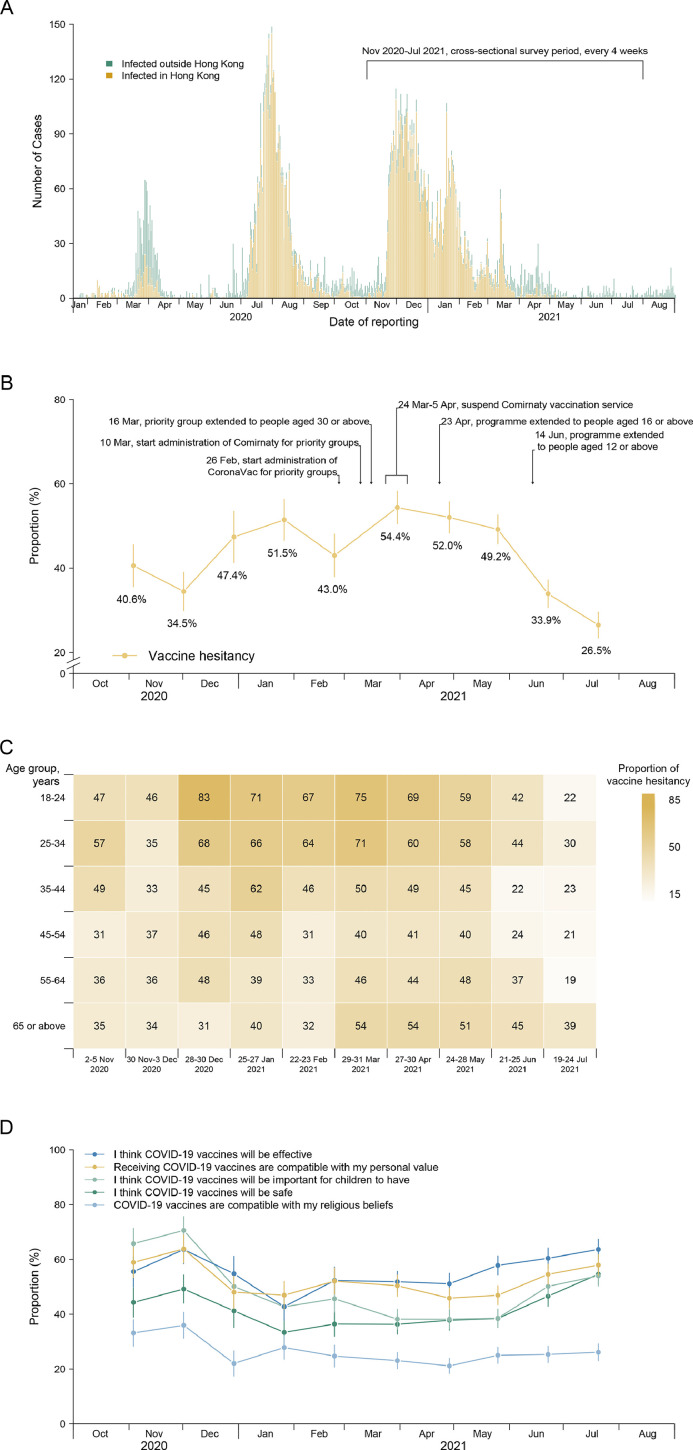
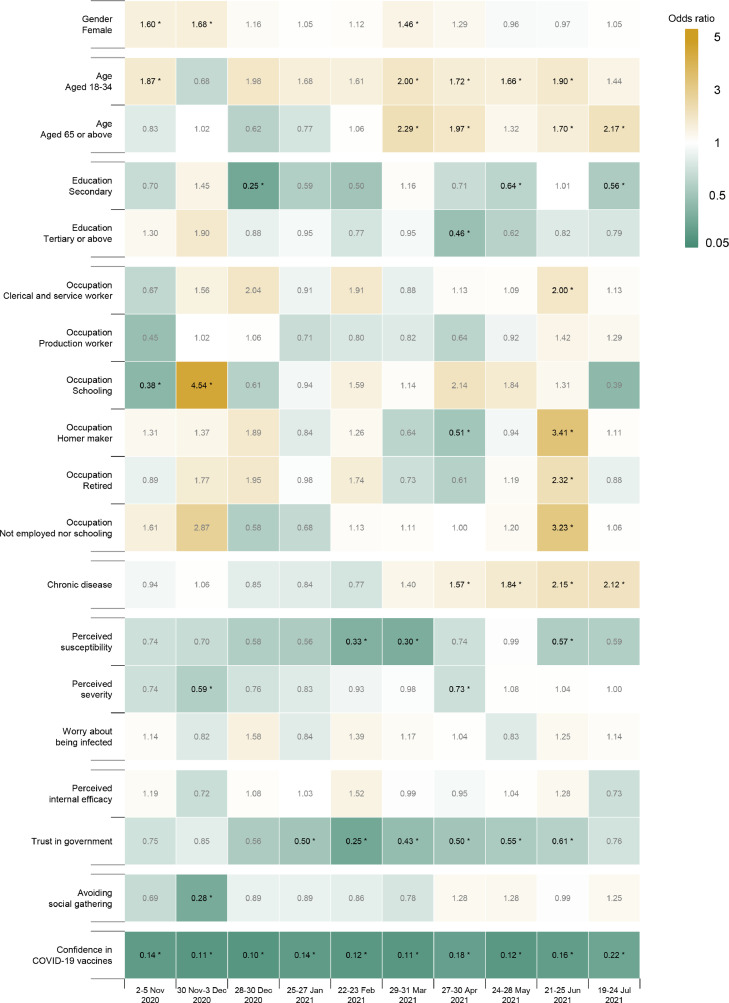
Findings: Ten cross-sectional surveys were conducted, including 7411 respondents. The levels of vaccine hesitancy fluctuated over time. From December 2020 to May 2021, the age group with the highest vaccine hesitancy was young adults 18-34y, while the vaccine hesitancy was highest among adults ≥ 65y in June-July 2021 (Fig. 2C). Our regression analyses (Fig. 3) showed that before and at the beginning of the rollout of the mass vaccination program, there was no statistically significant association between chronic medical conditions and vaccine hesitancy. However, two-five months after the program implementation respondents with chronic medical conditions were more likely to be hesitant. From January to June 2021, higher confidence in the government was associated with lower vaccine hesitancy (Fig. 3). Confidence in COVID-19 vaccines was consistently associated with lower vaccine hesitancy at different stages of the program.

Interpretation: The factors associated with COVID-19 vaccine hesitancy changed over time. This study highlighted the importance to monitor temporal changes in COVID-19 vaccine hesitancy and associated factors, and adjust promotion strategies correspondingly to boost vaccination uptake.

Funding: Health and Medical Research Fund, Hong Kong.


Conflict of interest statement

BJC consults for AstraZeneca, GSK, Moderna, Pfizer, Roche and Sanofi Pasteur. The authors report no other potential conflicts of interest.

Figures
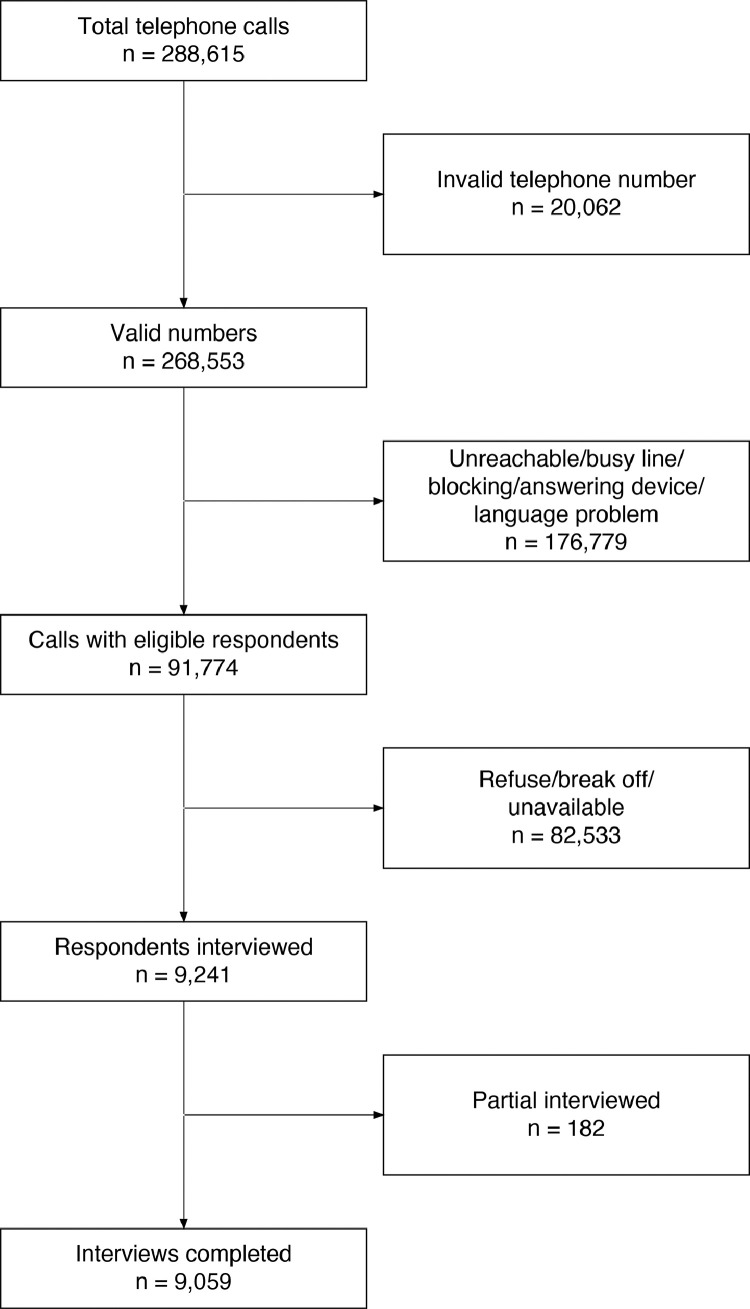
Fig 1
Figure 1
Flow chart of respondent recruitment and interview. There were 1004, 1004 and 1010 respondents in the first three rounds of surveys (2–5 November 2020, 30 November -3 December 2020 and 28–30 December 2020), respectively. But only 504, 537 and 329 respondents in these surveys were invited to answer the vaccination intention question. Therefore, there were 7,411 respondents included in the analysis.
Fig 2
Figure 2
Panel A. COVID-19 cases by date of reporting. The reporting period is from 18 January 2020 to 31 August 2021. Panel B. COVID-19 vaccine hesitancy. COVID‐19 vaccine hesitancy was defined as never, very unlikely, unlikely, or evens to get vaccinated, rather than likely, very likely or certain to vaccinate or already vaccinated. The proportions of COVID-19 vaccine hesitancy were weighted to the Hong Kong census data in 2019, with 95% CI +/- about 3%. Panel C. COVID-19 vaccine hesitancy stratified by age. Proportions shown in Panel C are unweighted age-stratified vaccine hesitancy rates. Panel D. COVID-19 vaccine confidence. Vaccine confidence was defined as agree or strongly agree to statements rather than neutral, disagree or strongly disagree. The proportions of vaccine confidence were weighted to the Hong Kong census data in 2019, with 95% CI +/- about 3%.
Fig 3
Figure 3
Multivariable logistic regression analysis of potential factors associated with COVID-19 vaccine hesitancy. Numbers in the boxes are odds ratios. Numbers in black and with “*” indicate statistically significant. Green color indicates less likely to be hesitant and orange indicates more likely to be hesitant.
Fig 4
Figure 4
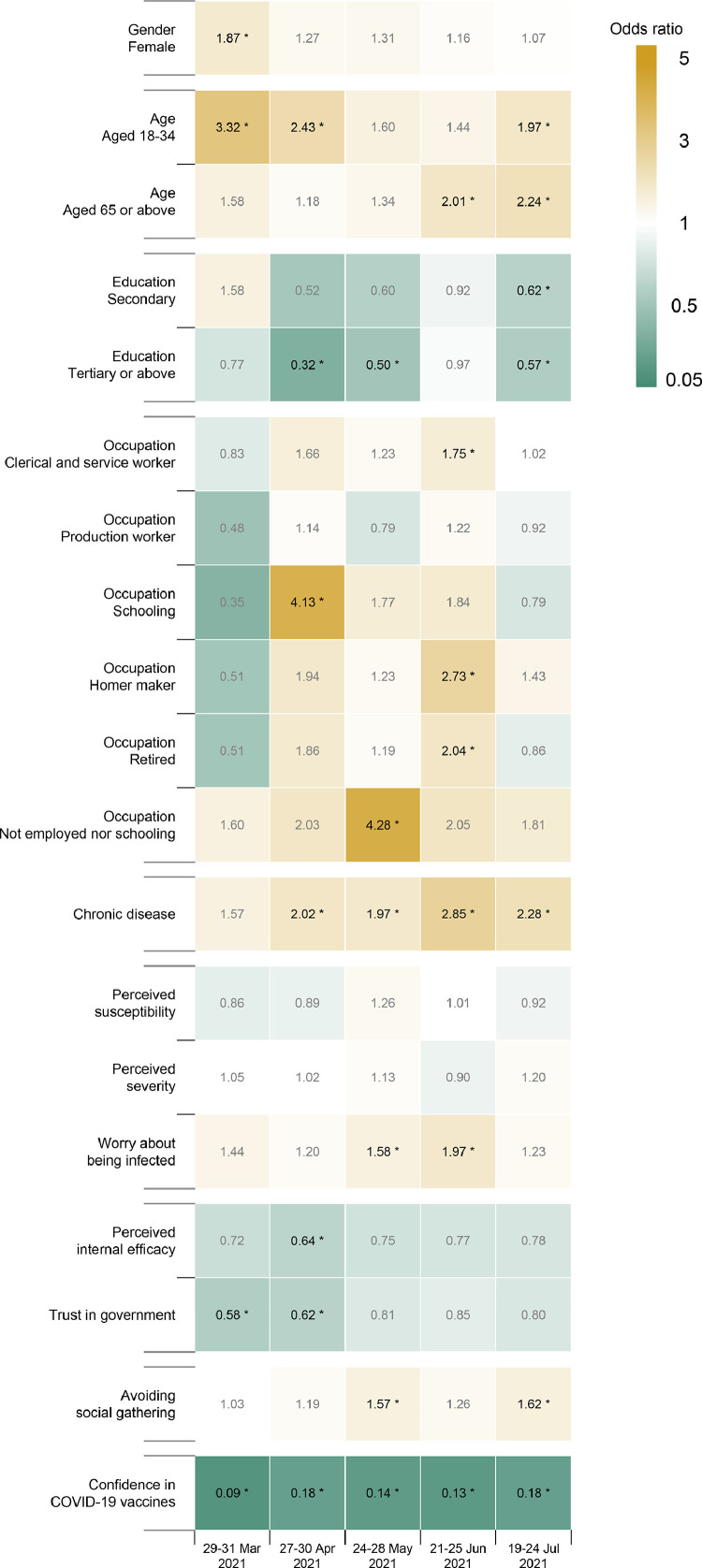
Multivariable logistic regression analysis of potential factors associated with COVID-19 vaccine uptake. Numbers in the boxes are odds ratios. Numbers in black and with “*” indicate statistically significant. Green color indicates more likely to be already vaccinated and orange indicates less likely to be already vaccinated.

References

    1. Al Kaabi N., Zhang Y., Xia S., et al. Effect of 2 inactivated SARS-CoV-2 vaccines on symptomatic COVID-19 infection in adults: a randomized clinical trial. JAMA. 2021;326(1):35–45. - PMC - PubMed
    1. Thomas S.J., Moreira E.D., Kitchin N., et al. Safety and efficacy of the BNT162b2 mRNA COVID-19 vaccine through 6 months. N Engl J Med. 2021;385:1761–1773. - PMC - PubMed
    1. Tartof S.Y., Slezak J.M., Fischer H., et al. Effectiveness of mRNA BNT162b2 COVID-19 vaccine up to 6 months in a large integrated health system in the USA: a retrospective cohort study. Lancet. 2021;398(10309):1407–1416. - PMC - PubMed
    1. Madhi S.A., Baillie V., Cutland C.L., et al. Efficacy of the ChAdOx1 nCoV-19 COVID-19 vaccine against the B. 1.351 variant. N Engl J Med. 2021;384(20):1885–1898. - PMC - PubMed
    1. Singanayagam A., Hakki S., Dunning J., et al. Community transmission and viral load kinetics of the SARS-CoV-2 delta (B. 1.617. 2) variant in vaccinated and unvaccinated individuals in the UK: a prospective, longitudinal, cohort study. Lancet Infect Dis. 2022;22(2):183–195. - PMC - PubMed

LinkOut - more resources