


Contributions of COVID-19 Pandemic-Related Stressors to Racial and Ethnic Disparities in Mental Health During Pregnancy
- PMID: 35360124
- PMCID: PMC8964047
- DOI: 10.3389/fpsyt.2022.837659
Contributions of COVID-19 Pandemic-Related Stressors to Racial and Ethnic Disparities in Mental Health During Pregnancy
Abstract
Background: This study aimed to identify racial and ethnic disparities in prenatal mental health and identify COVID-19 pandemic-related health/healthcare and economic contributors to these disparities, using an established framework for disparity investigation.
Methods: This cross-sectional study includes 10,930 pregnant people at Kaiser Permanente Northern California who completed an online survey between June 22, 2020 and April 28, 2021 on COVID-19 pandemic-related health/healthcare and economic stressors, depression, and anxiety. Self-reported race and ethnicity were extracted from electronic health records. Weighted analyses were used to evaluate the association between racial and ethnic category and prenatal depression and anxiety; the prevalence of each stressor by race and ethnicity; and the relationship between each stressor and prenatal depression and anxiety in each racial and ethnic category.
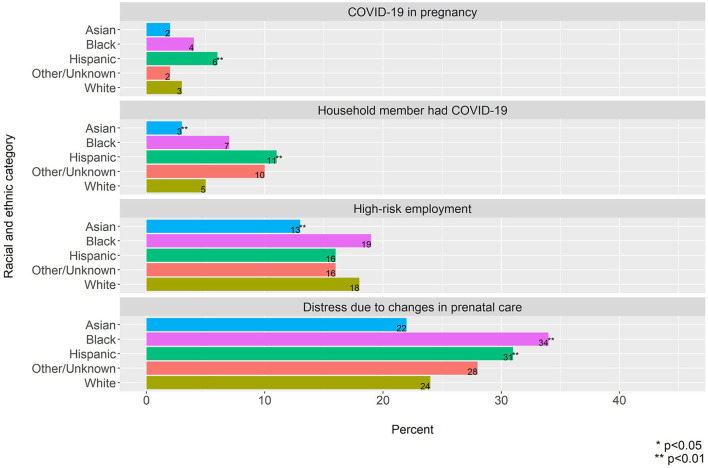
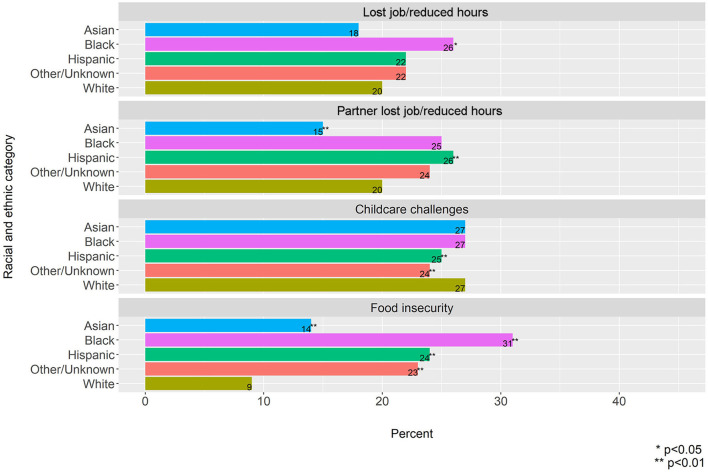
Results: The sample was 22% Asian, 3% Black, 20% Hispanic, 5% Other/Multiracial/Unknown, and 49% White. Compared to White people, Black and Hispanic people had a higher prevalence of prenatal depression (aPR: 1.85, 95% CI: 1.45, 2.35 and aPR: 1.17, 95% CI: 1.00, 1.37, respectively) and anxiety (aPR: 1.71, 95% CI: 1.34, 2.18 and aPR: 1.10, 95% CI: 0.94, 1.29, respectively). Compared to White people, Black and Hispanic people had a higher prevalence of moderate/severe distress due to changes in prenatal care (24 vs. 34 and 31%), and food insecurity (9 vs. 31 and 24%). Among Black and Hispanic people, distress due to changes in prenatal care was associated with a greater prevalence of prenatal depression (aPR: 2.27, 95% CI: 1.41, 3.64 and aPR: 2.76, 95% CI: 2.12, 3.58, respectively) and prenatal anxiety (aPR: 3.00, 95% CI: 1.85, 4.84 and aPR: 2.82, 95% CI: 2.15, 3.71, respectively). Additionally, among Hispanic people, high-risk employment and food insecurity were associated with a greater prevalence of prenatal depression and anxiety.
Conclusions: This study identified racial and ethnic disparities in mental health for pregnant Black and Hispanic people. Distress due to prenatal care changes contributed to the observed disparities in prenatal depression and anxiety for Black and Hispanic people and food insecurity additionally contributed to the observed disparities for Hispanic people. Addressing distress due to changes to prenatal care and food insecurity specifically in Black and Hispanic people may help reduce the high burden of poor mental health and reduce observed disparities in these communities.
Keywords: COVID-19; antenatal anxiety; antenatal depression; prenatal anxiety; prenatal depression; social determinants of health; stressors.
Copyright © 2022 Avalos, Nance, Zhu, Croen, Young-Wolff, Zerbo, Hedderson, Ferrara, Ames and Badon.
Conflict of interest statement
LA, NN, YZ, LC, KY-W, OZ, MH, AF, JA, and SB were employed by Kaiser Permanente Northern California.
Figures
References
-
- Ellington S SP, Tong VT, Woodworth K, Galang RR, Zambrano LD, Nahabedian J, et al. Characteristics of women of reproductive age with laboratory-confirmed SARS-CoV-2 infection by pregnancy status — United States, January 22–June 7, 2020. MMWR Morb Mortal Wkly Rep. (2020) 69:769–75. 10.15585/mmwr.mm6925a1 - DOI - PMC - PubMed
-
- ACOG . Coronavirus (COVID-19), Pregnancy, and Breastfeeding: A Message for Patients: American College of Obstetricians and Gynecologists. (2021). Available online at: https://www.acog.org/womens-health/faqs/coronavirus-covid-19-pregnancy-a... (accessed November 2, 2021).
Grants and funding
LinkOut - more resources
Full Text Sources
Miscellaneous
