


Interrelationship Amongst University Student Perceived Learning Burnout, Academic Self-Efficacy, and Teacher Emotional Support in China's English Online Learning Context
- PMID: 35360629
- PMCID: PMC8963801
- DOI: 10.3389/fpsyg.2022.829193
Interrelationship Amongst University Student Perceived Learning Burnout, Academic Self-Efficacy, and Teacher Emotional Support in China's English Online Learning Context
Abstract
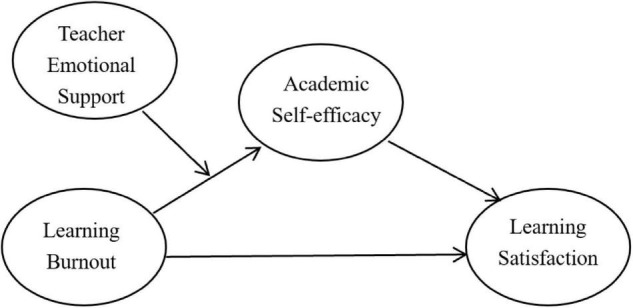
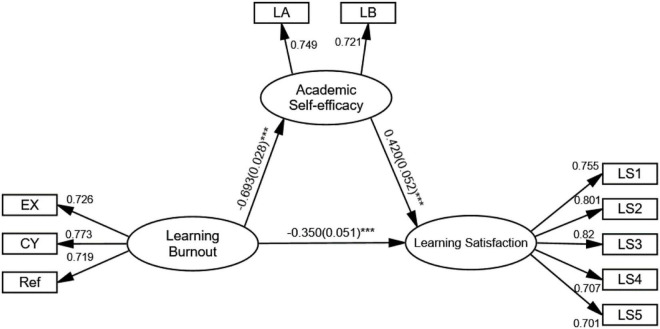
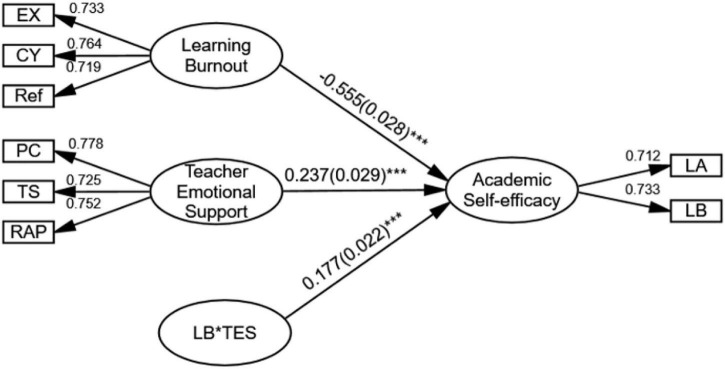
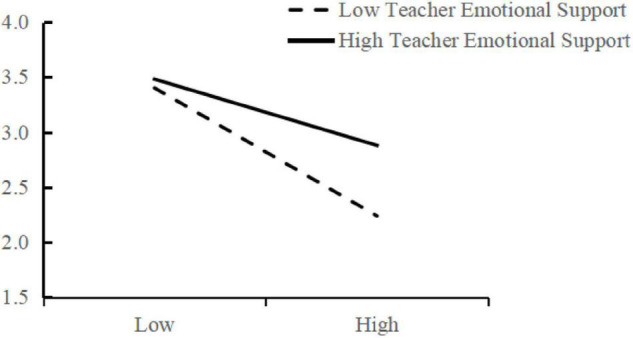
This study seeks to explore the impact of learning burnout on university students' English learning effect in the online environment. Through a large sample questionnaire survey, the study uses structural equation modelling to measure the interactions amongst university students' English online learning burnout (EOLB), academic self-efficacy (AEE), and teacher emotional support (TES), thereby analysing and summarising the characteristics of their impacts on students' online learning satisfaction. The results from the data analysis show that AEE plays a mediating role between students' EOLB and learning satisfaction, and TES plays a moderating role between students' EOLB and AEE, which all eventually influence students' online learning effect manifested in aspects such as behaviour, cognition, and emotion. Given the results, the study further provides suggestions for alleviating university students' EOLB, which can be used to optimise English online teaching design and learning practice.
Keywords: EFL learning; academic self-efficacy; learning burnout; online learning context; teacher emotional support.
Copyright © 2022 Yang, Sun and Jiang.
Conflict of interest statement
The authors declare that the research was conducted in the absence of any commercial or financial relationships that could be construed as a potential conflict of interest.
Figures
References
-
- Ahmad S., Zulkurnain N. N. A., Khairushalimi F. I. (2016). Assessing the validity and reliability of a measurement model in Structural Equation Modeling (SEM). J. Adv. Math. Comput. Sci. 15 1–8. 10.9734/BJMCS/2016/25183 - DOI
-
- Aldhahi M. I., Alqahtani A. S., Baattaiah B. A., Al-Mohammed H. I. (2021). Exploring the relationship between students’ learning satisfaction and self-efficacy during the emergency transition to remote learning amid the coronavirus pandemic: a cross-sectional study. Educ. Inform. Technol. 27 1323–1340. 10.1007/s10639-021-10644-7 - DOI - PMC - PubMed
-
- Ariani D. W. (2017). Why am I burnout and engaged? The role of motivation and personality. J. Psychol. Educ. Res. 25 61–89.
-
- Artino A. R., Jr., Jones K. D., II (2012). Exploring the complex relations between achievement emotions and self-regulated learning behaviors in online learning. Internet High. Educ. 15 170–175. 10.1016/j.iheduc.2012.01.006 - DOI
-
- Bandura A. (2003). Perceived self-efficacy in cognitive development and functioning. Educ. Psychol. 28 117–148. 10.1207/s15326985ep2802_3 - DOI
LinkOut - more resources
Full Text Sources
