


Incidence of Injury for Professional Soccer Players in the United States: A 6-Year Prospective Study of Major League Soccer
- PMID: 35360881
- PMCID: PMC8961375
- DOI: 10.1177/23259671211055136
Incidence of Injury for Professional Soccer Players in the United States: A 6-Year Prospective Study of Major League Soccer
Abstract
Background: Despite an abundance of injury research focusing on European professional soccer athletes, there are limited injury data on professional soccer players in the United States.
Purpose: To describe the epidemiology of injury across multiple years in Major League Soccer (MLS) players.
Study design: Descriptive epidemiology study.
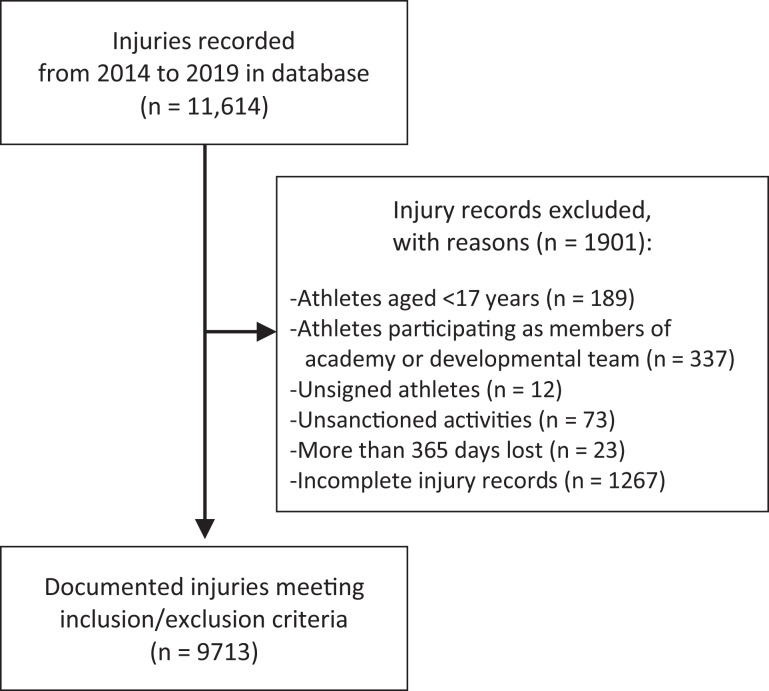
Methods: A web-based health management platform was used to prospectively collect injury data from all MLS teams between 2014 and 2019. An injury was defined as an incident that required medical attention and was recorded into the health management platform anytime over the course of the 2014-2019 seasons. Injuries and exposure data were recorded in training and match settings to calculate injury incidence.
Results: A total of 9713 injuries were recorded between 2014 and 2019. A mean 1.1 injuries per year per player were identified, with midfielders sustaining the largest number of injuries. The most common injuries were hamstring strains (12.3%), ankle sprains (8.5%), and adductor strains (7.6%). The mean time missed per injury was 15.8 days, with 44.2% of injuries resulting in no days missed. Overall injury incidence was 8.7 per 1000 hours of exposure, declining over the course of the investigation, with a 4.1-times greater mean incidence during matches (14.0/1000 h) than training (3.4/1000 h).
Conclusion: Between 2014 and 2019, the most commonly reported injuries in MLS players were hamstring strains, ankle sprains, and adductor strains. Injury incidence during matches was 4.1 times greater when compared with training, while overall injury incidence was found to decline during the course of the study period.
Keywords: Major League Soccer; ankle; hamstring; injury; injury incidence; professional soccer.
© The Author(s) 2022.
Conflict of interest statement
One or more of the authors has declared the following potential conflict of interest or source of funding: B.F. has received grants from Arthrex and Stryker, research support from Smith & Nephew, education payments from Medwest, consulting fees from Stryker, and personal fees from Elsevier and has stock/stock options in Jace Medical. M.D.C. has received education payments from Smith & Nephew and hospitality payments from Abbott, Misonix, and Stryker. D.H. has received hospitality payments from Horizon Pharma and Sentnyl Therapeutics. B.R.M. has received consulting fees from Arthrex, Biomarin, DePuy, and Exactech; speaking fees from Arthrex; and hospitality payments from Aesculap, Bioventus, Ferring, Flexion, Sanofi, and Stryker. L.L. has received consulting fees from Aesculap and hospitality payments from Ferring, Fidia, Flexion, Orthofix, Pacira, Sanofi, and Si-bone. E.G. has received education payments from Sequoia; consulting fees from Arthrex, Ipsen, MedShape, and Zimmer; royalties from Arthrex and Zimmer; honoraria from In2Bones; and hospitality payments from ACELL, Evolution Surgical, Integra, Steelhead Surgical, and Stryker. AOSSM checks author disclosures against the Open Payments Database (OPD). AOSSM has not conducted an independent investigation on the OPD and disclaims any liability or responsibility relating thereto.
Figures
References
-
- Al-Kashmiri A, Delaney J. Head and neck injuries in football (soccer). Trauma. 2006;8:189–195.
-
- Aoki H, O’Hata N, Kohno T, et al. A 15-year prospective epidemiological account of acute traumatic injuries during official professional soccer league matches in Japan. Am J Sports Med. 2012;40(5):1006–1014. - PubMed
-
- Azubuike SO, Okojie OH. An epidemiological study of football (soccer) injuries in Benin City, Nigeria. Br J Sports Med. 2009;43(5):382–386. - PubMed
-
- Bengtsson H, Ekstrand J, Hägglund M. Muscle injury rates in professional football increase with fixture congestion: an 11-year follow-up of the UEFA Champions League injury study. Br J Sports Med. 2013;47(12):743–747. - PubMed
