. 2021 Dec 8;3(2):242-249.
doi: 10.1039/d1cb00200g. eCollection 2022 Feb 9.

A COVID-19 vaccine candidate composed of the SARS-CoV-2 RBD dimer and Neisseria meningitidis outer membrane vesicles

Affiliations

A COVID-19 vaccine candidate composed of the SARS-CoV-2 RBD dimer and Neisseria meningitidis outer membrane vesicles

Darielys Santana-Mederos et al. RSC Chem Biol. .

Abstract

SARS-CoV-2 infection is mediated by the interaction of the spike glycoprotein trimer via its receptor-binding domain (RBD) with the host's cellular receptor. Vaccines seek to block this interaction by eliciting neutralizing antibodies, most of which are directed toward the RBD. Many protein subunit vaccines require powerful adjuvants to generate a potent antibody response. Here, we report on the use of a SARS-CoV-2 dimeric recombinant RBD combined with Neisseria meningitidis outer membrane vesicles (OMVs), adsorbed on alum, as a promising COVID-19 vaccine candidate. This formulation induces a potent and neutralizing immune response in laboratory animals, which is higher than that of the dimeric RBD alone adsorbed on alum. Sera of people vaccinated with this vaccine candidate, named Soberana01, show a high inhibition level of the RBD-ACE2 interaction using RBD mutants corresponding to SARS-CoV-2 variants of concern and wild-type expressed using the phage display technology. To our knowledge, this is the first time that the immunostimulation effect of N. meningitidis OMVs is evaluated in vaccine candidates against SARS-CoV-2.


Conflict of interest statement

The authors declare no financial conflicts of interest. Some of the authors are co-inventors on a provisional SARS-CoV-2 vaccine patent (Cu 2020-57) based on these results.

Figures
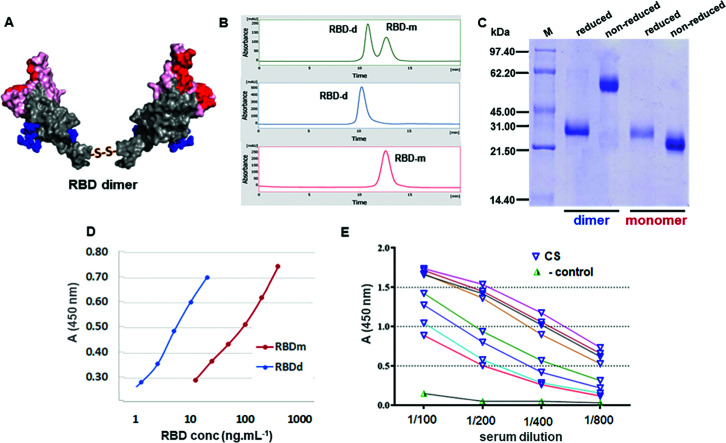
Fig. 1
Fig. 1. Characterization of the recombinant RBD dimer. (A) Structure of the RBD dimer (red: amino acids contacting the ACE2 receptor upon binding, pink: RBM, blue: glycan chains, grey: RBD core). (B) SE-HPLC chromatograms of the RBD-d/RBD-m mixture and the purified antigens. (C) RBD-d and RBD-m in reducing and non-reducing SDS-PAGE. (D) Interaction of RBD-d and RBD-m with the ACE2 receptor expressed in Vero cells. (E) Recognition of RBD-d by eight convalescent sera from a Cuban panel.
Fig. 2
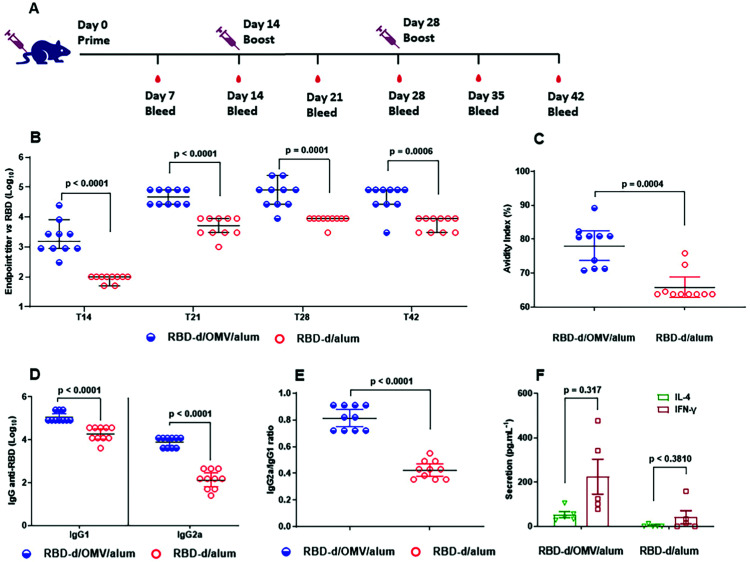
Fig. 2. Preclinical immunogenicity evaluation. Immunization of BALB/c mice with RBD-d/OMV/alum (blue) and RBD-d/alum (red). (A) Immunization protocol. (B) Anti-RBD IgG at days 14, 21, 28 and 42. (C) Avidity index of anti-RBD IgG elicited on day 42. (D) Anti-RBD IgG1 and IgG2a titers. (E) Anti-RBD IgG2a/IgG1 ratio. (F). Cytokine secretion (IL-4 and IFN-γ) after in vitro stimulation with RBD-d.
Fig. 3
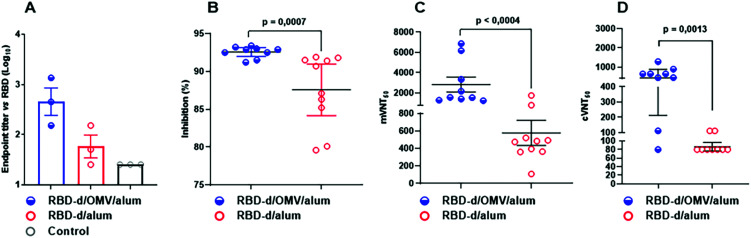
Fig. 3. Virus neutralization by anti-RBD antibodies induced by formulations RBD-d/OMV/alum and RBD-d/alum. (A) Classical passive transfer of splenocytes from BALB/c mice immunized with each vaccine formulation or placebo to naïve recipient mice and stimulated with RBD-d/alum (secondary response on day 7 after immunization). (B) Percentage of inhibition of the RBD-ACE2 interaction at 1/100 serum dilution. (C) mVNT50 represents the serum dilution giving 50% inhibition of the RBD-ACE2 interaction. (D) cVNT50 measured as serum dilution giving 50% of virus neutralization.
Fig. 4
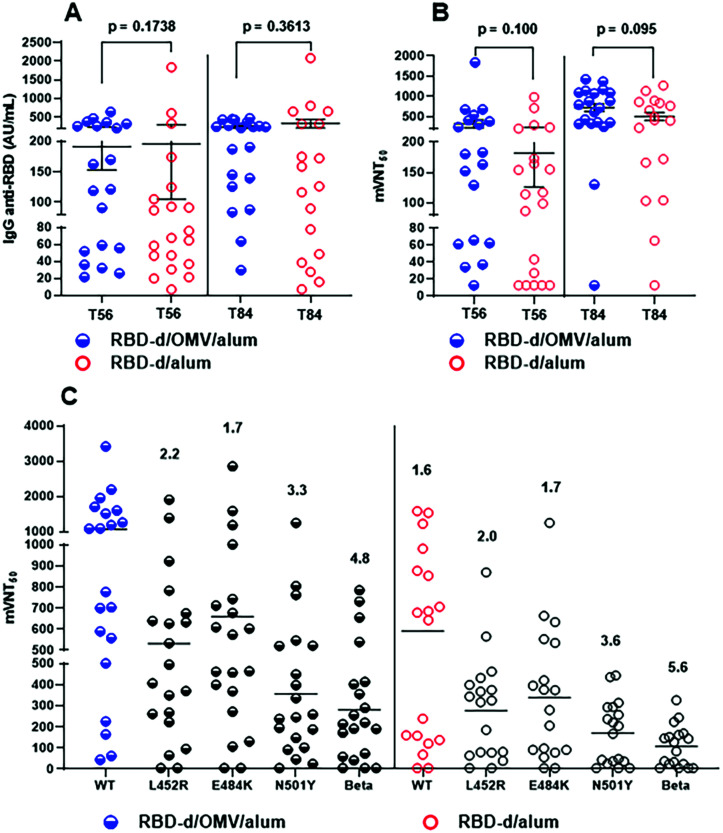
Fig. 4. Immunogenicity evaluation from a phase I clinical trial. Subjects immunized with RBD-d/OMV (50 μg/20 μg, blue) vs. RBD-d (50 μg, red) adsorbed in alum. (A) Anti-RBD IgG titers. (B) mVNT50 represents the serum dilution giving 50% inhibition of the RBD-ACE2 interaction. (C) mVNT50 comparing the inhibition of the interaction between the phage-displayed RBD mutants and the ACE2 receptor. Represented are the ratios of geometric mean titers (GMTs) between the RBD wild-type and the RBD mutants for each of the two vaccine formulations and the ratio of GMTs between the two formulations for the RBD wild-type.

References

    1. Krammer F. SARS-CoV-2 vaccines in development. Nature. 2020;586:516–527. doi: 10.1038/s41586-020-2798-3. - DOI - PubMed
    1. Li Y. Tenchov R. Smoot J. Liu C. Watkins S. Zhou Q. A Comprehensive Review of the Global Efforts on COVID-19 Vaccine Development. ACS Cent. Sci. 2021;7:512–533. doi: 10.1021/acscentsci.1c00120. - DOI - PMC - PubMed
    1. Kashte S. Gulbake A. El-Amin III S. F. Gupta A. COVID-19 vaccines: rapid development, implications, challenges and future prospects. Hum. Cell. 2021;34:711–733. doi: 10.1007/s13577-021-00512-4. - DOI - PMC - PubMed
    1. Thanh Le T. Andreadakis Z. Kumar A. Gómez Román R. Tollefsen S. Saville M. Mayhew S. The COVID-19 Vaccine Development Landscape. Nat. Rev. Drug Discovery. 2020;19:305–306. doi: 10.1038/d41573-020-00073-5. - DOI - PubMed
    1. Shang J. Ye G. Shi K. Wan Y. Luo C. Aihara H. Geng Q. Auerbach A. Li F. Structural basis of receptor recognition by SARS-CoV-2. Nature. 2020;581:221–224. doi: 10.1038/s41586-020-2179-y. - DOI - PMC - PubMed