


Treatments, resource utilization, and outcomes of COVID-19 patients presenting to emergency departments across pandemic waves: an observational study by the Canadian COVID-19 Emergency Department Rapid Response Network (CCEDRRN)
- PMID: 35362857
- PMCID: PMC8972682
- DOI: 10.1007/s43678-022-00275-3
Treatments, resource utilization, and outcomes of COVID-19 patients presenting to emergency departments across pandemic waves: an observational study by the Canadian COVID-19 Emergency Department Rapid Response Network (CCEDRRN)
Erratum in
-
Correction to: Treatments, resource utilization, and outcomes of COVID-19 patients presenting to emergency departments across pandemic waves: an observational study by the Canadian COVID-19 Emergency Department Rapid Response Network (CCEDRRN).CJEM. 2022 Jun;24(4):461-462. doi: 10.1007/s43678-022-00314-z. CJEM. 2022. PMID: 35451805 Free PMC article. No abstract available.
Abstract
Background: Treatment for coronavirus disease 2019 (COVID-19) evolved between pandemic waves. Our objective was to compare treatments, acute care utilization, and outcomes of COVID-19 patients presenting to emergency departments (ED) across pandemic waves.
Methods: This observational study enrolled consecutive eligible COVID-19 patients presenting to 46 EDs participating in the Canadian COVID-19 ED Rapid Response Network (CCEDRRN) between March 1 and December 31, 2020. We collected data by retrospective chart review. Our primary outcome was in-hospital mortality. Secondary outcomes included treatments, hospital and ICU admissions, ED revisits and readmissions. Logistic regression modeling assessed the impact of pandemic wave on outcomes.
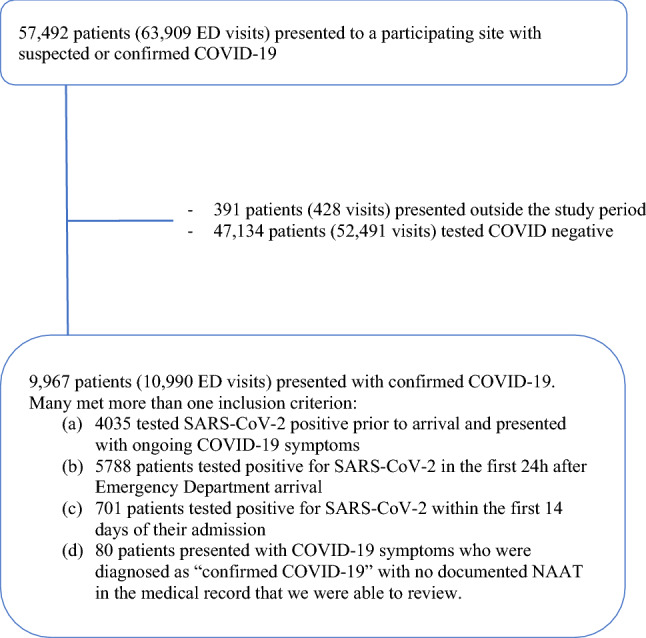
Results: We enrolled 9,967 patients in 8 provinces, 3,336 from the first and 6,631 from the second wave. Patients in the second wave were younger, fewer met criteria for severe COVID-19, and more were discharged from the ED. Adjusted for patient characteristics and disease severity, steroid use increased (odds ratio [OR] 7.4; 95% confidence interval [CI] 6.2-8.9), and invasive mechanical ventilation decreased (OR 0.5; 95% CI 0.4-0.7) in the second wave compared to the first. After adjusting for differences in patient characteristics and disease severity, the odds of hospitalization (OR 0.7; 95% CI 0.6-0.8) and critical care admission (OR 0.7; 95% CI 0.6-0.9) decreased, while mortality remained unchanged (OR 0.7; 95% CI 0.5-1.1).
Interpretation: In patients presenting to cute care facilities, we observed rapid uptake of evidence-based therapies and less use of experimental therapies in the second wave. We observed increased rates of ED discharges and lower hospital and critical care resource use over time. Substantial reductions in mechanical ventilation were not associated with increasing mortality. Advances in treatment strategies created health system efficiencies without compromising patient outcomes.
Trial registration: Clinicaltrials.gov, NCT04702945.
RéSUMé: CONTEXTE: Le traitement de la maladie à coronavirus 2019 (COVID-19) a évolué entre les vagues pandémiques. Notre objectif était de comparer les traitements, l'utilisation des soins aigus et les résultats des patients atteints de la maladie COVID-19 se présentant aux urgences à travers les vagues de pandémie. MéTHODES: Cette étude observationnelle a recruté des patients COVID-19 éligibles consécutifs se présentant à 46 services d'urgence participant au Réseau canadien de réponse rapide aux services d'urgence COVID-19 (CCEDRRN) entre le 1er mars et le 31 décembre 2020. Nous avons recueilli des données au moyen d’un examen rétrospectif des dossiers. Notre principal résultat a été la mortalité à l’hôpital. Les résultats secondaires incluaient les traitements, les admissions à l'hôpital et aux soins intensifs, les revisites aux urgences et les réadmissions. La modélisation par régression logistique a évalué l'impact de la vague de pandémie sur les résultats. RéSULTATS: Nous avons recruté 9 967 patients dans 8 provinces, 3 336 de la première vague et 6 631 de la deuxième vague. Les patients de la deuxième vague étaient plus jeunes, moins nombreux à répondre aux critères de gravité de la COVID-19 et plus nombreux à quitter les urgences. Après ajustement en fonction des caractéristiques des patients et de la gravité de la maladie, le recours aux stéroïdes a augmenté (rapport de cotes [RC] 7.4 ; intervalle de confiance à 95 % [IC] 6.2–8.9) et la ventilation mécanique invasive a diminué (RC 0.5 ; IC à 95 % 0.4–0.7) lors de la deuxième vague par rapport à la première. Après ajustement pour tenir compte des différences dans les caractéristiques des patients et la gravité de la maladie, les probabilités d'hospitalisation (RC 0.7 ; IC à 95 % 0.6–0.8) et d'admission en soins intensifs (RC 0.7 ; IC à 95 % 0.6–0.9) ont diminué, tandis que la mortalité est restée inchangée (RC 0.7 ; IC à 95 % 0.5–1.1). INTERPRéTATION: Chez les patients se présentant dans les établissements de soins de santé, nous avons observé une adoption rapide des thérapies fondées sur des données probantes et un moindre recours aux thérapies expérimentales lors de la deuxième vague. Nous avons observé une augmentation des taux de sortie des services d'urgence et une diminution de l'utilisation des ressources hospitalières et des soins intensifs au fil du temps. Les réductions substantielles de la ventilation mécanique n'étaient pas associées à une augmentation de la mortalité. Les progrès réalisés dans les stratégies de traitement ont permis d'améliorer l'efficacité des systèmes de santé sans compromettre les résultats pour les patients.
Keywords: COVID-19; coronavirus disease 2019; SARS-COV-2; resource utilization; patient outcomes; pandemic waves.
© 2022. The Author(s).
Conflict of interest statement
The study authors have no conflicts of interest to declare.
References
Publication types
MeSH terms
Associated data
Grants and funding
LinkOut - more resources
Full Text Sources
Medical
Miscellaneous
