


Longitudinal trajectories of HIV care engagement since diagnosis among persons with HIV in the Florida Ryan White program
- PMID: 35362911
- PMCID: PMC10080894
- DOI: 10.1007/s10461-022-03659-9
Longitudinal trajectories of HIV care engagement since diagnosis among persons with HIV in the Florida Ryan White program
Abstract
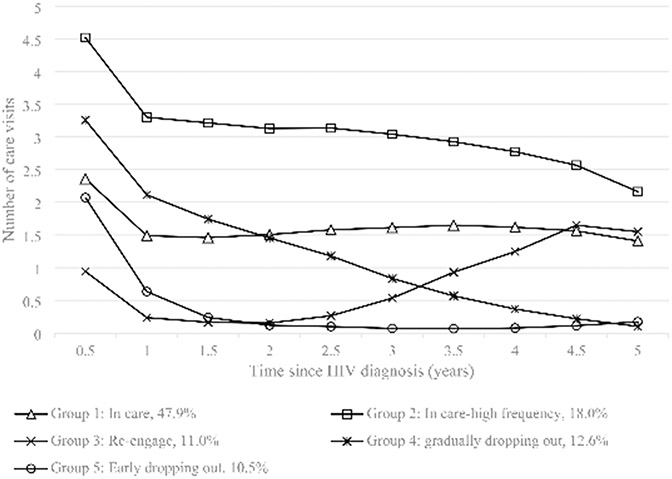
HIV care engagement is a dynamic process. We employed group-based trajectory modeling to examine longitudinal patterns in care engagement among people who were newly diagnosed with HIV and enrolled in the Ryan White program in Florida (n = 9,755) between 2010 and 2015. Five trajectories were identified (47.9% "in care" with 1-2 care visit(s) per 6 months, 18.0% "frequent care" with 3 or more care visits per 6 months, 11.0% "re-engage", 11.0% "gradual drop out", 12.6% "early dropout") based on the number of care attendances (including outpatient/case management visits, viral load or CD4 test) for each six-month during the first five years since diagnosis. Relative to "in care", people in the "frequent care" trajectory were more likely to be Hispanic/Latino and older at HIV diagnosis, whereas people in the three suboptimal care retention trajectories were more likely to be younger. Area deprivation index, rurality, and county health rankings were also strongly associated with care trajectories. Individual- and community-level factors associated to the three suboptimal care retention trajectories, if confirmed to be causative and actionable, could be prioritized to improve HIV care engagement.
Keywords: Care engagement and retention; Community factors; HIV care continuum; Ryan White; Trajectory analysis.
© 2022. The Author(s), under exclusive licence to Springer Science+Business Media, LLC, part of Springer Nature.
Conflict of interest statement
Figures
References
-
- Crawford T, Sanderson W, Thornton A. Impact of poor retention in HIV medical care on time to viral load suppression. Journal of the International Association of Providers of AIDS Care. 2014;13(3):242–249. - PubMed
-
- Stricker SM, Fox KA, Baggaley R, Negussie E, de Pee S, Grede N, et al. Retention in care and adherence to ART are critical elements of HIV care interventions. AIDS Behav. 2014;18(Suppl 5):465–75. - PubMed
-
- Amstutz A, Brown JA, Ringera I, Muhairwe J, Lejone TI, Klimkait T, et al. Engagement in Care, Viral Suppression, Drug Resistance, and Reasons for Nonengagement After Home-Based Same-Day Antiretroviral Therapy Initiation in Lesotho: A Two-Year Follow-up of the CASCADE Trial. Clin Infect Dis. 2020;71(10):2608–14. - PMC - PubMed
-
- Brantley AD, Burgess S, Bickham J, Wendell D, Gruber D. Using Financial Incentives to Improve Rates of Viral Suppression and Engagement in Care of Patients Receiving HIV Care at 3 Health Clinics in Louisiana: The Health Models Program, 2013–2016. Public Health Rep. 2018;133(2_suppl):75S–86S. - PMC - PubMed
MeSH terms
Grants and funding
LinkOut - more resources
Full Text Sources
Medical
Research Materials
