


Diagnostic accuracy of SARS-CoV-2 saliva antigen testing in a real-life clinical setting
- PMID: 35364282
- PMCID: PMC8964446
- DOI: 10.1016/j.ijid.2022.03.037
Diagnostic accuracy of SARS-CoV-2 saliva antigen testing in a real-life clinical setting
Abstract
Background: SARS-CoV-2 antigen tests with saliva facilitate examination in settings that lack trained personnel. However, little is known about the diagnostic accuracy in real-life clinical settings. Therefore, we studied the diagnostic accuracy of a saliva antigen test in diagnosing SARS-CoV-2 infection in a primary/secondary care testing facility.
Methods: Individuals who presented at a COVID-19 testing facility affiliated with a Swiss university hospital were prospectively recruited (n=377). Saliva specimen was obtained, and the PCL Inc. COVID19 Gold antigen test was conducted in parallel with 2 real-time polymerase chain reaction (RT-PCR) assays from a nasopharyngeal swab.
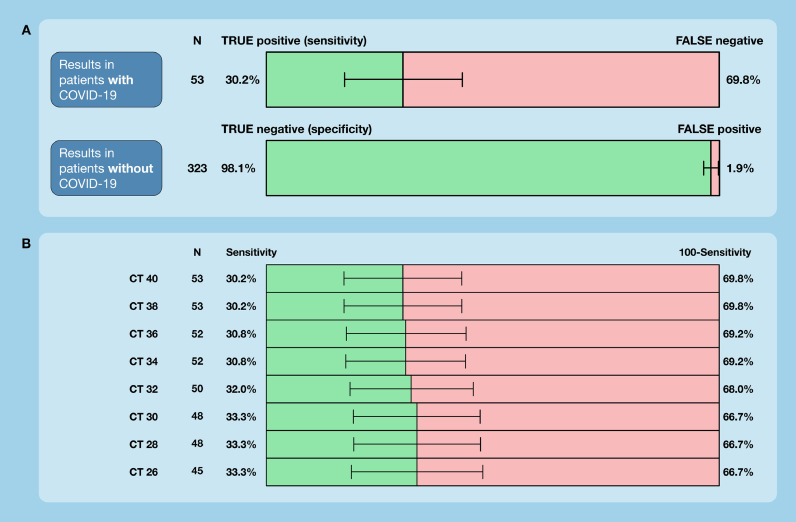
Results: RT-PCR results were positive in 53 individuals, corresponding to a prevalence of 14.1% (missing material in 1 individual). The PCL saliva antigen test was positive in 22 individuals (5.8%) and negative in 354 (93.9%). The sensitivity of the saliva antigen test was 30.2% (95% confidence interval 18.3, 44.3), both overall and in symptomatic individuals. The specificity was 98.1% (96.0, 99.3).
Conclusions: The diagnostic accuracy of a SARS-CoV-2 saliva antigen test in a primary/secondary care testing facility was remarkably lower than that reported in the manufacturer's specifications.
Keywords: COVID-19 diagnostic testing [Supplementary Concept]; Infections/*epidemiology/transmission; severe acute respiratory syndrome coronavirus 2 [Supplementary Concept].
Copyright © 2022 The Author(s). Published by Elsevier Ltd.. All rights reserved.
Conflict of interest statement
Competing interests MN received research support from Roche diagnostics outside of the present work. The other authors declare no conflict of interest.
Figures
References
-
- CDC CfDCaP. Coronavirus Self-Checker; 2020. Available from: https://www.cdc.gov/coronavirus/2019-ncov/.
MeSH terms
LinkOut - more resources
Full Text Sources
Medical
Miscellaneous
