


Olfactory function and discrimination ability in the elderly: a pilot study
- PMID: 35365090
- PMCID: PMC10717643
- DOI: 10.1186/s12576-022-00832-6
Olfactory function and discrimination ability in the elderly: a pilot study
Abstract
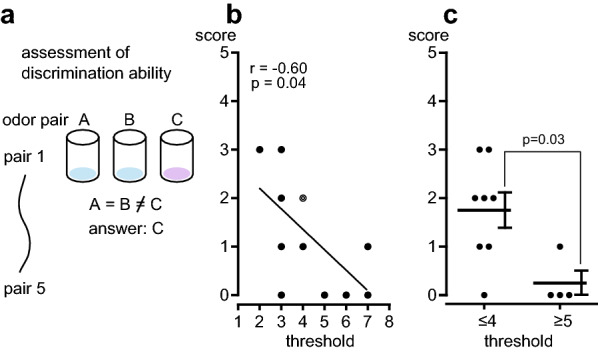
We recently reported that subjects with a higher olfactory identification threshold for rose odor declined more in attentional ability in the elderly. This study focuses on discrimination ability and olfactory identification threshold in twelve elderly subjects living in a community (age: 80.9 ± 1.6). Olfactory function was assessed by the rose odor identification threshold. We assessed the discrimination ability by distinguishing 5 similar odor pairs. Our results showed that the subjects with a higher olfactory identification threshold (≥ 5) declined more in discrimination ability (14% ± 14%, p = 0.03) compared to those with a lower threshold (≤ 4) (averaged value set at 100%). As discrimination ability is related to the basal forebrain cholinergic system, our results suggest that olfactory impairment links to the decline in cognitive function relating the cholinergic system.
Keywords: Cholinergic system; Cognitive function; Discrimination ability; Elderly people; Odor identification threshold; Olfactory function.
© 2022. The Author(s).
Conflict of interest statement
The authors declare that they have no conflicts of interest.
Figures
References
-
- Devanand DP, Liu X, Tabert MH, Pradhaban G, Cuasay K, Bell K, de Leon MJ, Doty RL, Stern Y, Pelton GH. Combining early markers strongly predicts conversion from mild cognitive impairment to Alzheimer's disease. Biol Psychiatry. 2008;64:871–879. doi: 10.1016/j.biopsych.2008.06.020. - DOI - PMC - PubMed
-
- Sengoku R, Saito Y, Ikemura M, Hatsuta H, Sakiyama Y, Kanemaru K, Arai T, Sawabe M, Tanaka N, Mochizuki H, Inoue K, Murayama S. Incidence and extent of Lewy body-related α-synucleinopathy in aging human olfactory bulb. J Neuropathol Exp Neurol. 2008;67:1072–1083. doi: 10.1097/NEN.0b013e31818b4126. - DOI - PubMed
MeSH terms
Grants and funding
LinkOut - more resources
Full Text Sources
Medical
Research Materials
