. 2022 Apr 1:11:giac024.
doi: 10.1093/gigascience/giac024.

The rise of genomics in snake venom research: recent advances and future perspectives

Affiliations

The rise of genomics in snake venom research: recent advances and future perspectives

Wei-Qiao Rao et al. Gigascience. .

Abstract

Snake venoms represent a danger to human health, but also a gold mine of bioactive proteins that can be harnessed for drug discovery purposes. The evolution of snakes and their venom has been studied for decades, particularly via traditional morphological and basic genetic methods alongside venom proteomics. However, while the field of genomics has matured rapidly over the past 2 decades, owing to the development of next-generation sequencing technologies, snake genomics remains in its infancy. Here, we provide an overview of the state of the art in snake genomics and discuss its potential implications for studying venom evolution and toxinology. On the basis of current knowledge, gene duplication and positive selection are key mechanisms in the neofunctionalization of snake venom proteins. This makes snake venoms important evolutionary drivers that explain the remarkable venom diversification and adaptive variation observed in these reptiles. Gene duplication and neofunctionalization have also generated a large number of repeat sequences in snake genomes that pose a significant challenge to DNA sequencing, resulting in the need for substantial computational resources and longer sequencing read length for high-quality genome assembly. Fortunately, owing to constantly improving sequencing technologies and computational tools, we are now able to explore the molecular mechanisms of snake venom evolution in unprecedented detail. Such novel insights have the potential to affect the design and development of antivenoms and possibly other drugs, as well as provide new fundamental knowledge on snake biology and evolution.

Keywords: DNA sequencing; snake genomics; snake toxins; snakes; venom; venom evolution.


Figures

Figure 1:
Figure 1:
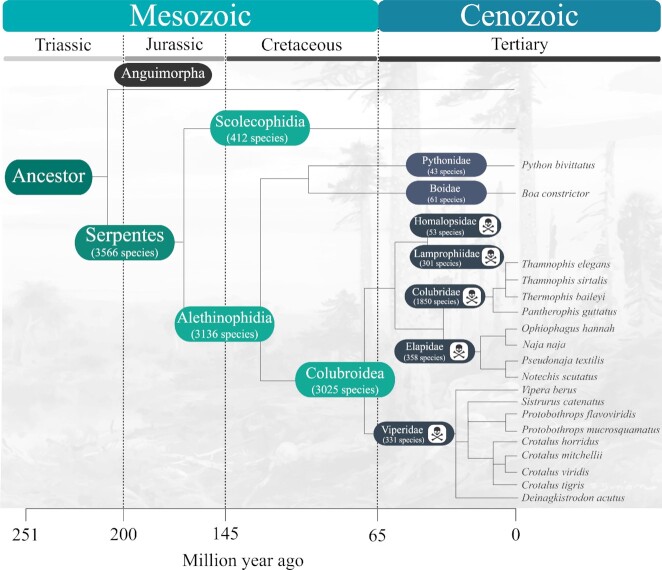
Schematic diagram of snake evolution based on data from Reptile-database.org [16]. Snakes (Serpentes) are divided into 3 main infraorders, Scolecophidia, Henophidia, and Alethinophidia, which together encompass ∼24 families (7 shown here). Families comprising venomous species are indicated with a skull and crossbones symbol. Colubridae constitutes the largest family of snakes, encompassing 52% of the ∼3,566 snake species currently described. The total number of currently described venomous snake species is 2,901, predominantly falling within the families Homalopsidae, Lamprophiidae, Colubridae, Elapidae, and Viperidae. Only snake species that have undergone whole-genome sequencing and assembly are listed in this figure.
Figure 2:
Figure 2:
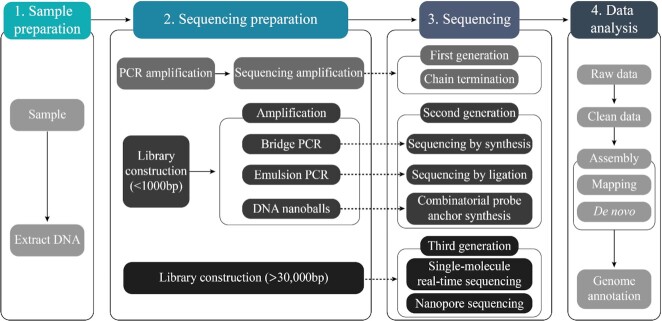
Schematic representation of the next-generation sequencing pipeline for genomic assembly. (1) Multiple companies have marketed sequencing platforms for genomic and transcriptomic studies, the most commonly used being Illumina (left), PacBio (middle), and Nanopore (right). (2) The 3 platforms differ in read length and accuracy of their generated sequences. Whilst Illumina sequencing generally yields short reads with low error rates, Nanopore sequences are substantially longer (≤2 Mb), yet subject to frequent sequencing errors. Last, PacBio generates sequences with lengths and error rates in between the 2 other platforms. (3) After sequencing, reads are computationally processed and assembled into contigs, which in turn (4) serve as the building blocks for scaffolds.The scaffolds are then aligned and annotated to produce the complete target genome.
Figure 3:
Figure 3:
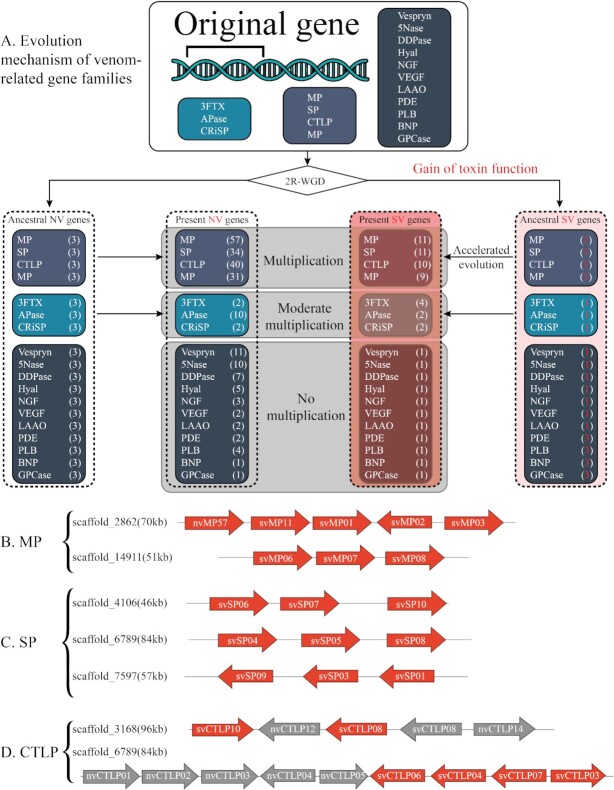
Venom-related gene families in the P. flavoviridis genome. (A) Deduced evolutionary history of venom-related gene families through 2 rounds of whole-genome duplication (2R-WGD). An original set of 18 genes (shown in the top box) became 72 (4 copies each). Then, a single copy of each family was likely co-opted to develop toxic functions, resulting in 1 snake venom (SV) copy (shown in a pale red box in the right column) and 3 non-venom (NV) paralogs (shown in the see-through box to the left). (B) Tandem duplications of SVMP genes. (C) Tandem duplications of SVSP genes. (D) Tandem duplications of CTLP genes. Based on Fig. 2 and Fig. S8 from [15].
Figure 4:
Figure 4:
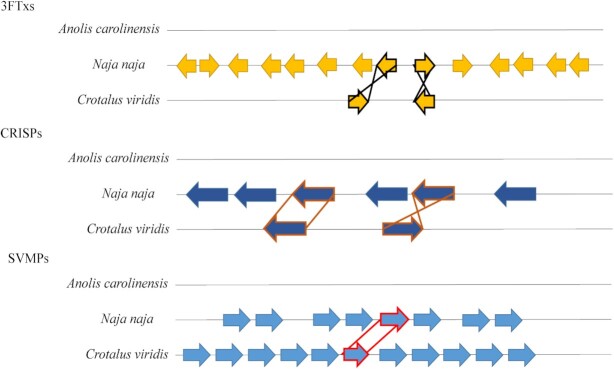
Syntenic comparison of toxin gene clusters. Comparison showing the 3FTx, CRISP, and SVMP genes in N. naja and C. viridis genomes. Orthologous gene pairs are indicated by the line linked across the corresponding genomic regions. Based on Fig. 4 and Extended Fig. 4 from [27].

References

    1. Burbrink FT, Pyron RA.. The taming of the skew: estimating proper confidence intervals for divergence dates. Syst Biol. 2008;57(2):317–28. - PubMed
    1. Wallach V, Williams KL, Boundy J.. Snakes of the World: A Catalogue of Living and Extinct Species. 1st ed. Boca Raton: CRC Press; 2014.
    1. Da Silva FO, Fabre A-C, Savriama Y, et al. The ecological origins of snakes as revealed by skull evolution. Nat Commun. 2018;9(1):doi: 10.1038/s41467-017-02788-3. - DOI - PMC - PubMed
    1. Pyron RA, Burbrink FT, Wiens JJ.. A phylogeny and revised classification of Squamata, including 4161 species of lizards and snakes. BMC Evol Biol. 2013;13(1):93. - PMC - PubMed
    1. Wiens JJ, Hutter CR, Mulcahy DG, et al. Resolving the phylogeny of lizards and snakes (Squamata) with extensive sampling of genes and species. Biol Lett. 2012;8(6):1043–6. - PMC - PubMed

Publication types