Review
. 2022 Jun 1;163(6):bqac041.
doi: 10.1210/endocr/bqac041.

Targeting mTOR in the Context of Diet and Whole-body Metabolism

Affiliations
Review

Targeting mTOR in the Context of Diet and Whole-body Metabolism

Nikos Koundouros et al. Endocrinology. .

Abstract

The mechanistic target of the rapamycin (mTOR) signaling pathway is the central regulator of cell growth and proliferation by integrating growth factor and nutrient availability. Under healthy physiological conditions, this process is tightly coordinated and essential to maintain whole-body homeostasis. Not surprisingly, dysregulated mTOR signaling underpins several diseases with increasing incidence worldwide, including obesity, diabetes, and cancer. Consequently, there is significant clinical interest in developing therapeutic strategies that effectively target this pathway. The transition of mTOR inhibitors from the bench to bedside, however, has largely been marked with challenges and shortcomings, such as the development of therapy resistance and adverse side effects in patients. In this review, we discuss the current status of first-, second-, and third-generation mTOR inhibitors as a cancer therapy in both preclinical and clinical settings, with a particular emphasis on the mechanisms of drug resistance. We focus especially on the emerging role of diet as an important environmental determinant of therapy response, and posit a conceptual framework that links nutrient availability and whole-body metabolic states such as obesity with many of the previously defined processes that drive resistance to mTOR-targeted therapies. Given the role of mTOR as a central integrator of cell metabolism and function, we propose that modulating nutrient inputs through dietary interventions may influence the signaling dynamics of this pathway and compensatory nodes. In doing so, new opportunities for exploiting diet/drug synergies are highlighted that may unlock the therapeutic potential of mTOR inhibitors as a cancer treatment.

Keywords: diet; drug resistance; mTOR; metabolism.


Figures

Figure 1.
Figure 1.
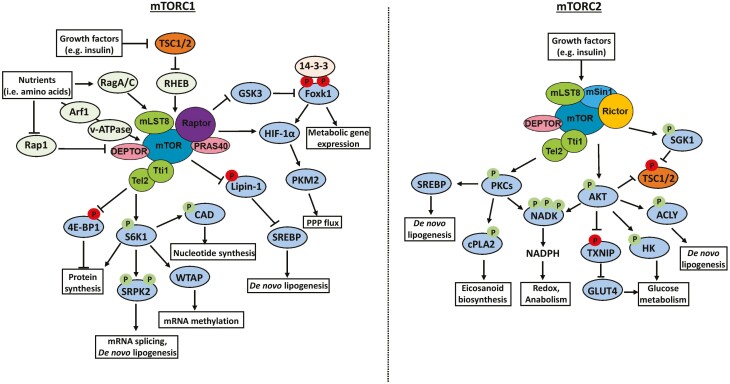
Regulation of key cellular processes by mTORC1 and mTORC2. The mTOR signaling pathway comprises mTORC1 and mTORC2, which together promote anabolism, growth, and proliferation. mTORC1 is activated by various signals including growth factors and nutrient availability in the form of amino acids and glucose. The downstream processes regulated by mTORC1 include induction of protein synthesis, mRNA processing, and metabolic rewiring toward de novo nucleotide synthesis, lipogenesis, and oxidative PPP. mTORC2 is only activated by growth factors such as insulin, and its best-characterized substrate is AKT, which is a key activator of glucose and lipid metabolism. More recently, essential roles for other kinases such as PKCs and SGKs downstream of mTORC2 have been defined—such as increased bioactive eicosanoid and arachidonic acid metabolism—which provide compensatory signals that drive cell proliferation. Activating and inhibitory phosphorylation events are denoted by an arrowhead or blunt ended lines, respectively. Abbreviations: TSC1/2, tuberous sclerosis complex 1/2; Rag, Ras-related GTPase; RHEB, Ras homolog enriched in brain; Rap1, Ras-related protein 1; HIF, hypoxia inducible factor; PKM2, pyruvate kinase isozyme M2; PPP, pentose phosphate pathway; SREBP, sterol-regulatory element binding protein; CAD, carbamoyl phosphate synthetase 2; WTAP, Wilms’ tumor 1 associated protein; SRPK2, SR protein kinase 2; ACLY, ATP-citrate lyase; HK, hexokinase; SGK1, serum and glucocorticoid-induced protein kinase-1; PKC, protein kinase C; cPLA2, cytosolic phospholipase A2; NADK, NAD kinase.
Figure 2.
Figure 2.
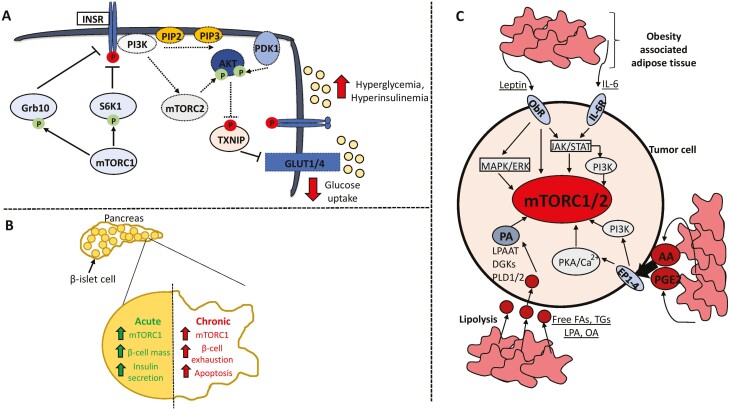
mTOR signaling in the context of type 2 diabetes and obesity. Hyperactivation of mTOR in response to chronic nutrient excess contributes to type 2 diabetes through 2 main pathways. (A) Sustained mTORC1 activity induces the negative-feedback loops converging on activation of the insulin receptor and downstream induction of the mTORC2–AKT axis that promotes glucose uptake. This contributes to hyperglycemia and hyperinsulinemia. (B) Chronic mTORC1 activation leads to exhaustion and apoptosis of pancreatic β-islet cells, culminating in reduced insulin secretion. (C) Obesity-associated adipose tissue profoundly alters the tumor microenvironment and can stimulate mTOR activity through secretion of adipokines such as leptin and IL-6, proinflammatory metabolites including arachidonic acid and prostaglandin E2, and release of fatty acid substrates through lipolysis that can be used to synthesize phosphatidic acid. Activating and inhibitory phosphorylation events are denoted by an arrowhead or blunt ended lines, respectively. Dotted lines or outlines surrounding enzymes denote downregulation/inhibition. Abbreviations: T2D, type 2 diabetes; INSR, insulin receptor; Grb10, growth factor receptor bound protein 10; PIP2, phosphatidylinositol (4,5)-bisphosphate; PIP3, phosphatidylinositol (3,4,5)-trisphosphate; PDK1, phosphoinositide-dependent kinase 1; TXNIP, thioredoxin interacting protein; ObR, leptin receptor; IL-6, interleukin-6; PKA, protein kinase A; AA, arachidonic acid; PGE2, prostaglandin E2; FA, fatty acid; TG, triglycerides; LPA, lysophosphatidic acid; OA, oleic acid; PA, phosphatidic acid; PLD1/2; phospholipase D1/2; DGKs, diacylglycerol kinase; LPAAT, lysophosphatidic acid acyltransferase.
Figure 3.
Figure 3.
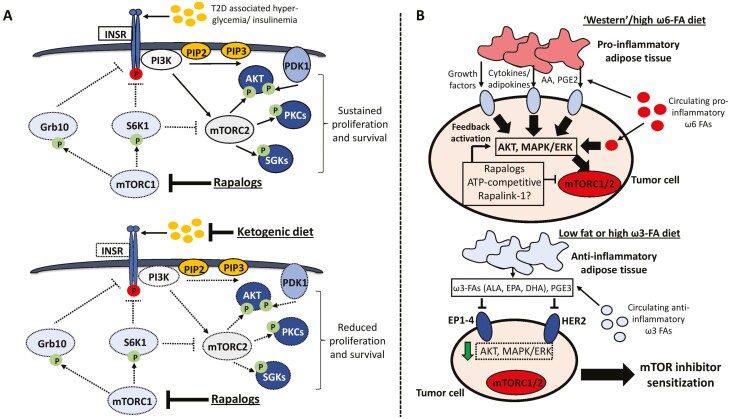
Proposed model of how dietary factors could modulate resistance to mTOR inhibitors. (A) One of the most pervasive mechanisms of resistance to rapalogs is the hyperactivation of mTORC2 signaling and downstream AKT, PKC and SGK signaling following mTORC1-S6K inhibition. Furthermore, in the context of hyperglycemia and hyperinsulinemia observed in patients with type-2 diabetes and even following chronic rapalog treatment, feedback activation of the insulin receptor may occur which overrides the therapeutic benefit of these inhibitors. In this scenario, a very low carbohydrate diet such as the ketogenic diet could lower the metabolic feedback signals that hyperactivate resistance pathways downstream of the insulin receptor. (B) Schematic of how altering dietary fat content in the form of pro-inflammatory ω-6 or anti-inflammatory ω-3 FA ratios could impact the physiology of adipose tissue that shapes autocrine/paracrine signaling networks in the tumor microenvironment. In this context, “Western” diets containing an excess of ω-6 FAs such as linoleic and arachidonic acid may cooperate with the feedback hyperactivation of AKT and MAPK/ERK signaling observed following first- and second-generation mTOR inhibitor treatment to drive therapy resistance. Conversely, a diet rich in ω-3 FAs such as linolenic acid, EPA, and DHA may suppress the reactivation of these oncogenic pathways. Dotted lines or outlines surrounding enzymes denote downregulation/inhibition. Abbreviations: T2D, type 2 diabetes; INSR, insulin receptor; Grb10, growth factor receptor bound protein 10; PIP2, phosphatidylinositol (4,5)-bisphosphate; PIP3, phosphatidylinositol (3,4,5)-trisphosphate; PDK1, phosphoinositide-dependent kinase 1; SGK1, serum and glucocorticoid-induced protein kinase 1; PKC, protein kinase C; AA, arachidonic acid; PGE2, prostaglandin E2; ALA, alpha-linolenic acid; EPA, eicosapentaenoic acid; DHA, docosahexaenoic acid; PGE3, prostaglandin E3; EP1-4, Prostaglandin E2 receptor 1-4; HER2, receptor tyrosine-protein kinase erbB-2.

References

    1. Kim SG, Buel GR, Blenis J. Nutrient regulation of the mTOR complex 1 signaling pathway. Mol Cells. 2013;35(6):463-473. - PMC - PubMed
    1. Saxton RA, Sabatini DM. mTOR signaling in growth. Metab Dis Cell. 2017;169(2):361-371. - PubMed
    1. Stemke-Hale K, Gonzalez-Angulo AM, Lluch A, et al. An integrative genomic and proteomic analysis of PIK3CA, PTEN, and AKT mutations in breast cancer. Cancer Res. 2008;68(15):6084-6091. - PMC - PubMed
    1. Brännmark C, Nyman E, Fagerholm S, et al. Insulin signaling in type 2 diabetes: experimental and modeling analyses reveal mechanisms of insulin resistance in human adipocytes. J Biol Chem. 2013;288(14):9867-9880. - PMC - PubMed
    1. Brown KA. Metabolic pathways in obesity-related breast cancer. Nat Rev Endocrinol. 2021;17(6):350-363. - PMC - PubMed

Publication types