. 2022 Jun;127(6):645-651.
doi: 10.1007/s11547-022-01484-7. Epub 2022 Apr 2.

Vessel Wall MRI: clinical implementation in cerebrovascular disorders-technical aspects

Affiliations

Vessel Wall MRI: clinical implementation in cerebrovascular disorders-technical aspects

Luigi Cirillo et al. Radiol Med. 2022 Jun.

Abstract

Vessel Wall MRI (VW-MRI) is an emerging MR sequence used for diagnosis, characterization, and treatment planning of cerebrovascular diseases. Although VW-MRI is not yet routinely used, most papers have emphasized its role in several aspects of the management of cerebrovascular diseases. Nowadays, no VW-MRI sequence optimized for the intracranial imaging is commercially available, thus the Spin Echo sequences are the more effective sequences for this purpose. Moreover, as one of the principal technical requirements for intracranial VW-MR imaging is to achieve both the suppression of blood in vessel lumen and of the outer cerebrospinal fluid, different suppression techniques have been developed. This short report provides the technical parameters of our VW-MR sequence developed over 3-years' experience.

Keywords: 3 Tesla MRI; Intracranial aneurysm; RCVS; Vasculitis; Vessel Wall Imagin.


Conflict of interest statement

The authors declare that they have no conflict of interest.

Figures
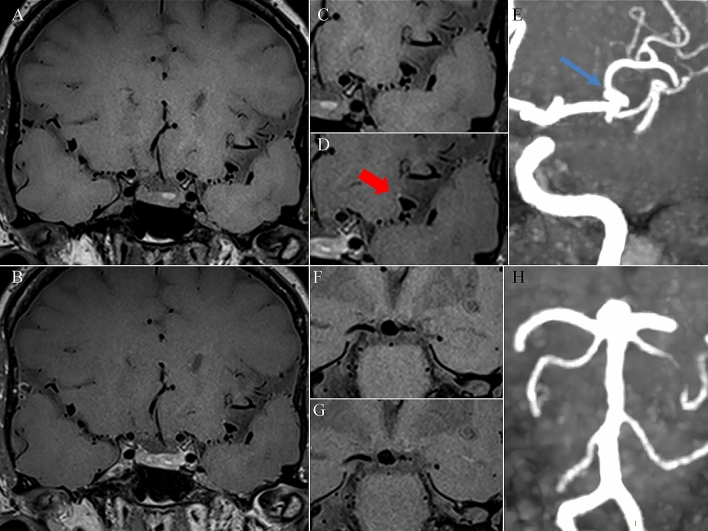
Fig. 1
Fig. 1
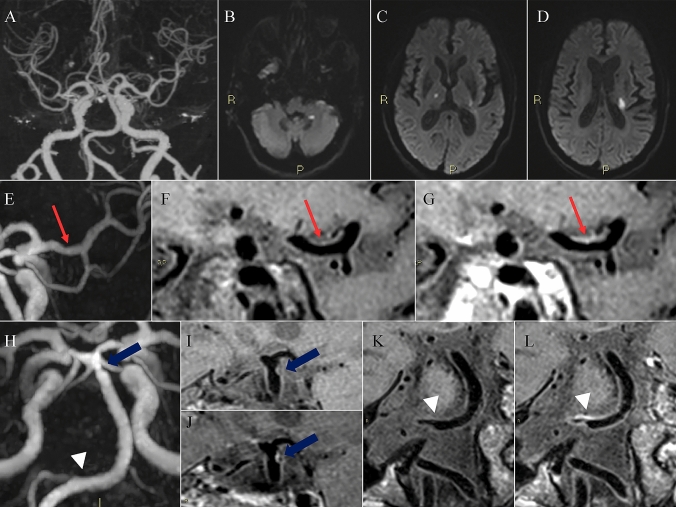
Aneurysms. A 64-year-old woman underwent brain MRI examination for the presence of incidentally discovering of multiple aneurysms, the largest located at left middle cerebral artery bifurcation (E) and at the basilar apex (H). Vessel Wall MRI sequences before (A) and after (B) the contrast medium administration, demonstrate the presence of a focal parietal enhancement after contrast medium of the left middle cerebral artery aneurysm (C, D red arrow, and E), while the basilar apex aneurysms did not show any parietal enhancement after the contrast medium administration (F, G, H). Despite the left bifurcation, MCA aneurysm did not fulfill the dimension criteria for treatment, the presence of wall enhancement let us decide to treat the aneurysm
Fig. 2
Fig. 2
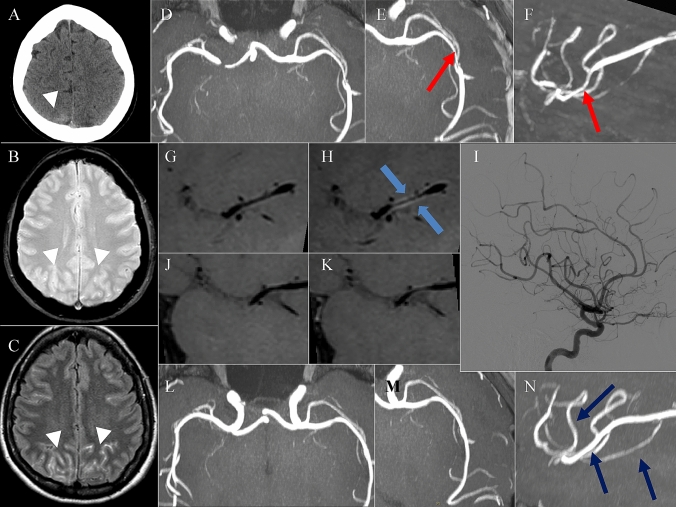
CNS vasculitis. A 58-year-old man with dizziness, vomiting, and speech disturbance underwent MRI study demonstrating in the TOF sequence, the presence of multiple caliber alterations in the intracranial arterial circulation (A), associated with recent ischemic lesions in the brain tissue (BD) both in the anterior and in the posterior circulation. The caliber alterations detected in the TOF sequence demonstrated the presence of wall enhancement after the administration of contrast medium (G, J, l), particularly in the left M1 segment of the middle cerebral artery (E, F, G, red arrows), at the basilar artery apex (H, I, J blue arrows) and in the proximal portion of the basilar artery at the level of the right anterior inferior cerebellar artery (H, K, L white arrowheads). The laboratory test demonstrated the positivity for a T. pallidum infection and thus the final diagnosis is a luetic CNS vasculitis
Fig. 3
Fig. 3
RCVS. A 56-year-old woman presented with an abrupt onset of headache and a CT scan demonstrated the presence of a small amount of subarachnoid hemorrhage in the right posterior parietal sulci (A). Nonvascular lesions responsible for the SAH were detected and thus the patient underwent brain MRI after few days, confirming the presence of a small amount of subarachnoid hemorrhage in the right posterior parietal sulci for the presence of hyperintensity in T2* and FLAIR sequences (B, C white arrowheads). The TOF sequence highlight the presence of caliber alterations in the left M2 segment (DF, red arrows), and the Vessel Wall MRI study before (G) and after (H) the administration of contrast material demonstrated the presence of a slight circumferential enhancement in correspondence of the left M2 segment stenosis (blue arrows). Few days after the patient underwent a DSA angiography (I) that demonstrated the presence of a more diffuse caliber alterations in the intracranial arterial vasculature. The six months MRI follow-up demonstrates the complete resolution of the enhancement at Vessel Wall study before (J) and after (K) the contrast administration, as well as the caliber alterations (LN blue arrows). The reversibility of those findings was then suggestive for a Reversible Cerebral Vasoconstriction Syndrome (RCVS), although non-enhancing concentric wall thickenings are more common than enhancing ones

References

    1. Yang Q, Deng Z, Bi X, Song SS, Schlick KH, Gonzalez NR, Li D, Fan Z. Whole-brain vessel wall MRI: a parameter tune-up solution to improve the scan efficiency of three-dimensional variable flip-angle turbo spin-echo. J Magn Reson Imaging. 2017;46(3):751–757. doi: 10.1002/jmri.25611. - DOI - PMC - PubMed
    1. Texakalidis P, Hilditch CA, Lehman V, Lanzino G, Pereira VM, Brinjikji W. Vessel wall imaging of intracranial aneurysms: systematic review and meta-analysis. World Neurosurg. 2018;117:453–458.e1. doi: 10.1016/j.wneu.2018.06.008. - DOI - PubMed
    1. Johannes TH, Val MR, Wolfgang RN (2018) The physics of clinical MR taught through images
    1. Jung SC, Kang DW, Turan TN. Vessel and vessel wall imaging. Front Neurol Neurosci. 2016;40:109–123. doi: 10.1159/000448308. - DOI - PubMed
    1. Kiruluta AJM, González RG. Magnetic resonance angiography: physical principles and applications. Handb Clin Neurol. 2016;135:137–149. doi: 10.1016/B978-0-444-53485-9.00007-6. - DOI - PubMed

MeSH terms