


Convergent neural correlates of prenatal exposure to air pollution and behavioral phenotypes of risk for internalizing and externalizing problems: Potential biological and cognitive pathways
- PMID: 35367513
- PMCID: PMC9119947
- DOI: 10.1016/j.neubiorev.2022.104645
Convergent neural correlates of prenatal exposure to air pollution and behavioral phenotypes of risk for internalizing and externalizing problems: Potential biological and cognitive pathways
Abstract
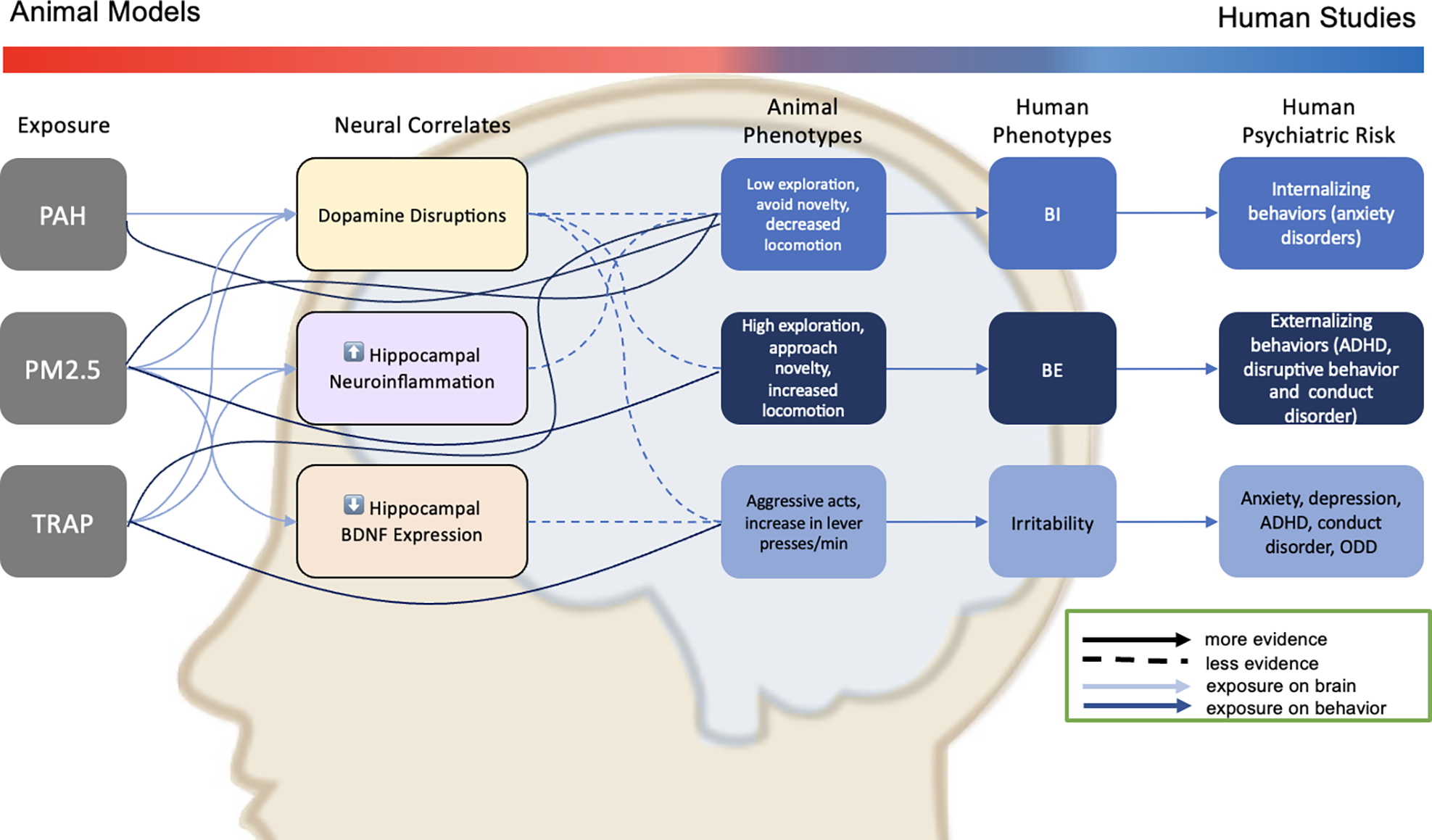
Humans are ubiquitously exposed to neurotoxicants in air pollution, causing increased risk for psychiatric outcomes. Effects of prenatal exposure to air pollution on early emerging behavioral phenotypes that increase risk of psychopathology remain understudied. We review animal models that represent analogues of human behavioral phenotypes that are risk markers for internalizing and externalizing problems (behavioral inhibition, behavioral exuberance, irritability), and identify commonalities among the neural mechanisms underlying these behavioral phenotypes and the neural targets of three types of air pollutants (polycyclic aromatic hydrocarbons, traffic-related air pollutants, fine particulate matter < 2.5 µm). We conclude that prenatal exposure to air pollutants increases risk for behavioral inhibition and irritability through distinct mechanisms, including altered dopaminergic signaling and hippocampal morphology, neuroinflammation, and decreased brain-derived neurotrophic factor expression. Future studies should investigate these effects in human longitudinal studies incorporating complex exposure measurement methods, neuroimaging, and behavioral characterization of temperament phenotypes and neurocognitive processing to facilitate efforts aimed at improving long-lasting developmental benefits for children, particularly those living in areas with high levels of exposure.
Keywords: Air pollution; Animal models; Behavioral phenotypes; Neural mechanisms.
Copyright © 2022 Elsevier Ltd. All rights reserved.
Conflict of interest statement
Declarations of interest: none
Figures
References
-
- Alemany S, Vilor-Tejedor N, García-Esteban R, Bustamante M, Dadvand P, Esnaola M, Mortamais M, Forns J, van Drooge BL, Álvarez-Pedrerol M, Grimalt JO, Rivas I, Querol X, Pujol J, & Sunyer J (2018). Traffic-related air pollution, APOEε4 status, and neurodevelopmental outcomes among school children enrolled in the BREATHE project (Catalonia, Spain). Environmental Health Perspectives, 126(8), 087001. - PMC - PubMed
-
- Alexander GE, DeLong MR, & Strick PL (1986). Parallel Organization of Functionally Segregated Circuits Linking Basal Ganglia and Cortex. Annual Review of Neuroscience, 9(1), 357–381. - PubMed
-
- Althammer F, Ferreira-Neto HC, Rubaharan M, Roy RK, Patel AA, Murphy A, Cox DN, & Stern JE (2020). Three-dimensional morphometric analysis reveals time-dependent structural changes in microglia and astrocytes in the central amygdala and hypothalamic paraventricular nucleus of heart failure rats. Journal of Neuroinflammation, 17(1), 221. - PMC - PubMed
-
- Barker DJP (2004). The developmental origins of chronic adult disease. Acta Paediatrica. Supplement, 93(446), 26–33. - PubMed
Publication types
MeSH terms
Substances
Grants and funding
LinkOut - more resources
Full Text Sources
Medical
