Stakeholder-Guided Development of Dialysis Vascular Access Education Materials
- PMID: 35368361
- PMCID: PMC8786100
- DOI: 10.34067/KID.0002382021
Stakeholder-Guided Development of Dialysis Vascular Access Education Materials
Abstract
Background: Initiating hemodialysis via an arteriovenous (AV) access is considered best practice for most patients. Despite the well-recognized advantages of AV access, 80% of US patients start hemodialysis with a catheter. Limited patient knowledge about vascular access, among other factors, may play a role in this high rate. We used iterative stakeholder input to develop novel, mixed media vascular access education materials and evaluated their preliminary acceptability.
Methods: We conducted preliminary focus groups and interviews with key stakeholders to assess patient vascular access understanding and elicit perspectives on existing education materials. We then used stakeholder input to inform initial development and iterative updates to the content and design of an animated video and complementary brochure. Video development (scripting, storyboarding, animation) was guided by an evidence-based framework and two health behavior change models. We assessed acceptability of the completed materials with patients and medical providers/personnel via interviews.
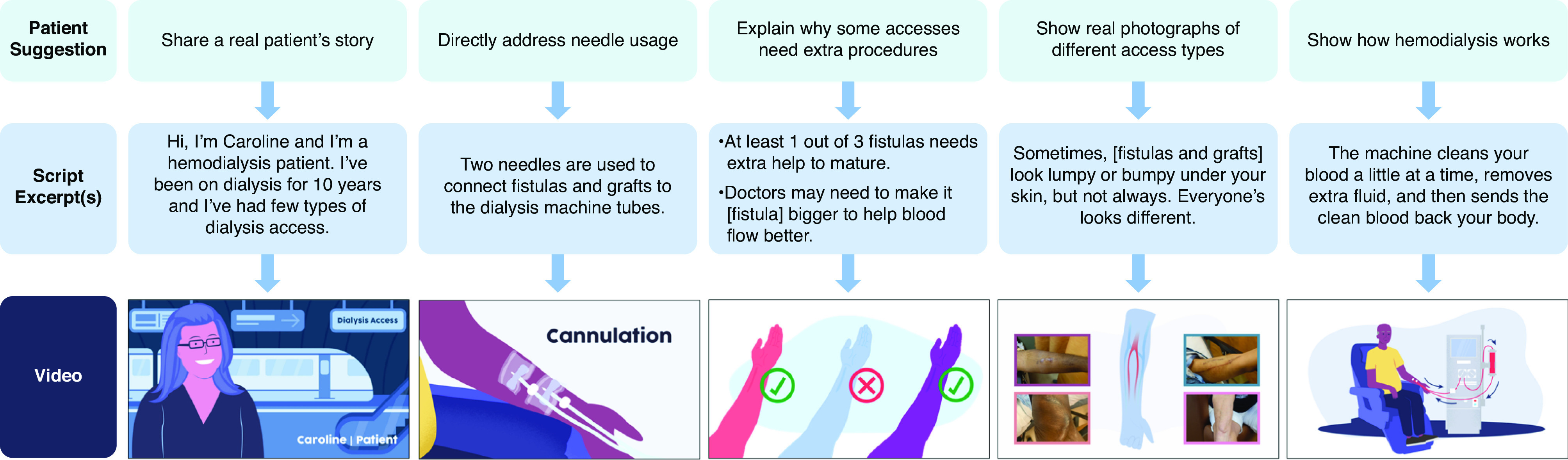
Results: Overall, 105 stakeholders participated in education materials development and review (80 patients/care partners, 25 medical providers/personnel). Preliminary qualitative work included 52 patients/care partners and 16 providers/personnel; video development included 28 patients/care partners and nine providers/personnel. The video script, storyboards, and animation underwent 14, four, and nine stakeholder-guided iterations, respectively. Responsive changes included aesthetic modifications, technical updates, and content additions (e.g., HD circuit, access self-monitoring, enhanced patient testimonials). The final 18-minute video and complementary brochure define vascular access types, describe care processes, outline potential complications, and address common patient concerns. Interviews with 28 patients/care partners and nine providers/personnel from diverse geographic regions revealed preliminary acceptability of, and enthusiasm for, the materials by patients and providers.
Conclusions: In collaboration with key stakeholders, we developed mixed media vascular access education materials that were well-received by patients and providers. Preliminary findings suggest that the materials are promising to improve vascular access understanding among patients.
Keywords: animation; arteriovenous; catheter; dialysis; education; fistula; graft; hemodialysis; mixed methods; stakeholder; vascular access; video.
Copyright © 2021 by the American Society of Nephrology.
Conflict of interest statement
E.H. Chang reports receiving research funding from Lantheus Medical Imaging, and serving on the medical advisory board for the North Carolina chapter of the National Kidney Foundation (NKF). J.E. Flythe reports serving on the editorial board of American Journal of Kidney Diseases (2017–), CJASN (2017–), Kidney Medicine (2019–), and Nephrology Dialysis Transplantation (as the HD theme editor; 2018–), and as an associate editor for Kidney360 (2019–); receiving honoraria from American Renal Associates, American Society of Nephrology, Baxter, Dialysis Clinic Incorporated, Fresenius Medical Care North America, NKF, Renal Ventures, and numerous universities; having consultancy agreements with AstraZeneca and NxStage Medical Advisory Board; serving on the Kidney Disease Improving Global Outcomes Executive Committee (2020–) and Kidney Health Initiative (KHI) Board of Directors (2019–), and as the KHI Patient Preferences Project Chairperson (2019–); and receiving research funding from National Institutes of Health (NIH)/National Institute of Diabetes and Digestive and Kidney Diseases (NIDDK), NIH/National Heart, Lung, and Blood Institute, Patient-Centered Outcomes Research Institute, Renal Research Institute (subsidiary of Fresenius Medical Care North America), and Robert Wood Johnson Foundation. A. Hegde reports serving on the research committee for the American Society of Diagnostic and Interventional Nephrology, and having consultancy agreements with Truepill. C. Wilkie reports having consultancy agreements with KHI, the UNC at Chapel Hill, University of Pennsylvania’s HOPE Consortium, and University of Pittsburgh; and having other interests in/relationships with NKF. All remaining authors have nothing to disclose.
Figures


References
-
- Ravani P, Palmer SC, Oliver MJ, Quinn RR, MacRae JM, Tai DJ, Pannu NI, Thomas C, Hemmelgarn BR, Craig JC, Manns B, Tonelli M, Strippoli GF, James MT: Associations between hemodialysis access type and clinical outcomes: A systematic review. J Am Soc Nephrol 24: 465–473, 2013. 10.1681/ASN.2012070643 - DOI - PMC - PubMed
-
- National Kidney Foundation : KDOQI clinical practice guideline for vascular access, 2019. Available at: https://www.kidney.org/professionals/guidelines/guidelines_commentaries/.... Accessed June 30, 2021 - PubMed
-
- Ravani P, Gillespie BW, Quinn RR, MacRae J, Manns B, Mendelssohn D, Tonelli M, Hemmelgarn B, James M, Pannu N, Robinson BM, Zhang X, Pisoni R: Temporal risk profile for infectious and noninfectious complications of hemodialysis access. J Am Soc Nephrol 24: 1668–1677, 2013. 10.1681/ASN.2012121234 - DOI - PMC - PubMed
-
- US Renal Data System 2018 annual data report: Epidemiology of kidney disease in the United States. Available at: https://www.usrds.org/annual-data-report. Accessed June 30, 2021 - PMC - PubMed
-
- Lopez-Vargas PA, Craig JC, Gallagher MP, Walker RG, Snelling PL, Pedagogos E, Gray NA, Divi MD, Gillies AH, Suranyi MG, Thein H, McDonald SP, Russell C, Polkinghorne KR: Barriers to timely arteriovenous fistula creation: A study of providers and patients. Am J Kidney Dis 57: 873–882, 2011. 10.1053/j.ajkd.2010.12.020 - DOI - PubMed
Publication types
MeSH terms
Grants and funding
LinkOut - more resources
Full Text Sources
Medical