From Theory to Reality: Establishing a Successful Kidney Genetics Clinic in the Outpatient Setting
- PMID: 35368791
- PMCID: PMC8815482
- DOI: 10.34067/KID.0004262020
From Theory to Reality: Establishing a Successful Kidney Genetics Clinic in the Outpatient Setting
Abstract
Background: Genetic testing in nephrology is increasingly described in the literature and several groups have suggested significant clinical benefit. However, studies to date have described experience from established genetic testing centers or from externally funded research programs.
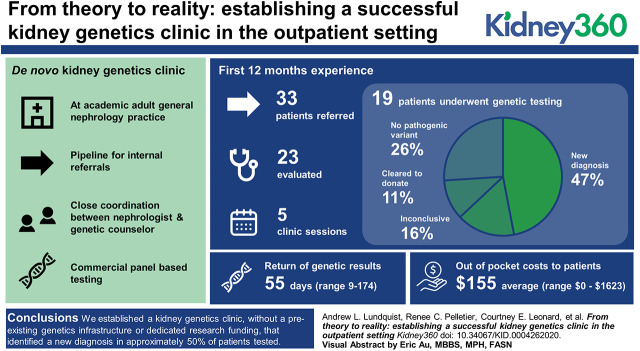
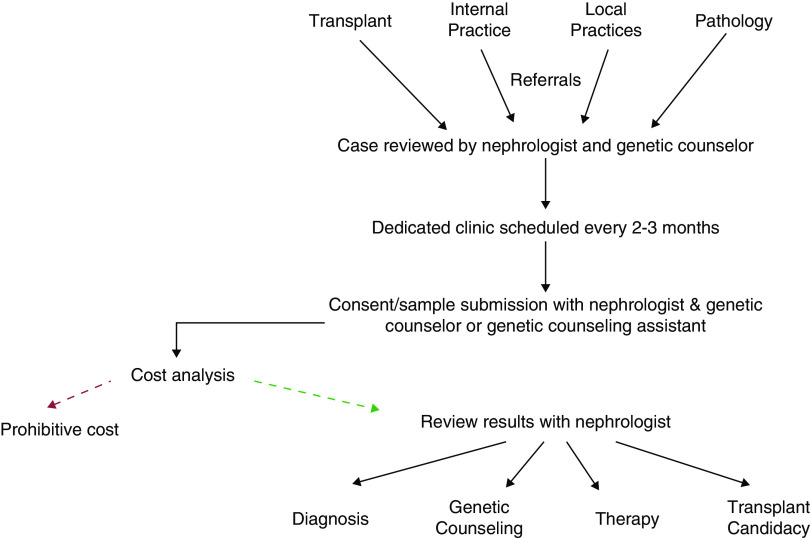
Methods: We established a de novo kidney genetics clinic within an academic adult general nephrology practice. Key features of this effort included a pipeline for internal referrals, flexible scheduling, close coordination between the nephrologist and a genetic counselor, and utilization of commercial panel-based testing. Over the first year, we examined the outcomes of genetic testing, the time to return of genetic testing, and out-of-pocket cost to patients.
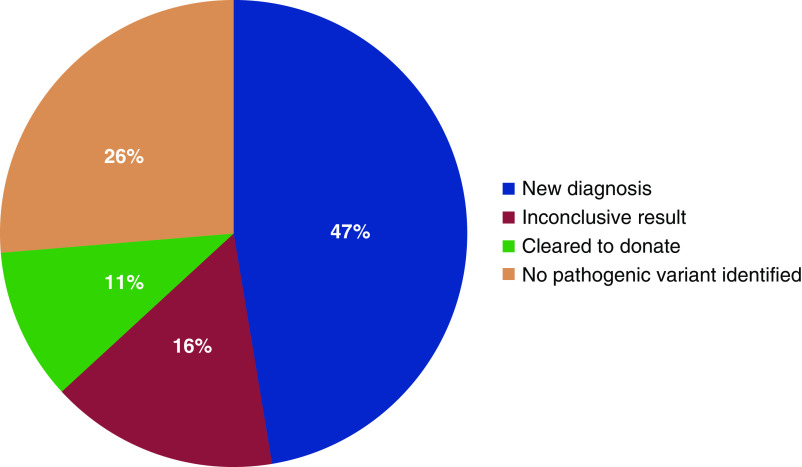
Results: Thirty patients were referred and 23 were evaluated over the course of five clinic sessions. Nineteen patients underwent genetic testing with new diagnoses in nine patients (47%), inconclusive results in three patients (16%), and clearance for kidney donation in two patients (11%). On average, return of genetic results occurred 55 days (range 9-174 days) from the day of sample submission and the average out-of-pocket cost to patients was $155 (range $0-$1623).
Conclusions: We established a kidney genetics clinic, without a pre-existing genetics infrastructure or dedicated research funding, that identified a new diagnosis in approximately 50% of patients tested. This study provides a clinical practice model for successfully incorporating genetic testing into ambulatory nephrology care with minimal capital investment and limited financial effect on patients.
Keywords: ambulatory care facilities; familial nephropathy; genetic kidney disease; genetics; kidney dysfunction; outpatients.
Copyright © 2020 by the American Society of Nephrology.
Conflict of interest statement
All authors have nothing to disclose.
Figures
Comment in
-
Moving Nephrology Genetics into Clinical Care.Kidney360. 2020 Sep 21;1(10):1040-1041. doi: 10.34067/KID.0005142020. eCollection 2020 Oct 29. Kidney360. 2020. PMID: 35368787 Free PMC article. No abstract available.
References
-
- Connaughton DM, Kennedy C, Shril S, Mann N, Murray SL, Williams PA, Conlon E, Nakayama M, van der Ven AT, Ityel H, Kause F, Kolvenbach CM, Dai R, Vivante A, Braun DA, Schneider R, Kitzler TM, Moloney B, Moran CP, Smyth JS, Kennedy A, Benson K, Stapleton C, Denton M, Magee C, O’Seaghdha CM, Plant WD, Griffin MD, Awan A, Sweeney C, Mane SM, Lifton RP, Griffin B, Leavey S, Casserly L, de Freitas DG, Holian J, Dorman A, Doyle B, Lavin PJ, Little MA, Conlon PJ, Hildebrandt F: Monogenic causes of chronic kidney disease in adults. Kidney Int 95: 914–928, 2019. Available at: 10.1016/j.kint.2018.10.031 - DOI - PMC - PubMed
-
- Groopman EE, Marasa M, Cameron-Christie S, Petrovski S, Aggarwal VS, Milo-Rasouly H, Li Y, Zhang J, Nestor J, Krithivasan P, Lam WY, Mitrotti A, Piva S, Kil BH, Chatterjee D, Reingold R, Bradbury D, DiVecchia M, Snyder H, Mu X, Mehl K, Balderes O, Fasel DA, Weng C, Radhakrishnan J, Canetta P, Appel GB, Bomback AS, Ahn W, Uy NS, Alam S, Cohen DJ, Crew RJ, Dube GK, Rao MK, Kamalakaran S, Copeland B, Ren Z, Bridgers J, Malone CD, Mebane CM, Dagaonkar N, Fellström BC, Haefliger C, Mohan S, Sanna-Cherchi S, Kiryluk K, Fleckner J, March R, Platt A, Goldstein DB, Gharavi AG: Diagnostic utility of exome sequencing for kidney disease. N Engl J Med 380: 142–151, 2019. Available at: 10.1056/NEJMoa1806891 - DOI - PMC - PubMed
-
- Mallett AJ, McCarthy HJ, Ho G, Holman K, Farnsworth E, Patel C, Fletcher JT, Mallawaarachchi A, Quinlan C, Bennetts B, Alexander SI: Massively parallel sequencing and targeted exomes in familial kidney disease can diagnose underlying genetic disorders. Kidney Int 92: 1493–1506, 2017. Available at: 10.1016/j.kint.2017.06.013 - DOI - PubMed
MeSH terms
LinkOut - more resources
Full Text Sources