


B-cell activating factor and IL-21 levels predict treatment response in autoimmune hepatitis
- PMID: 35368991
- PMCID: PMC8971938
- DOI: 10.1016/j.jhepr.2022.100460
B-cell activating factor and IL-21 levels predict treatment response in autoimmune hepatitis
Erratum in
-
Corrigendum to 'B-cell activating factor and IL-21 levels predict treatment response in autoimmune hepatitis' [J Hepatol (2022) doi: 10.1016/j.jhepr.2022.100460].JHEP Rep. 2025 Jun 3;7(7):101447. doi: 10.1016/j.jhepr.2025.101447. eCollection 2025 Jul. JHEP Rep. 2025. PMID: 40524698 Free PMC article.
Abstract
Background & aims: Increased serum IgG and autoantibodies suggest involvement of B cells in autoimmune hepatitis (AIH). The aim of this study was to assess levels of B cell activating factor of the tumour necrosis family (BAFF), IL-21, and circulating B cell populations in AIH and correlate these to treatment response.
Methods: BAFF and IL-21 levels were determined in 66 patients with AIH before treatment and 10 healthy controls. Flow cytometry was performed on circulating B cells of 10 patients with AIH and 12 healthy controls.
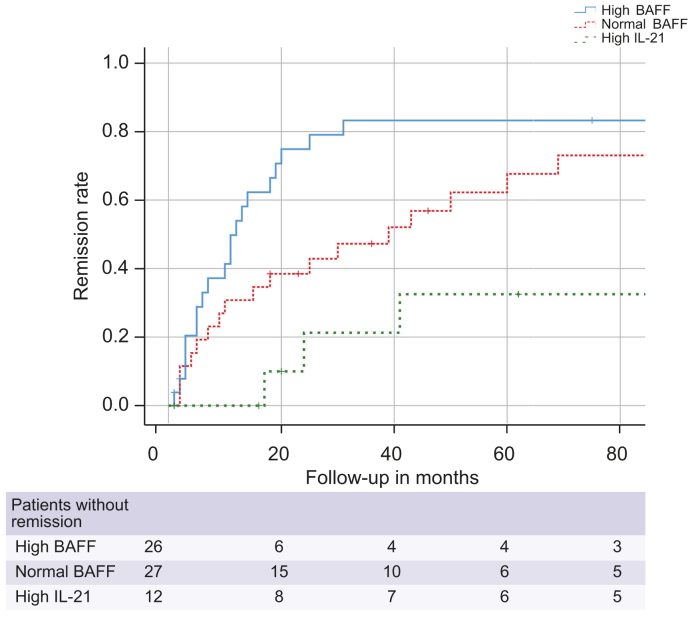
Results: Based on BAFF and IL-21 levels, untreated patients with AIH were divided into 3 groups: 27 (41%) patients with normal BAFF and IL-21 (normal BAFF), 27 (41%) patients with elevated BAFF but normal IL-21 (high BAFF), and 12 (18%) patients with elevated IL-21 (high IL-21). The high BAFF group presented with higher bilirubin compared with the normal BAFF and high IL-21 groups (159 vs. 26 vs. 89 μmol/L; p = 0.001; Mann-Whitney U test). After 12 months of treatment, 54% of the high BAFF group reached remission compared with 34% of the normal BAFF group and 0% of the high IL-21 group (p = 0.006, Chi-square test). During follow-up, 3 patients (25%) with high IL-21 developed primary sclerosing cholangitis (PSC) variant syndrome. Autoimmune-associated B cells were increased in patients with AIH compared with healthy controls (4.4 vs. 1.4%; p = 0.003, Mann-Whitney U test). BAFF levels were correlated positively with naïve B cells (p = 0.01) and negatively with class-switched B cells (p = 0.003) and nonclass-switched B cells (p = 0.005, Spearman correlation).
Discussion: Using BAFF and IL-21, we identified different immunological phenotypes of AIH with a different presentation, treatment response, and outcome. Patients with high IL-21 had the poorest treatment response and a risk of developing PSC variant syndrome. BAFF level was related to shifts in circulating B-cell populations.
Lay summary: In patients with untreated autoimmune hepatitis (AIH), circulating B-cell activating factor of the tumour necrosis family (BAFF), IL-21, and B-cell populations were determined. Three subgroups were identified: with (1) normal BAFF and IL-21, (2) elevated BAFF and normal IL-21, and (3) elevated IL-21. Remission after 1-year treatment occurred in 54, 34, and 0% in Groups 1, 2, and 3, respectively. Group 2 had higher bilirubin, indicating more liver dysfunction. In 25% of patients with high IL-21, AIH-PSC variant syndrome developed, but none in the other groups. Autoimmune-associated B cells were elevated and BAFF levels correlated with certain B cells.
Keywords: AIH, autoimmune hepatitis; ALT, alanine aminotransferase; AP, alkaline phosphatase; AST, aspartate aminotransferase; Autoimmune hepatitis; B-cell immunity; BAFF; BAFF, B-cell activating factor of the tumour necrosis family; Biochemical remission; GGT, gamma-glutamyltransferase; IL-21; LKM-1, liver–kidney–microsomal type 1; MRCP, magnetic resonance cholangiopancreaticography; PBC, primary biliary cholangitis; PBMC, peripheral blood mononuclear cell; PSC, primary sclerosing cholangitis; UDCA, ursodeoxycholic acid; ULN, upper limit of normal.
© 2022 The Authors.
Conflict of interest statement
MB was supported by unrestricted grants from Zambon Pharma. No other potential conflict of interests. Please refer to the accompanying ICMJE disclosure forms for further details.
Figures




References
-
- European Association for the Study of the L EASL Clinical Practice Guidelines: autoimmune hepatitis. J Hepatol. 2015;63:971–1004. - PubMed
-
- Choi J., Choi G.H., Lee D., Shim J.H., Lim Y.-S., Lee H.C., et al. Long-term clinical outcomes in patients with autoimmune hepatitis according to treatment response in Asian country. Liver Int. 2019;39:985–994. - PubMed
-
- Chazouillères O. Overlap syndromes. Dig Dis. 2015;33(Suppl. 2):181–187. - PubMed
-
- Mack C.L., Adams D., Assis D.N., Kerkar N., Manns M.P., Mayo M.J., et al. Diagnosis and management of autoimmune hepatitis in adults and children: 2019 practice guidance and guidelines from the American Association for the Study of Liver Diseases. Hepatology. 2020;72:671–722. - PubMed
-
- Tiniakos D.G., Brain J.G., Bury Y.A. Role of histopathology in autoimmune hepatitis. Dig Dis. 2015;33(Suppl. 2):53–64. - PubMed
LinkOut - more resources
Full Text Sources
Miscellaneous
